
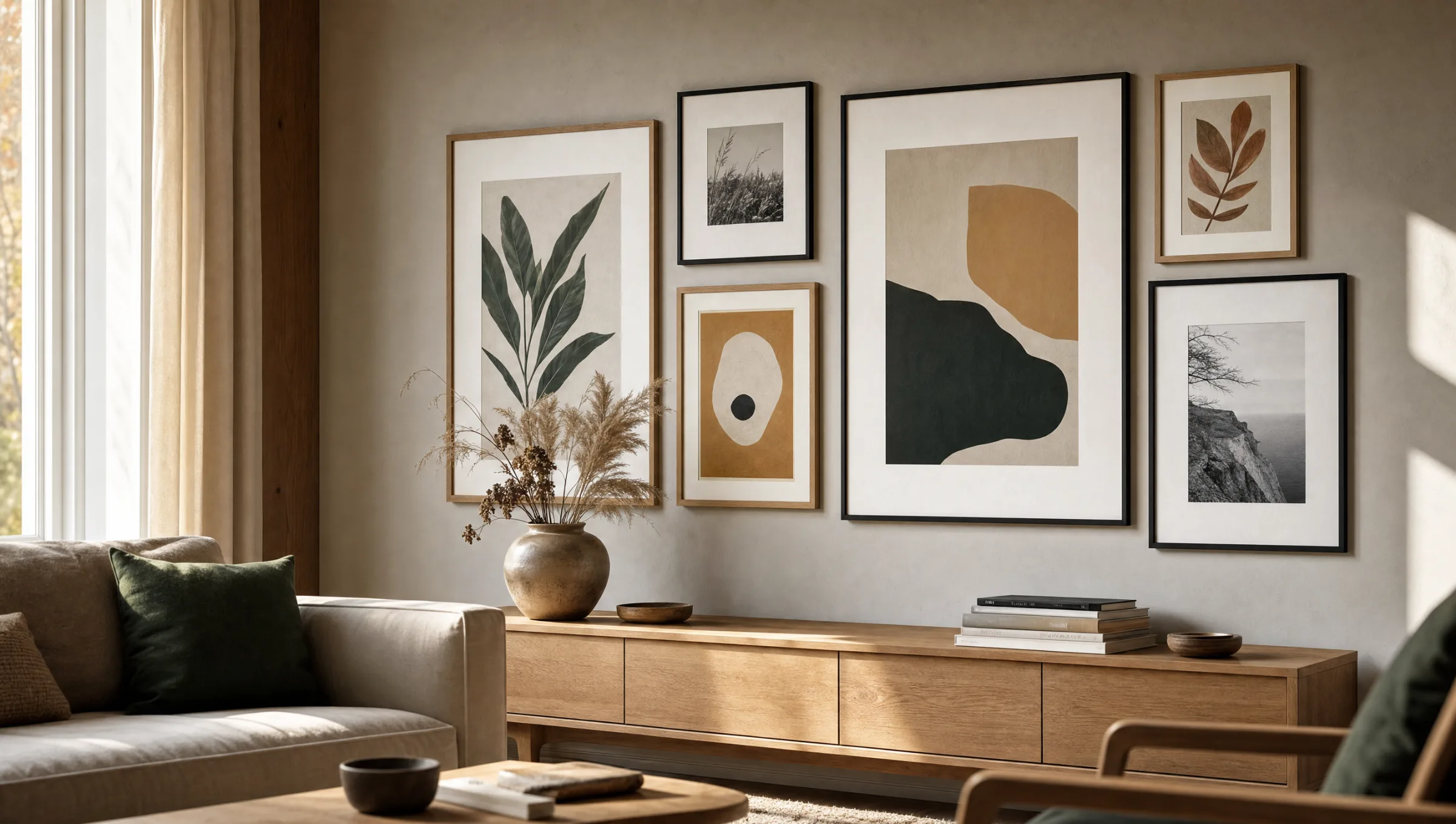
Art Prints Pictures: A Guide to Selection, Format and Hanging
Anyone looking for art prints and pictures for their walls faces many decisions: subject matter, paper, format, frame, hanging height. This overview sorts the most important criteria editorially and shows what to look for beyond the motif itself.
What Art Prints Pictures Do for a Room
Art prints pictures are more than wall decoration. They structure spaces, direct sightlines and add a layer of meaning to interiors that would otherwise be defined by furniture and materials alone. A well-placed print can make a seating corner feel calmer, visually lengthen a hallway, or give a dining room a clear focal point.
Unlike an original artwork, high-quality art prints are reproduced but carefully produced renditions of a motif. What matters most is colour fidelity, paper quality and a clean trim. Those who regularly change their pictures also benefit from standardised formats that can be reframed or rehung without hassle.
Compared to posters, art prints pictures are typically intended for a longer stay on the wall. They are replaced less often, framed with more care and positioned more deliberately. This slower logic pays off at the selection stage: fewer quick trend motifs, more subjects that will still hold their own years from now.
Four Styles of Art Prints Pictures at a Glance
The range of art prints is broad. Four directions appear particularly often in curated collections and serve as useful reference points for planning your own wall arrangement.
Abstract Compositions
Reduced colour fields, geometric arrangements and gestural brushwork. These prints work well in modern interiors and allow furniture and textiles to speak more prominently.
Botanical Illustrations
Detailed plant, leaf and blossom motifs drawing on historical reference plates. They suit warm wood tones and create calm, timeless wall art.
Black-and-White Photography
Landscapes, architecture and portraits without colour. The reduction directs the eye to line and light, and sits comfortably within minimalist interior concepts.
Typographic Prints
Text as visual element, from small quotations to large-scale letterform compositions. Well suited to work areas, kitchens and entrance situations.
Materials and Formats for Art Prints Pictures
The choice of substrate influences the appearance of an art print more than is often assumed. Matte fine-art paper from 200 g/m² upwards has a restrained, book-like quality; very smooth surfaces emphasise photographic sharpness; textured papers favour painterly motifs. FSC-certified papers are now standard among reputable producers, including those made in Germany.
Alongside the classic DIN sizes, proportions such as 2:3, 3:4 and 1:1 have become firmly established. Square art prints pictures work particularly well in groups; narrow portrait formats draw the eye upward and suit walls beside doors or between windows. Large-format prints from 70 × 100 cm need sufficient wall space around them so they do not feel overpowering.
Alternatives to framed paper prints include canvas, laminated aluminium panels and hexagon shapes. Each material has its own tonality: canvas reads as painterly, aluminium as crisp and contemporary, paper behind glass as formal and gallery-like. A considered material choice can change the feel of a motif considerably.
An art print only realises its full effect in combination with wall, light and distance – the motif alone rarely determines the outcome.
Reetro Editorial
Framing, Hanging and Care
For framing art prints pictures, slim wooden mouldings in oak, walnut or black have established themselves as understated companions. A mat board creates distance between motif and frame and reads particularly calmly with smaller formats. Frameless mounts or anti-reflective glass reduce glare in bright rooms.
A reliable guide for hanging height: the centre of the picture sits at roughly eye level for a standing person, around 145 to 150 cm from the floor. Above sofas and sideboards the lower edge moves closer to the furniture without touching it – a gap of 15 to 30 cm has proven effective. For groups of pictures, it is worth laying paper templates out on the floor first before committing to the wall.
Art prints pictures are sensitive to direct sunlight and strongly fluctuating humidity. Those wishing to preserve quality prints long-term should avoid placing them in full south-facing light or directly above radiators. A light wipe of the frame with a dry microfibre cloth is sufficient for cleaning; glass cleaner should be avoided wherever the print surface is exposed.
Combining Art Prints Pictures: Gallery Wall or Solo Statement
Two fundamental approaches shape wall arrangements with art prints. The gallery wall brings together several pictures of different sizes into a single composition. It relies on a unifying element: a recurring colour tone, a shared frame family or a thematic thread – architecture, plants or portraits, for instance.
The solo statement follows the opposite logic. A single, sufficiently large picture takes the leading role on a wall and needs no companions. This approach works especially well in pared-back interiors and is straightforward to position – the hanging height can be aligned clearly with the centre of the wall or the dominant piece of furniture.
Häufige Fragen
-
01
How do art prints pictures differ from posters?
Art prints pictures are generally produced on heavier, often FSC-certified fine-art papers from 200 g/m² upwards, with an emphasis on colour fidelity and a clean trim. Posters are thinner, frequently glossier and designed for short-term use. Art prints are usually framed, kept on the wall longer and chosen more carefully. The price difference comes from paper, printing process and quality control, not necessarily from the motif itself.
-
02
What format suits art prints pictures hung above a sofa?
Above a sofa, pictures tend to look balanced when they occupy roughly two-thirds to three-quarters of the sofa's width. For a 220 cm wide sofa that equates to a single print of around 100 × 70 cm, or a group of prints of comparable total width. Landscape formats follow the horizontal line of the furniture and calm the composition. A gap of 15 to 30 cm between the lower frame edge and the sofa back helps the picture and furniture read as a unit.
-
03
How do you hang multiple art prints as a gallery wall?
A sensible starting point is to lay the arrangement out on the floor first, or to tape paper templates in their actual sizes to the wall. A unifying element – a frame family, a colour palette or a shared theme – keeps the result cohesive. Gaps between frames typically sit between 4 and 8 cm. An imagined centre line or shared upper or lower edge stabilises the overall composition. Picture centres should be oriented around the eye level of a standing person.
-
04
Which paper is recommended for art prints pictures?
Matte or lightly textured fine-art paper from 200 g/m² is a reliable standard for art prints pictures. It absorbs light softly, avoids glare and works well with most motifs from botanical illustrations to abstract compositions. For highly detailed photography, smoother papers may be preferable. Key quality indicators are FSC certification, low-acid processing and pigment-based inks, which are significantly more lightfast than cheaper dye-based alternatives.
-
05
Do art prints fade over time?
High-quality art prints made with pigment-based inks on low-acid paper remain lightfast for many years, provided they are not exposed to direct, intense sunlight. South-facing walls with unfiltered daylight accelerate fading. High humidity – in bathrooms or directly above radiators – can also stress both paper and print. A position with indirect light and stable room conditions will extend the lifespan considerably.
-
06
What does Reetro focus on in production?
Reetro has art prints pictures printed to order by our production partner in the EU, using FSC-certified papers from 200 g/m² and matte coatings. The range includes classic paper prints alongside XXL posters, premium canvases and hexagon aluminium wall art. Each edition is editorially curated rather than assembled automatically, so motif, format and material are matched to one another. Pigment-based inks and careful final inspection are intended to ensure the prints remain colour-stable on the wall for years to come.