
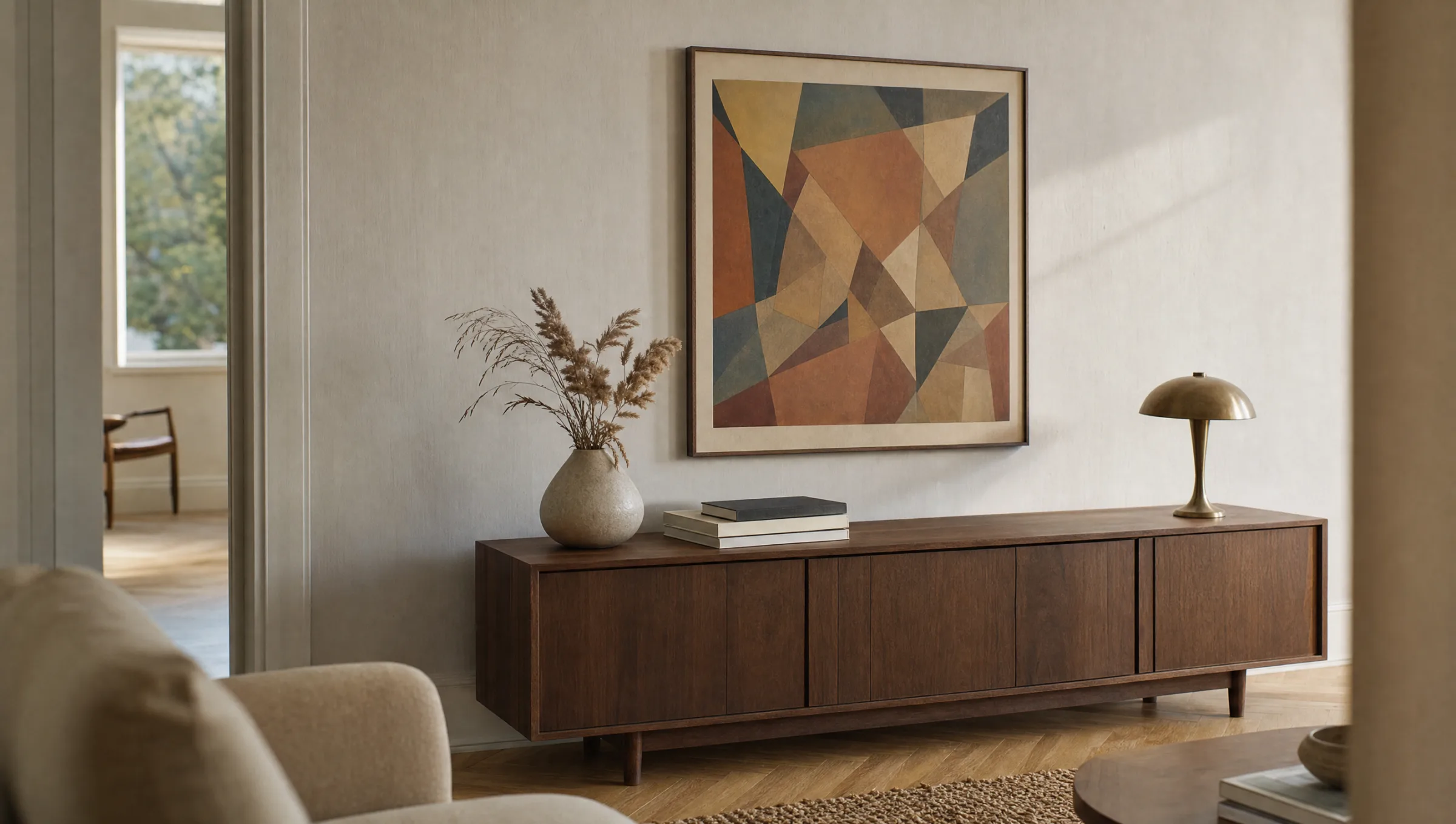
Picasso Art Print: Work Periods, Motifs and Interior Hanging
Pablo Picasso shaped the visual language of the 20th century more profoundly than almost any other artist. A Picasso art print in the living space is therefore more than decoration — it is a reference to Cubism, Classical Modernism and a lifelong experimentation with form, colour and line. This overview maps the key work periods and offers guidance on format, hanging and care.
Work Periods That Define a Picasso Art Print
Picasso's œuvre can be broadly divided into several phases, each with its own visual character. The Blue Period (1901–1904) is defined by melancholic subjects and cool blue tones, while the subsequent Rose Period brings warmer colouring and figures drawn from circus and travelling-entertainer milieus. Both phases tend to read particularly calmly on a living room wall.
From 1907 onwards, Picasso developed Cubism alongside Georges Braque. Analytic Cubism breaks objects down into geometric facets; Synthetic Cubism introduces collage elements and clearer areas of colour. The works produced in this phase are largely responsible for the iconic reputation that a Picasso art print carries today.
The later years bring a free, almost playful line quality — visible in the ceramic works and the reduced animal depictions. Anyone choosing a Picasso art print for a specific interior should first identify the period whose colour mood matches the tone of the room.
Popular Motif Groups at a Glance
Within Picasso's extensive body of work, several motif groups have emerged as particularly sought-after in poster format. They differ considerably in mood and spatial effect.
Portraits and Female Figures
From cubistically fragmented faces to clean line portraits: these motifs set a calm, often introspective tone and suit studies and reading corners well.
Still Lifes and Guitars
Guitars, jugs and tables are among Picasso's central subjects for study. They read graphically, are mostly muted in colour and harmonise well with wooden furniture.
Line Drawings and Animals
The Dove of Peace and the single-line bull are reduced and bold. They work in smaller formats too and look well above sideboards.
Classical Period
Figures with a neo-antique quality and soft volumes. These works feel less experimental and fit naturally into classically furnished rooms.
Formats, Hanging and Spatial Effect
A Picasso art print draws much of its impact from format. Line drawings such as the Dove of Peace suit smaller to medium sizes between 30 × 40 cm and 50 × 70 cm, because their graphic quality remains legible at that scale. Cubist compositions with many facets benefit from larger formats from 70 × 100 cm upwards, so that the individual picture planes stay readable.
For hanging, the general rule is that the centre of the image should sit at roughly 145 to 155 cm from the floor. Above a sofa, a gap of 20 to 30 cm between the print and the back of the sofa is recommended. When combining several Picasso motifs, it is worth keeping to a single work period or a consistent colour palette to avoid visually overloading the wall.
The surrounding environment matters as well. Against white or gently broken white walls, the typical earth tones, blues and ochres come through quietly. Against strongly coloured walls, the motif can quickly compete with the background.
Art washes away from the soul the dust of everyday life.
Pablo Picasso
Material and Print Quality for a Picasso Art Print
Because Picasso's works frequently rely on fine lines, muted earth tones and subtle transitions, print quality plays an important role. Matte coatings reduce reflections and allow areas of colour to read as cohesive surfaces; FSC-certified papers at 200 g/m² or above provide sufficient body and a pleasant feel in the hand.
For larger formats, premium canvas is a good option, as the surface texture recalls traditional painting techniques without overwhelming the graphic character. Hexagonal aluminium wall prints are an alternative for reduced line motifs such as the well-known Dove. Reetro has all these variants printed to order by its production partner in the EU using pigment-based inks with high lightfastness.
For ongoing care, a dry microfibre cloth is all that is needed. Direct sunlight should be avoided, as should persistently high humidity — for instance in poorly ventilated bathrooms.
Häufige Fragen
-
01
Which Picasso art print suits someone new to collecting art?
For a first purchase, reduced line works such as the Dove of Peace or the single-line bull are a sound starting point. They are immediately legible, require no deep art-historical background and integrate into almost any interior. Works from the Rose Period are also approachable, as the palette is warm and the figures are narrative in character. Anyone who later wishes to explore more complex cubist compositions can build their collection step by step.
-
02
What size Picasso art print works above a sofa?
A useful rule of thumb is that the print should span roughly two thirds of the sofa's width. For a three-seater around 200 cm wide, that points to a format of approximately 100 × 70 cm or 120 × 80 cm. For cubist motifs with a great deal of detail, the larger size is preferable so that facets and lines remain legible. Reduced line drawings also work well in smaller formats, provided they are centred and hung with sufficient clearance above the back cushions.
-
03
Are reproductions of Picasso's work legally permissible?
Picasso died in 1973. Under EU and UK copyright law, protection lasts for 70 years after the artist's death, meaning works remain under copyright until the end of 2043. Reputable suppliers clarify licensing rights, source motifs from licensed image archives, or work with images that fall into the public domain or use stylistically related designs. When purchasing, it is worth checking for transparent sourcing information from the supplier.
-
04
What frame colour suits a Picasso art print?
Narrow black frames reinforce the graphic quality of line drawings and cubist compositions. Natural wood frames in oak or ash read warmer and harmonise particularly well with the earth tones of the Rose and Classical Periods. White frames are a restrained option when the motif itself has strong contrast. More important than colour is a slim profile width, so the print is not visually overwhelmed by an ornate surround.
-
05
How do I care for a high-quality art print over the long term?
Art prints should be kept away from direct sunlight, high humidity and cigarette smoke. For cleaning, a dry, soft microfibre cloth is sufficient; cleaning agents and damp cloths should be avoided. With matte-coated FSC papers at 200 g/m² or above — as used by Reetro for its prints printed to order by its production partner in the EU — colour depth and line sharpness remain stable under normal living conditions for many years.