
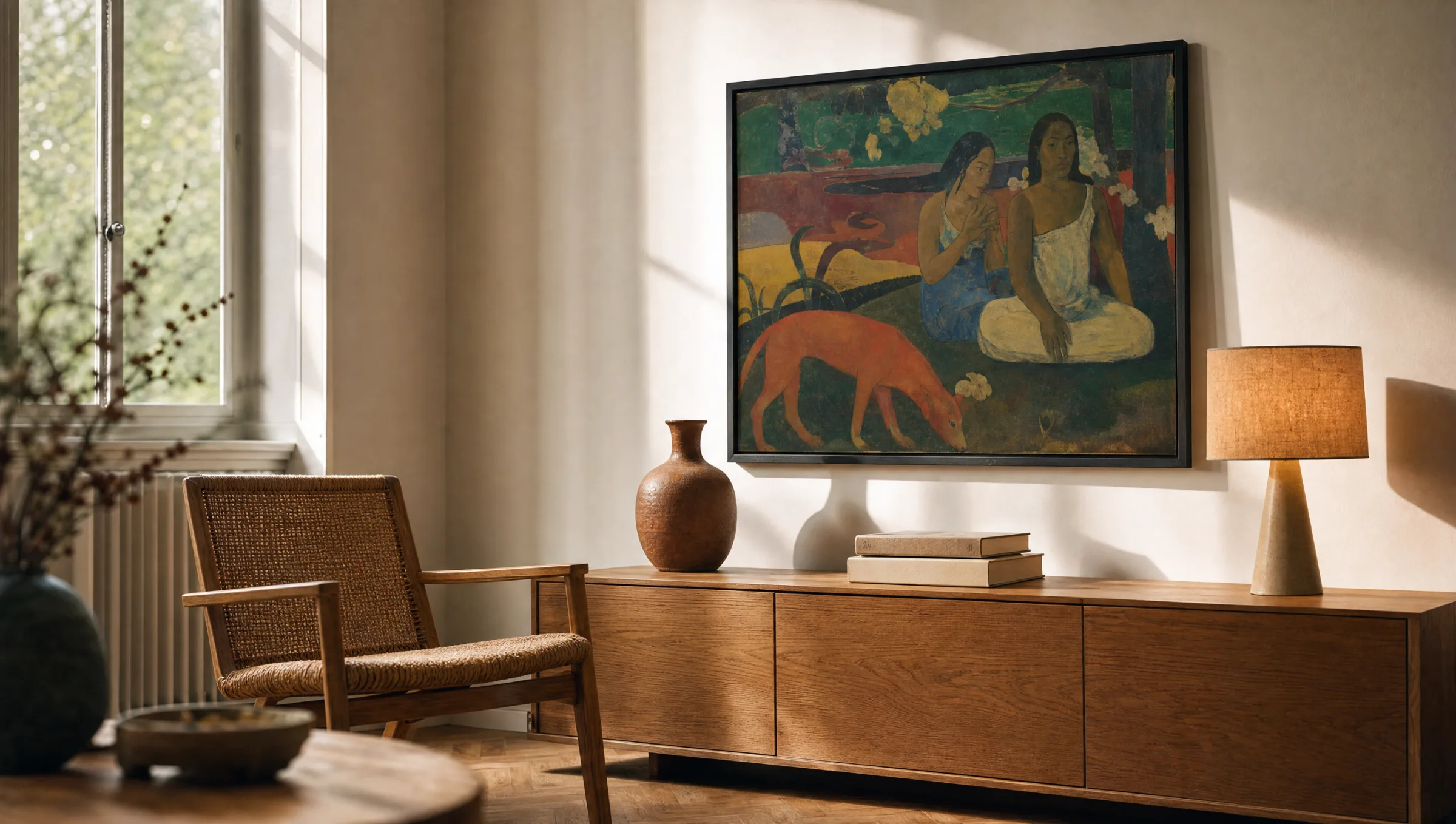
Paul Gauguin Paintings: Colour Worlds Between Brittany and the South Seas
Paul Gauguin paintings rank among the defining works of Post-Impressionism. Between Pont-Aven, Arles and Tahiti, he developed a visual language built on flat colour fields, clear contours and symbolic depth. This overview places his central creative phases in context and explains what matters when choosing a high-quality reproduction.
Creative Phases and Subject Matter
Paul Gauguin (1848–1903) began his career as a stockbroker in Paris and turned fully to painting only later in life. His early style is still clearly shaped by Impressionism, yet by the 1880s he was moving away from pure perceptual painting, seeking an art that foregrounded inner feeling, myth and what he called the primal.
His stays in Pont-Aven in Brittany mark a turning point. Together with Émile Bernard, Gauguin developed so-called Synthetism: large, clearly outlined colour fields, reduced spatial depth and a deliberate rejection of detailed realistic modelling. Works such as 'Vision After the Sermon' stand as prime examples of this phase.
From 1891 onwards, his travels to Tahiti and the Marquesas Islands decisively shaped his imagery. Portraits such as 'Woman with a Flower' and compositions such as 'Where Do We Come From? What Are We? Where Are We Going?' combine Polynesian motifs with European symbolism, creating the colour-rich, meditative atmosphere for which Paul Gauguin paintings are internationally renowned today.
Well-Known Paul Gauguin Paintings at a Glance
A curated selection of his most influential works, spanning the arc from Brittany to the South Seas and illuminating different aspects of his practice.
Vision After the Sermon (1888)
Breton women witness the biblical struggle of Jacob with the angel. The vivid red ground and black contours mark the beginning of Synthetism and Gauguin's departure from Impressionism.
The Yellow Christ (1889)
A wooden crucifix sculpture set in a Breton autumn landscape. The work condenses folk piety, flat composition and a sacred golden tone into an iconic image of the Pont-Aven school.
Woman with a Flower (1891)
One of the first portraits from Tahiti. Strict frontality, a dark background and a concentrated gaze combine European portrait tradition with Polynesian subject matter.
Where Do We Come From? (1897/98)
His monumental main work in landscape format. The figure-rich composition reads like a painted testament on birth, life and transience.
Colour, Surface, Symbol: What Defines Paul Gauguin Paintings
Characteristic of Paul Gauguin paintings is the liberation of colour from its purely representational role. A horse can be green, a shadow violet, a sky lemon yellow — what matters is the emotional and compositional effect, not faithful reproduction of nature. This approach later influenced the Fauves, the Nabis and parts of German Expressionism.
Equally important is the flat pictorial conception. Gauguin frequently reduces spaces to a few clearly separated zones held together by dark contours. The result is an ornamental calm that makes his works appear very balanced even in large formats on the wall.
Then there is the symbolism: many of his motifs reference religious, mythological or existential themes without resolving them unambiguously. Anyone who looks at a work for longer will discover allusions to Māori myths, Christian iconography or literary sources — one reason why his pieces work particularly well in quiet living and working spaces.
I close my eyes in order to see.
Paul Gauguin
Paul Gauguin Paintings as Art Prints: Format and Material
When it comes to reproduction, colour depth is decisive. Gauguin's palettes rely on rich reds, ochres and turquoise tones that can quickly appear flat on paper that is too bright or too smooth. An FSC-certified fine art matte paper from 200 g/m² upward preserves the depth of the shadows and allows the colour fields to appear soft, almost pastel-like.
For format, it is worth looking at the original proportions. The main Tahitian works are often wide in orientation and only develop their full impact from around 70 × 100 cm. Portraits such as 'Woman with a Flower', on the other hand, work very well in the classic portrait orientation above a seating group or sideboard.
Those who want a more textured feel can opt for a premium canvas; for a modern, slim presentation a framed print with a mount is a strong choice. In both cases the same principle applies: indirect light, a calm wall colour in off-white or warm grey, and sufficient distance from furniture allow Paul Gauguin paintings to come fully into their own.
Hanging and Combining in an Interior
In a living space, Gauguin's earthy tones pair particularly well with natural materials such as linen, rattan, oak or unfinished clay. A single large work above the sofa often has more presence than a tightly grouped salon hang, because the flat composition needs room to breathe.
Combined with other Post-Impressionists — such as van Gogh, Cézanne or Bernard — a coherent gallery emerges without the works competing with one another. A consistent frame choice is key: slim wooden profiles in natural oak or matt black visually unify the group.
Häufige Fragen
-
01
Which Paul Gauguin paintings are considered his most important works?
Among the most widely discussed Paul Gauguin paintings are 'Vision After the Sermon' (1888), 'The Yellow Christ' (1889), 'Woman with a Flower' (1891), 'Nafea Faa Ipoipo? (When Will You Marry?)' (1892) and the monumental late work 'Where Do We Come From? What Are We? Where Are We Going?' (1897/98). They mark the central stages of his practice from Brittany through Arles to Tahiti, covering religious, mythological and portraiture subjects alike.
-
02
Which artistic style do Paul Gauguin paintings belong to?
Gauguin is regarded as a key representative of Post-Impressionism and a co-founder of the Synthetism associated with the Pont-Aven school. His works combine flat, clearly outlined colour zones with symbolic pictorial content, placing them between Impressionism, Symbolism and early Modernism. Painters such as Henri Matisse, Pierre Bonnard and Édouard Vuillard, as well as the German Expressionists, later explicitly drew on Gauguin's approach to colour and surface.
-
03
Why did Paul Gauguin go to Tahiti?
Gauguin was searching, outside urban Europe, for a way of life and a pictorial world he felt to be more primal and unencumbered. He first travelled to Tahiti in 1891, returned briefly to France, and eventually settled permanently in French Polynesia. This perspective is subject to critical scrutiny today, yet it decisively shaped his choice of subject matter, his colour palette and the symbolic concentration of his late work.
-
04
What format suits Paul Gauguin paintings as art prints?
Original formats vary considerably. The main Tahitian works are often wide in orientation and only come fully into their own as prints from around 70 × 100 cm. Portraits such as 'Woman with a Flower' work very well in the classic portrait format around 50 × 70 cm, for instance above a sideboard. It is important to respect the original aspect ratio and avoid cropping, so that composition and visual weight are preserved.
-
05
What should I look for in print quality for Paul Gauguin paintings?
The key factors are colour depth, paper and coating. Gauguin's rich reds, ochres and turquoise tones require a high-grammage paper with a matte surface so that the colour fields do not appear flat. At Reetro, Paul Gauguin paintings are printed to order by our production partner in the EU on FSC-certified fine art paper from 200 g/m²; the matte coating reduces reflections and preserves the quiet, almost velvety depth that defines Gauguin's palette.