
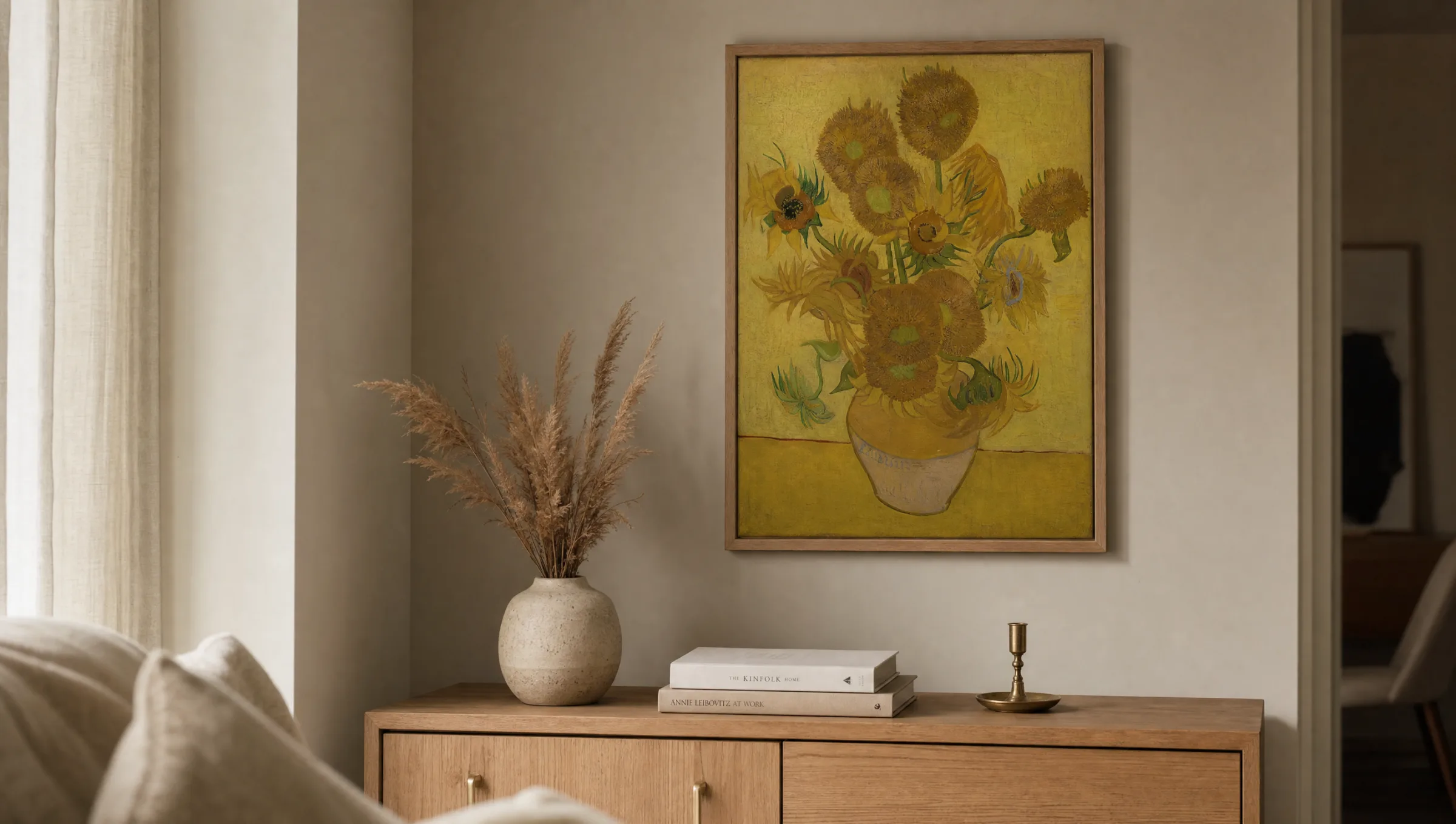
Van Gogh Sunflowers Painting: Background, Style and Display
Few works in art history are as widely recognised as Vincent van Gogh's Sunflowers. This page places the motif in context, describes the painterly qualities of the series, and explains what matters when it comes to format, paper and placement if you want to bring the Sunflowers home as a reproduction.
The Van Gogh Sunflowers Painting in Historical Context
Between 1888 and 1889, Vincent van Gogh painted his now-famous Sunflowers series in Arles — a group of still lifes showing vases of flowers. The works were originally intended as wall decoration for the guest room of Paul Gauguin in the so-called Yellow House. Van Gogh saw the blooms as a symbol of gratitude and light, and worked under considerable time pressure since sunflowers wilt quickly.
Five completed versions survive today, held at the National Gallery in London, the Van Gogh Museum in Amsterdam, the Neue Pinakothek in Munich, the Sompo Museum in Tokyo, and the Philadelphia Museum of Art. A sixth version, once in private Japanese ownership, was destroyed during the Second World War.
Anyone acquiring a van Gogh Sunflowers painting as a reproduction today most commonly refers to the London or Munich version — both show yellow blooms against a yellow ground and differ primarily in the number of flowers and the composition of the vase.
Three Ways to Read the Series
The Sunflowers paintings can be approached from several angles. Three perspectives help place the motif in context for your own wall.
A Colour Study in Yellow
Van Gogh used chrome yellow, ochre and broken white to explore the limits of a single colour family. The painting sits quietly in warm-toned interiors as a result.
A Still Life with Gesture
Despite the classical subject matter, the brushwork is impasto — almost relief-like. A quality reproduction should make this texture visible without artificially exaggerating it.
A Symbol of Friendship
The paintings were created in anticipation of Gauguin's arrival and carry strong biographical weight. That gives them a layer of meaning beyond purely decorative florals.
An Icon of Modern Art
The series is widely regarded as a turning point towards Expressionism and is regularly cited in art histories, which explains the motif's enduring presence.
Format and Material for a Van Gogh Sunflowers Painting
The originals measure around 92 × 73 centimetres — portrait-format still lifes of medium size. When reproducing the work for a wall at home, it makes sense to preserve this ratio rather than crop the motif. Popular print sizes for a van Gogh Sunflowers painting are 50 × 70 cm for smaller walls, and 70 × 100 cm or larger formats for open living areas.
For paper, a matte surface of 200 g/m² or above is recommended. Glossy coatings reflect light and strip the characteristic yellow of its depth. A lightly textured natural paper or a matte premium canvas renders the impasto quality of the original more faithfully.
For kitchens, bathrooms or brightly lit spaces, aluminium wall prints are a practical alternative: they are moisture-resistant, lightfast, and display the warm yellow evenly without glare.
It is a kind of painting that does not change easily — the longer you look at it, the richer it becomes in meaning.
Vincent van Gogh, letter to Theo, 1889
Hanging and Combining the Van Gogh Sunflowers Painting
A Sunflowers print hung on its own looks most composed when the centre of the image sits at around 145 to 150 centimetres from the floor, with enough clear wall space around it. Against warm wall tones in sand, greige or muted olive, the yellow settles without dominating the room.
In a gallery-style arrangement, the motif pairs well with smaller black-and-white photographs, botanical drawings or calm landscapes. It is important that neighbouring works remain restrained in colour so that the Sunflowers retain their role as the visual anchor.
Direct sunlight should be avoided. Pigment prints on FSC-certified paper are lightfast, but prolonged UV exposure will gradually shift any colour balance over time.
What to Look for in Reproduction Quality
Not every reproduction faithfully captures the colour temperature of the original. A good van Gogh Sunflowers painting print renders the yellow in several distinct gradations rather than flattening it into a uniform tone, and retains detail in the darker areas of the flower centres. The signature on the vase should remain legible without appearing forced.
It is worth checking the printing process and colour profile. Pigment inks on calibrated paper produce finer colour gradients than standard prints. With canvas, it pays to look at the weave structure — too coarse a fabric will swallow the fine details of the brushwork.
Häufige Fragen
-
01
How many versions of the Van Gogh Sunflowers painting exist?
Van Gogh created a series of still lifes showing sunflowers in a vase while in Arles, between August 1888 and January 1889. Five completed versions survive today, held in London, Amsterdam, Munich, Tokyo and Philadelphia. A sixth version, formerly in private Japanese ownership, was destroyed in an air raid in 1945. There are also earlier Paris Sunflowers paintings showing cut blooms lying flat — these are not part of the vase series. Reproductions generally follow the London or Munich version.
-
02
What format suits a Van Gogh Sunflowers painting reproduction?
The originals are portrait format at roughly a 4:3 ratio. For a home wall, 50 × 70 cm and 70 × 100 cm are the most widely used sizes, as they stay close to the original proportions. Above a sofa or sideboard, larger formats from 80 × 120 cm upward also work well, provided there is sufficient wall space. It is important not to crop or stretch the motif, so that the composition of vase and flower heads remains intact.
-
03
Which material works best for this motif?
Matte premium papers from 200 g/m² upward display the warm yellow with the necessary depth while avoiding distracting reflections. Those who want to emphasise the impasto brushwork may prefer a finely woven canvas. For bright, humid or strongly lit spaces, an aluminium wall print is a sound choice — it is lightfast and unaffected by temperature fluctuations. Glossy surfaces are less suitable, as they tend to flatten the subtle gradations in the yellow tones.
-
04
How should I hang the Sunflowers print?
Hanging the centre of the image at 145 to 150 cm from the floor is a reliable starting point. Against warm, muted wall tones such as sand, greige or off-white, the yellow comes through calmly without overwhelming the room. Direct sunlight should be avoided, as should proximity to radiators. In a grouped arrangement, colour-restrained neighbours — black-and-white photographs or botanical drawings — work well, allowing the Sunflowers to hold their own character.
-
05
Is reproducing the Van Gogh Sunflowers painting legally straightforward?
Vincent van Gogh died in 1890, so his works have long been in the public domain and may be freely reproduced. This applies to the original paintings themselves. Photographs of those works taken by modern museum photographers may carry their own separate rights, which is why reputable suppliers work with licensed or independently prepared source files. When purchasing a reproduction, it is worth checking the origin of the image file and the accuracy of the colour rendering.
-
06
What distinguishes a Reetro reproduction of the Van Gogh Sunflowers painting?
Reetro prints to order through its production partner in the EU on FSC-certified papers from 200 g/m² using pigment inks and a matte coating. Before printing, the colour file is profiled to the specific material, so the characteristic yellows of the van Gogh Sunflowers painting remain readable across multiple gradations and the brushwork stays visible. Available formats include classic poster sizes, premium canvas and hexagonal aluminium wall prints, each produced from an editorially verified source file.