Old Movie Posters: An Editorial Overview
Old movie posters tell more than the story of a film. They document graphic design, typography and print craft of their time — from the hand-drawn imagery of the silent-film era to the photorealistic compositions of the 1970s. This overview places the most important eras in context and offers guidance on selection, format and framing.
Why Old Movie Posters Still Hold Their Own
A film poster was originally functional graphic design. At a kiosk stand, on a advertising column or in a cinema foyer, it had seconds to capture attention. That constraint drove many designs to graphic excellence: clear visual axes, bold areas of colour, typography that carries the title rather than merely illustrating it.
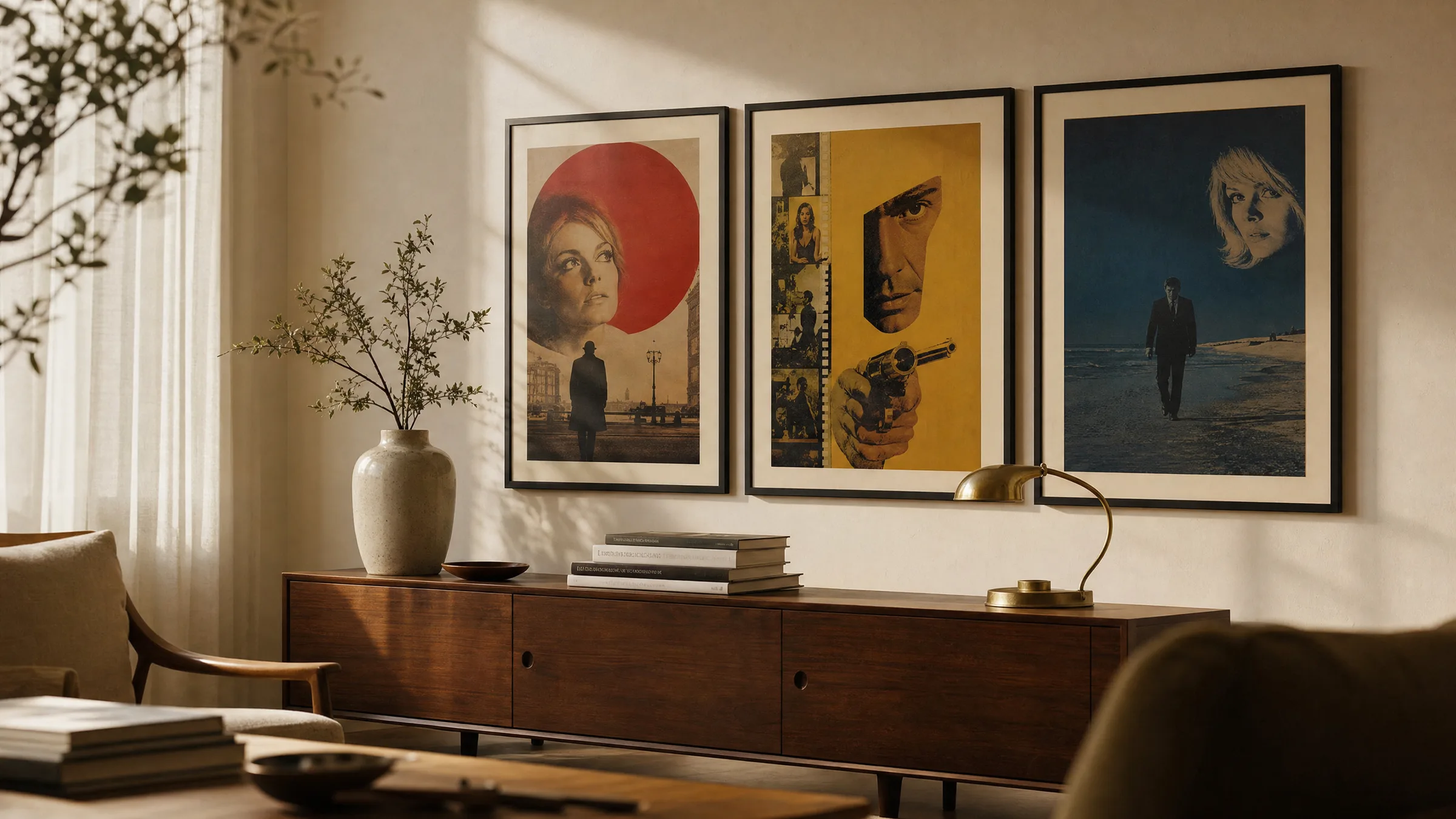
Hanging old movie posters on a wall today brings not only the memory of a particular film into a room, but a piece of applied design history. The work of Polish, Italian and French graphic artists from the 1950s to the 1970s has earned its own reputation, and is now collected independently of the films it once promoted.
For the effect on a wall, it matters whether a motif exists as a reproduction, a reinterpretation or a licensed print. This article focuses on editorially curated reproductions and motifs in the style of classic cinema posters.
Four Eras of Old Movie Posters Compared
Four distinct style phases shape the way we look at historic cinema posters. Each phase has its own visual logic — from hand-drawn illustration to the airbrushed aesthetic of the late 1970s.
Silent Film & Early Sound Era (1920–1935)
Hand-drawn motifs with Art Deco references, typically in red, black and cream white. Typography and illustration merge; faces are stylised, movement is suggested through diagonal composition.
Classic Hollywood (1940–1955)
Colour lithographic prints featuring prominent star portraits, painted scene compositions and sweeping title lettering. The visual language is narrative: multiple scenes are assembled into a single collage.
Eastern European School (1955–1975)
Polish and Czech graphic artists interpreted films abstractly and symbolically. Reduced forms, unusual colour combinations and an almost painterly handwriting make these among the most collectible old movie posters today.
New Hollywood & Airbrush (1968–1982)
Photorealistic illustration, soft gradients and dramatic lighting define the era. Titles move to the bottom of the image; the picture conveys mood rather than plot.
Materials and Formats for Old Movie Posters
Historic cinema posters were produced in different standard formats depending on the country. In Germany the DIN A1 format (approximately 59 × 84 cm) was long the norm; in the United States the One-Sheet measured around 69 × 104 cm; in France the large Grande ran to 120 × 160 cm. When displaying reproductions of old movie posters, it makes sense to respect these proportions, because the typography and layout were designed with them in mind.
For printing, a matte, uncoated paper of at least 200 g/m² is recommended. It takes colour quietly, does not reflect light and sits closer to the original than glossy surfaces do. Paper with a slight texture further reinforces the impression of offset printing from the relevant era.
As an alternative to the classic paper poster, canvas mounting works well for large-format motifs, and aluminium composite panels suit illustrations with a high level of detail. For collector pieces in their original format, however, paper behind glass remains the closest reference to the source material.
A good film poster doesn't sell the film — it reminds you why you go to the cinema.
Paraphrased, workshop note by a Polish poster designer, 1971
Framing, Care and Placement of Old Movie Posters
Paper responds to light, humidity and temperature fluctuations. Old movie posters — whether reproduction or original — should therefore be kept out of direct sunlight and away from radiators. A passe-partout of acid-free card creates distance between the paper and the glass, preventing printing inks from transferring to the glazing over time.
For framing, narrow wooden mouldings in black, natural wood or stained walnut work well. They recede behind the motif and let the typography speak. Brushed aluminium frames suit designs from the 1960s and 1970s, echoing the material character of cinema architecture from that period.
When hanging old movie posters, they tend to read best with some breathing room from neighbouring works. A calm wall surface, a single poster at eye level — that is often more convincing than a densely packed gallery arrangement.
Old Movie Posters in the Reetro Range
Reetro works as an editorial curator: we select motifs in the spirit of classic cinema posters and have them printed to order by our production partner in the EU on FSC-certified papers of at least 200 g/m². For old movie posters that means a matte surface, colour-stable pigment inks and formats that follow historical proportions.
Alongside paper prints, we offer canvas mounts, hexagonal aluminium wall prints and designer cushions. For film-historical motifs we generally recommend paper or canvas, as these materials best absorb the graphic language of the original designs.
Häufige Fragen
-
01
What counts as an old movie poster?
Old movie posters generally refers to cinema posters made before 1980. The range spans from hand-drawn imagery of the silent-film era through the colour lithographic prints of classic Hollywood to the airbrushed illustrations of the late 1970s. The exact year matters less than the visual character of the period: reduced forms, distinctive typography and a closeness to the craft of the typesetters and graphic artists of the time.
-
02
Are reproductions of old movie posters legally available?
Yes, provided that copyright in both the image and the typography is respected. Many posters from the early decades of cinema are now in the public domain, or are reproduced under licence. Reputable suppliers label their motifs accordingly and work with archives or rights holders. Motifs in the style of old movie posters are often independent reinterpretations that draw on the graphic language of a period without copying a specific original.
-
03
What format works best for old movie posters on a wall?
Historically common sizes include DIN A1 (59 × 84 cm) in German-speaking countries, the US One-Sheet at around 69 × 104 cm, and the French Grande at 120 × 160 cm. For a domestic living space, A1 and One-Sheet are usually large enough and sit well alongside standard furniture heights. It is important to retain the original proportions so that the typography and image layout of old movie posters are not compressed or distorted.
-
04
How do I care for framed movie posters over the long term?
Avoid direct sunlight, damp and strong temperature fluctuations. UV-filtering glass or acrylic protects against colour fading; an acid-free passe-partout prevents contact between the paper and the glazing. Dust should only be removed dry from the frame surface — the motif itself stays protected behind the glass. For original pieces, an acid-free backing board is also advisable to prevent yellowing caused by acid migration from the frame.
-
05
Do old movie posters work in modern interiors?
Yes — the contrast often works particularly well. Spare, uncluttered rooms with calm wall colours let the graphic quality of old movie posters stand on their own. Motifs from the Eastern European school with abstract forms fit naturally into minimalist interiors, while classic Hollywood designs add a narrative note to simply furnished rooms. One well-placed piece is generally more effective than a densely hung arrangement.
-
06
What material does Reetro use for prints in the style of old movie posters?
Reetro has prints made to order by our production partner in the EU on FSC-certified paper from 200 g/m² with a matte finish. For old movie posters this uncoated, understated paper is a deliberate choice: it takes colour modestly, does not reflect light and comes closer to the character of historic offset printing than any glossy surface. Canvas mounting is available as an alternative for larger formats; colour calibration is handled motif by motif in our studio.