On 9 November 1918, Philipp Scheidemann proclaimed the German Republic from the balcony of the Reichstag, and in the 15 years between the empire and dictatorship that followed, the Weimar Republic saw more than a dozen Reich Chancellors in total, none of whom governed longer than Wilhelm Marx with his four terms in office. This political instability was the breeding ground on which expressionist art leaflets and revolutionary wall posters flourished: every change of government, every crisis — whether hyperinflation or the Great Depression — drove artists onto the streets and to the printing press. Anyone who wants to understand why the graphic art of the Weimar Republic sounds so radical, so urgent and so visually loud will find the answer directly in this chronicle of political chaos, which ended in 1933 with the abolition of the Republic.
Art Leaflets & Political Wall Posters 1918–1933: Expressionism and Revolutionary Graphics in the Weimar Republic
The Weimar Republic, proclaimed on 9 November 1918 by Philipp Scheidemann from the balcony of the Reichstag in Berlin, was the first German state with a republican constitution and a nationally elected parliament. Between 1918 and 1933, one of the most productive eras of political and artistic printmaking the world has ever seen emerged during this highly politically unstable transitional period from the empire to dictatorship.
The Historical Context: Short Governments, Explosive Art
The terms of office of the Weimar Republic’s Reich Chancellors were remarkably short. According to Statista, Wilhelm Marx was the longest-serving Reich Chancellor with a total of four terms, followed by Hermann Müller. Kurt von Schleicher, by contrast, governed for only a matter of days. This political instability was no peripheral phenomenon — it was the climate in which art leaflets and wall posters thrived.
The Republic was under pressure from the Treaty of Versailles from the very beginning, was destabilised by hyperinflation and the Great Depression, and ended in 1933 with the National Socialists’ electoral victory and the establishment of a dictatorship in which people of Jewish faith, Sinti and Roma, homosexuals and other minorities were persecuted and murdered.
The three phases of the Weimar Republic — revolution and crisis, a brief period of stabilisation (1924–1929), and political dissolution — were directly mirrored in the visual language of its posters: turbulent expressionism in the early phase, matter-of-fact clarity in the Bauhaus style during stabilisation, and agitatory sharpness towards the end.
What Made the Graphics of This Era So Special?
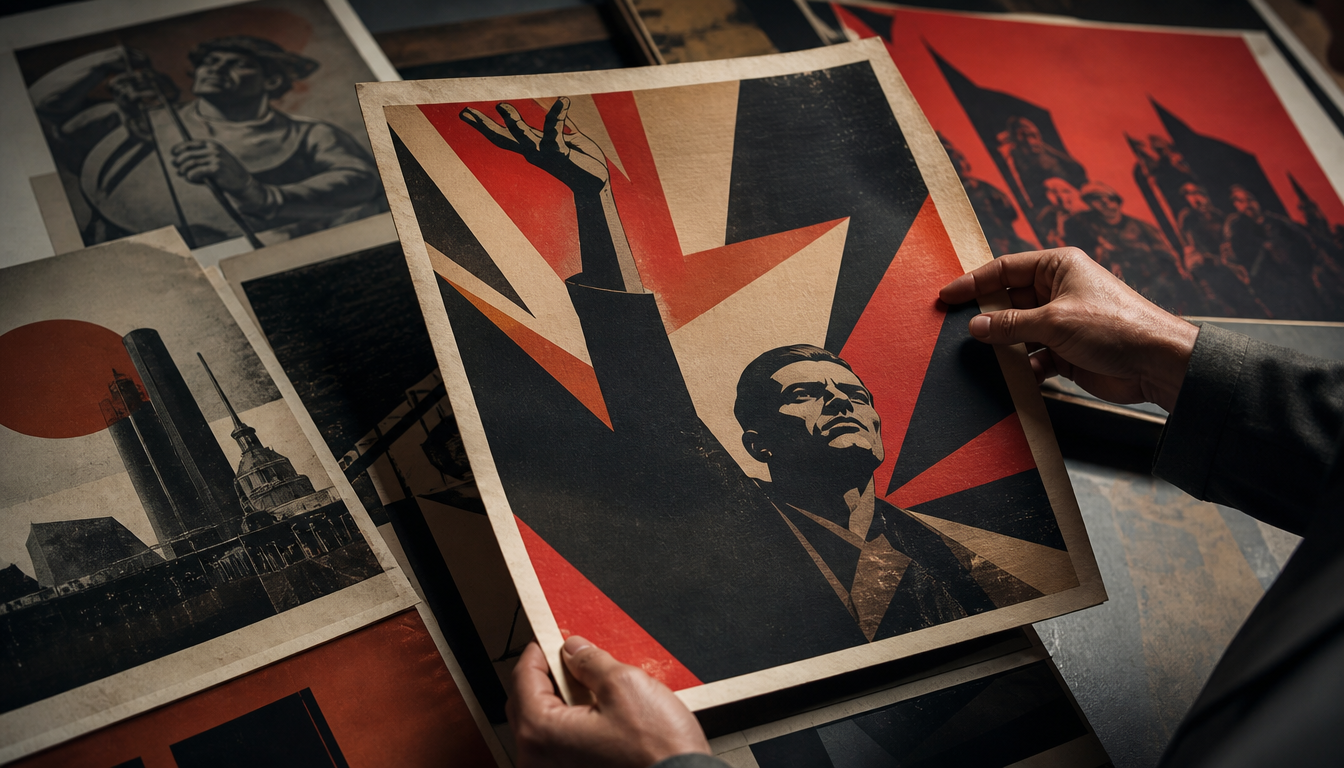
Expressionism as a weapon. Artists such as Käthe Kollwitz, George Grosz and John Heartfield used woodcut, lithography and photomontage to deliver political messages with maximum emotional impact onto streets, advertising columns and factory walls. The distorted lines of expressionism conveyed anger, grief and urgency at a glance.
The Bauhaus as a counterpoint. In parallel, the Bauhaus art school, founded in Weimar in 1919, developed a radically matter-of-fact, geometric visual language. Posters from the Bauhaus milieu — including the famous Bauhaus exhibition poster of 1923 — relied on typography, primary colours and clear structure as tools of persuasion. The Bauhaus understood design as a social responsibility.
Political mass merchandise. Parties of all persuasions — from the KPD and SPD to the NSDAP — invested massively in poster production. The wall poster was the social medium of the Weimar Republic: ubiquitous, quick to produce and difficult to censor.
4 Practical Ideas for Your Home
1. Choose Bauhaus design language as wall décor. The geometric reduction of the Bauhaus still feels fresh today. Those who want to bring this style into their room will find, at reetro, items such as the Bauhaus Ausstellung Poster, the Bauhaus Werbeplakat Kunsthochschule or the Bauhaus Sonne Poster. For a hexagon format, there is also the Bauhaus Hexagon Bild, which transfers the geometric rigour of the Bauhaus into modern wall design.
2. Expressionistic energy through classic reprints. Egon Schiele and Gustav Klimt were contemporaries and direct influences on Weimar graphics. Reprints such as the Schiele Galerie Poster, Schiele Sitzende Frau or the Klimt Kunstdruck Adele bring the spirit of the era directly onto the wall without gathering historical dust.
3. Vintage cinema posters as witnesses of the times. Weimar film culture — expressionism in cinema, The Cabinet of Dr. Caligari, Nosferatu, Metropolis — was inextricably linked to its poster art. The Klassische Retro Kinoposter or the Charlie Chaplin Kinoplakat are reminders of this connection between art and cinema from the Republic era.
4. Pay attention to material and format. Historical wall posters lived by their size and their medium. When selecting modern reprints, it is worth distinguishing between Poster, Leinwand and Hexagon-Aluminium: canvas feels warmer and more textured, while alu hexagons set sharper, more contemporary accents. The Kandinsky Poster Gelb Blau Rot, for example, has a completely different effect in a large format than as a small print.
Sources
- Weimar Republic: Terms of office of the Reich Chancellors 1918–1933 | Statista
- Weimar Republic: Democracy 1918–1933 | weltkrieg1-2.de
FAQ
When did the era of political wall posters and leaflets in the Weimar Republic begin?
The starting gun was fired on 9 November 1918, when Philipp Scheidemann proclaimed the German Republic from the balcony of the Reichstag in Berlin. With the November Revolution, a new political space was instantly created, which artists immediately filled with expressionist prints, woodcuts and agitatory posters. The Weimar Republic was the first German state with a republican constitution, and it was precisely this open yet crisis-ridden society that became the breeding ground for a radically new political visual language.
Which three phases of the Weimar Republic are reflected in the graphic art of the time?
The era can be divided into three clearly identifiable phases: firstly, revolution and crisis (1918 to approximately 1923), in which hyperinflation and unrest made the graphics wild and expressionistic. Secondly, a brief period of stabilisation (1924 to 1929), during which posters became more matter-of-fact and were often internationally influenced. Thirdly, political dissolution from 1929 onwards, when the Great Depression sharpened the tone once again and posters from all camps became more aggressive and propagandistic. Each phase left its own distinct visual fingerprint.
Why was the political graphic art of the Weimar Republic so short-lived and fragmented?
A glance at the terms of office of the Reich Chancellors explains this well: the terms were extremely short and changed in rapid succession. Kurt von Schleicher, for instance, governed for only a matter of days. This political instability meant that parties, trade unions and movements constantly had to produce new leaflets and posters in order to respond to shifting balances of power. The result is an enormous but barely systematically archived body of graphic works.
What pressure did graphic artists and poster artists feel as a result of the Treaty of Versailles?
The Weimar Republic was under pressure from the conditions of the Treaty of Versailles from the very start. This ongoing political and economic stress directly influenced the visual language: many expressionist graphics addressed impoverishment, war-wounded veterans and social injustice. The hyperinflation and later the Great Depression further intensified these themes. Political posters were often not art for art’s sake, but direct responses to real hardship.
What happened to free political graphics after 1933?
With the National Socialists’ electoral victory in 1933, they seized power, abolished the Republic and established a dictatorship. The free, pluralistic political graphics of the Weimar years were banned or brought into line. Artists — including many people of Jewish faith and members of other persecuted groups — were persecuted. The democratic constitution and the elected parliament that had first made this creative space possible no longer existed.
This article was generated automatically by an AI system. Disclosure pursuant to Article 50 of the EU AI Act.