
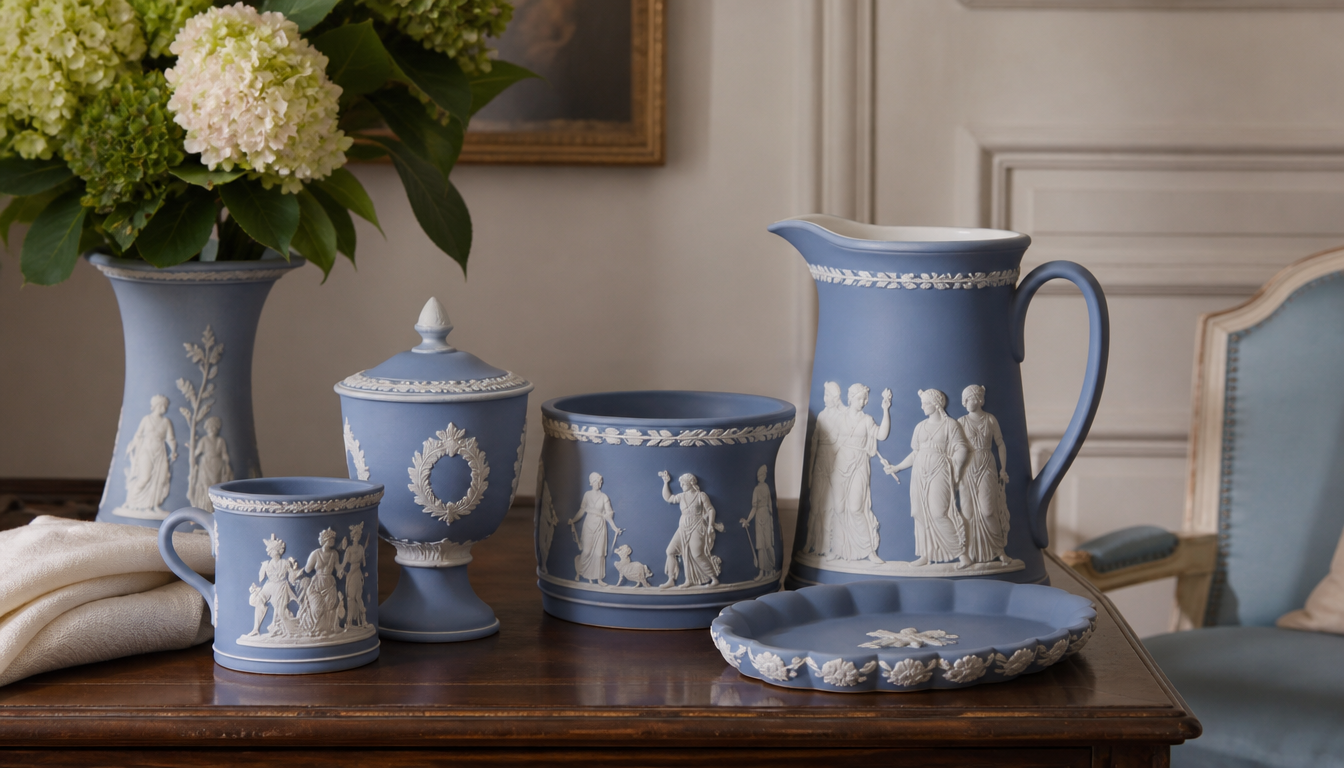
Jasperware was perfected by Josiah Wedgwood in 1774 after thousands of documented experiments and is still handcrafted exclusively in England to this day. More than 250 years of uninterrupted production history make Jasperware one of the longest-lived ceramic designs in the world. The unglazed matte finish, the characteristic white reliefs on “Wedgwood Blue” and the neoclassical style continue to shape how we read English formal design. For vintage hunters, a closer look pays off: depending on colour, age, condition and form, the value of a single piece ranges from twenty dollars to several thousand.
Wedgwood Jasperware: How English Ceramic Art Has Shaped Design History Since 1774
For over 250 years, Wedgwood Jasperware has been arguably England’s most iconic ceramic product. Josiah Wedgwood perfected the material in 1774 after thousands of meticulously documented experiments. The result: an unglazed, matte stoneware surface in a characteristic pale blue that has since entered design history as “Wedgwood Blue”.
What Makes Jasperware So Special
Technically speaking, Jasperware is a stoneware with a matte “biscuit” surface, produced in a variety of colours. Its most distinctive hallmark is the applied, contrasting relief decoration — typically white on a blue ground. These reliefs are cast in moulds and applied to the body as so-called sprigs, creating the characteristic cameo effect.
A particularly prominent example is a Jasperware vase from 1790, now held at the Victoria and Albert Museum in London. The white reliefs depict muse motifs designed by John Flaxman Senior.
Wedgwood began selling Jasperware in the late 1770s, initially as small objects. From the 1780s onwards, large vases were added to the range. The decoration was initially oriented towards the then-fashionable neoclassicism. Handcrafted exclusively in England, Jasperware continues to be produced to this day.
What You Should Know as a Buyer or Collector
1. Value varies considerably Jasperware spans more than 250 years of production history. Pieces range from 18th-century objects to decorative items from the mid-20th century. According to experts, a single piece can be worth anywhere between $20 and several thousand dollars. Four factors are decisive: colour, age, condition and form.
2. Rare colours are more valuable “Wedgwood Blue” is the best-known and most common colour variant. Other colours are rarer and correspondingly more sought-after among collectors. Anyone who owns an unusually coloured piece should take this into account when assessing its value.
3. Backstamps reveal age Over the decades, Wedgwood has used different markings on the underside of its pieces. Decoding these historical backstamps is one of the most reliable methods of narrowing down the period of production and thus the potential value of a piece.
4. Professional assessment is worthwhile for heirlooms Anyone who has inherited a shelf full of blue ceramics with white reliefs should consider having them professionally appraised. Without knowledge of the details, the difference between an everyday souvenir and a valuable collector’s item is almost impossible to detect.
Vintage Aesthetics in Your Own Home
The clean form, restrained colour contrast and handcrafted relief of Jasperware embody a design principle that continues to inspire today: less ornament, more impact. Those seeking this spirit in modern wall décor will find a kindred aesthetic at reetro — for example in our Bauhaus poster, the Kandinsky poster in Yellow, Blue and Red or the Bauhaus Hexagon print. Botanical classics such as our Lavender Botany poster or the Thornton Flowers poster carry the same quiet, timeless character. And anyone wishing to style their desk in the same spirit would do well to take a look at the William Morris Mouse Pad Red Bird, which comes with a similar Arts and Crafts heritage.
You can find the full reetro shop at /en/shop.
Sources
- Jasperware – Wedgwood (wedgwood.com)
- Jasperware – Wikipedia (en.wikipedia.org)
- Wedgwood Jasperware Value Guide: Colors, Marks, Worth – Lion & Unicorn (lionandunicorn.com)
FAQ
What exactly is Jasperware and why is it considered so special?
Jasperware is a stoneware ceramic developed by Josiah Wedgwood in the 1770s. Its hallmarks: an unglazed, matte surface in a so-called biscuit finish, as well as raised relief decorations in contrasting colours that create a cameo effect. The reliefs are cast in moulds and applied to the vessel as so-called sprigs. To this day, Jasperware is made exclusively by hand in England, which gives it its distinctive character.
How long did it take Wedgwood to perfect Jasperware?
Years. Josiah Wedgwood conducted thousands of experiments, all meticulously documented, before he perfected the material in 1774. The first pieces were not sold until the late 1770s, initially as small objects. From the 1780s onwards, large vases were added. This obsessive rigour was no coincidence — it was a guiding principle.
Why is the typical blue so strongly associated with Wedgwood?
The pale blue now known as “Wedgwood Blue” was from the very beginning the most widely produced and best-known colour variant. Classic pieces such as a vase from around 1790 with white muse reliefs by John Flaxman Sr. showcase this look in its purest form — today on view at the Victoria and Albert Museum in London, among other places. Although Jasperware was produced in various colours, the blue tone became so defining that it was simply named after the brand.
What factors determine the value of an antique Jasperware piece?
Value depends essentially on four factors: colour, age, condition and form. Jasperware has been produced for more than 250 years, meaning that a single piece can be worth anywhere from a low two-digit sum to several thousand dollars. Pieces from the 18th century are considered the most sought-after, while objects from the mid-20th century tend to be classified as everyday decorative ware. Backstamps help narrow down the year of manufacture.
In what style were the early Jasperware decorations executed?
Early Jasperware was firmly rooted in neoclassicism, the dominant artistic style of the period. Typical motifs included antique figures, muses and mythological scenes, many of them based on designs by sculptors such as John Flaxman Sr. This style remained defining for decades and was revisited time and again in subsequent centuries, even as later production phases introduced new motifs.
This article was generated automatically by an AI system. Disclosure pursuant to Article 50 of the EU AI Act.