
Brownie Wise invented the Tupperware party in the late 1940s, thereby saving a brand that had barely found any buyers in retail. In the 1950s and 1960s, these home events became both a sales format and a social network for millions of women. What sounds like plastic containers was actually a design revolution in everyday life: Tupperware established plastic as a practical material in kitchens worldwide and created a direct sales model that offered women one of the few flexible sources of income in the postwar era. Brownie Wise thereby became one of the first women to receive national recognition as a business leader in the United States. Anyone familiar with the history of sneakers knows: trainers also only became big through community culture.
Tupperware Parties and Plastic Kitchenware of the 1950s: How a Kitchen Container Revolutionized Everyday Life
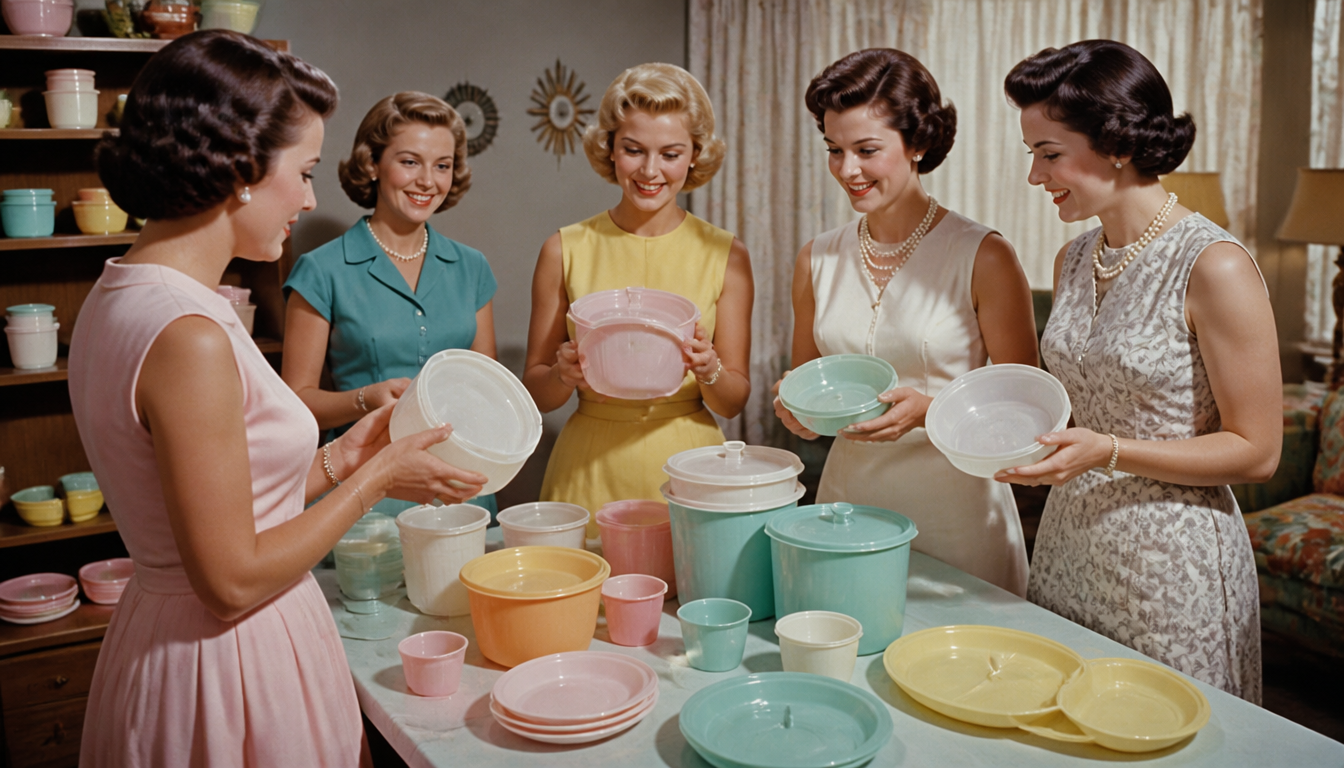
In the 1950s and 1960s, Tupperware parties were far more than a sales event for many housewives in American suburbs. They were social anchors. According to historyfacts.com, hostesses invited friends, neighbors, and relatives, received free products as commission, and in the process created one of the earliest direct sales networks of the postwar era.
The Real Mind Behind the Plastic Phenomenon
Earl Tupper invented the product. But it was Brownie Wise who made it sellable. The design history of Tupperware (workovereasy.com) makes it clear: in the late 1940s, retail sales were poor. The target audience did not respond to catalog photos and traditional advertising. Wise identified the problem and developed the home party model, in which the customers simultaneously became the sellers. She thereby created a system that combined familiarity with both the product and the seller in a living room.
According to historyfacts.com, Wise became one of the first women to receive national recognition as a business leader in the American postwar economy. This is no minor detail, but rather an indication of just how unusual this rise was for the time.
Plastic as a Design Promise
In the 1950s, Tupperware was not a disposable product. It was quite the opposite: durable, airtight, colorful, and modern. The characteristic “burping seal” (the air-release mechanism when closing) was considered a technical innovation. The material polyethylene was at the time a symbol of progress and hygiene.
It was only over the following decades that the meaning of plastic began to shift. The promise of modernity gave way to criticism of throwaway culture. The parties of the 1950s thus stand today as a tipping point in design consciousness: plastic as utopia, before it became a problem zone.
4 Practical Inspirations for Today
1. Longevity is the new vintage. The original Tupperware concept was designed for reuse, not single use. Those furnishing living spaces today think similarly: objects built to last rather than quickly replaceable mass-produced goods. Posters, wall art, and décor that endure for decades play into the same idea. Take a look, for example, at Bauhaus posters or vintage travel posters that reference the same era aesthetically.
2. Retro design has attitude. Tupperware’s color spectrum of the 1950s (avocado green, cream white, pastel pink) is today a reference for mid-century aesthetics. Those who bring this look into their own home are consciously drawing on a visual language that is culturally charged. Retro-style vintage cushions or an abstract retro cushion convey exactly this sense of living.
3. Community as a purchasing context. Brownie Wise’s party model worked because it embedded products in a social context. The same applies today: what you discover in conversation with others feels different from what you find alone in an online shop. That’s why it’s worth browsing the entire reetro shop together with friends.
4. Design icons deserve wall space. Those who appreciate the aesthetics of postwar modernism will find kindred imagery in pop art decorative cushions or a Kandinsky poster. The 1950s and early 1960s were a high point of graphic design, and this thread runs through to today’s interior aesthetics.
Sources
FAQ
Who actually invented the Tupperware party?
It wasn’t Earl Tupper, but Brownie Wise. In the late 1940s, sales of Tupperware were going really badly despite a strong product. Wise recognized that housewives simply couldn’t connect with traditional retail. Her idea: to turn the women who were supposed to buy the product into sellers at the same time. She built what became known as the ‘Home Party Plan’ model, making Brownie Wise one of the first women to become nationally known as a business leader in the postwar era.
What actually happened at a Tupperware party in the 1950s?
A hostess invited friends, neighbors, and relatives to her home. There were snacks, good company, and a product demonstration by a Tupperware representative. Games and small prizes kept the atmosphere relaxed. For many women who managed the household at home, this was one of the few regular opportunities to socialize outside of church groups or school events. Shopping and socializing in one, long before social media took over.
Was it financially worthwhile for the women who hosted these parties?
Yes, quite so. Hostesses earned free products depending on how much was sold at their party. This naturally motivated them to invite more guests. Independent consultants also earned money by organizing parties themselves and in turn recruiting other sellers. For many women at a time when flexible income opportunities were scarce, this was a genuine alternative.
Why is Tupperware considered a design phenomenon of the 1950s?
Tupperware represented a new everyday aesthetic: plastic as a modern, practical, and affordable material for the home. The airtight containers were a promise of modernity and efficiency. The design was clean, colorful, and functional, fitting perfectly into the image of the tidy suburban life of the postwar era. Tupperware didn’t just sell bowls — it sold a way of life.
Do Tupperware parties still exist today?
As a cultural memory, definitely. Although hardly anyone has personally attended one today, the image of neatly dressed 1950s ladies gathered around a living room table with plastic containers remains iconic to this day. The direct sales model that Brownie Wise developed at the time is considered the blueprint for countless sales concepts that came after it.
This article was generated automatically by an AI system. Disclosure pursuant to Article 50 of the EU AI Act.