
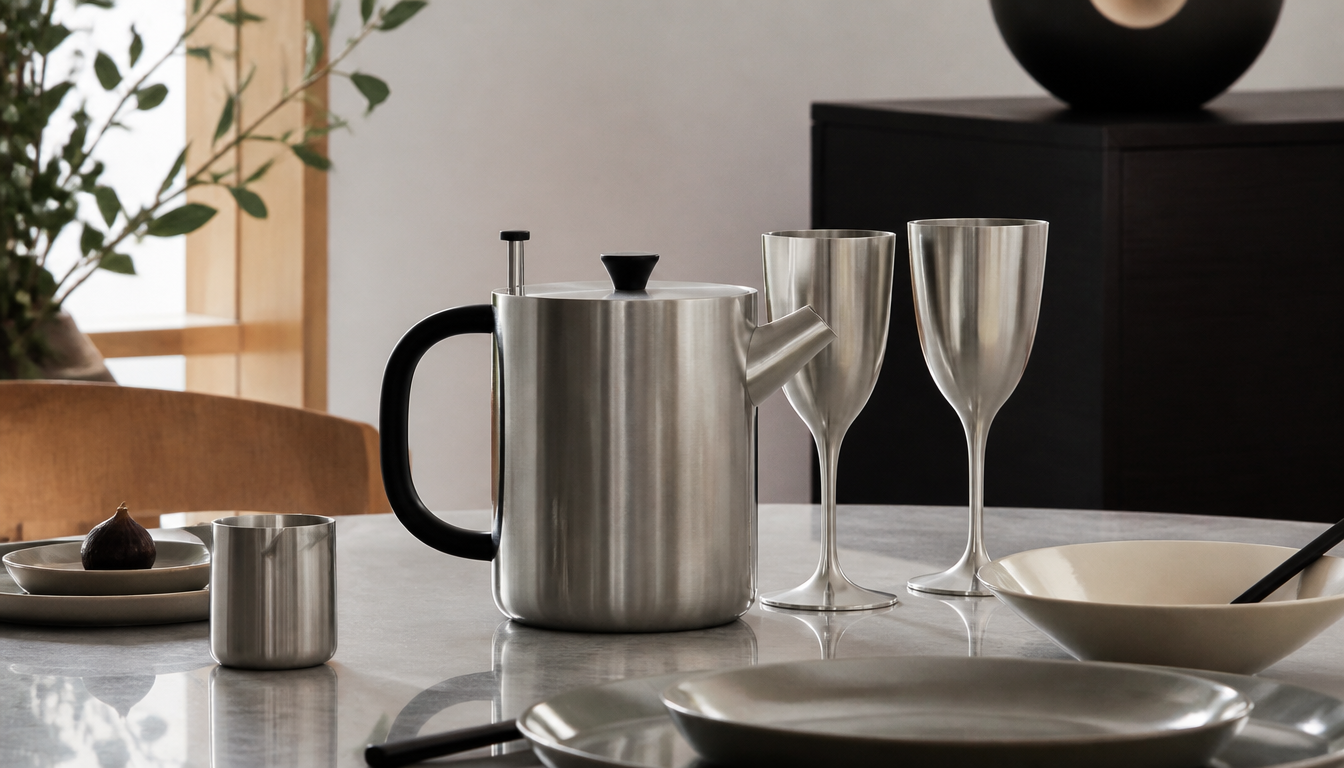
Arne Jacobsen’s Cylinda-Line teapot from 1967 holds exactly 1.25 liters and retails at Stelton today for $475 USD – a Danish design classic made of stainless steel with Bakelite handles, produced unchanged for over 55 years. What was intended in 1967 as an affordable alternative to classic silverware is today considered a sought-after collector’s item. Jacobsen was only persuaded by Stelton CEO Peter Holmblad after seeing his own designs at dinner and simply having to step in himself. The result: a series whose cylindrical basic form, derived from industrial standard steel tubes, continues to embody the tableware of the 1960s through 1975.
Stelton Cylinda-Line: Why Arne Jacobsen’s 1967 Teapot Became a Collector’s Question
The teapot from the Cylinda-Line was introduced in 1967 and is today considered a Danish design icon. That is the key fact from which much of what collectors of minimalist tableware from the 1960 to 1975 era should know can be understood.
How It Came About
Arne Jacobsen’s collaboration with Stelton began in 1965, when company director Peter Holmblad asked him to design a coffee and tea set in stainless steel. Jacobsen was difficult to persuade at the time. The turning point came at a dinner: Holmblad, the son of Jacobsen’s wife Jonna Jacobsen, showed him his own design drawings. Jacobsen found them so inadequate that he simply took matters into his own hands.
The Cylinda-Line was launched in 1967 as a modern, functional design series for a broad audience. It was conceived as a counterproposal to classic silverware. It was originally developed on the basis of standardized steel tubes that were cut to length and fitted with a base. While this method proved too costly, the characteristic geometric tube shape was retained and remains the unmistakable hallmark of the series to this day.
The Teapot in Detail
The Cylinda-Line teapot holds 1.25 liters and was one of the first products in the series. It is made of stainless steel and features characteristic Bakelite handles. The dimensions: 13 cm tall, 23.5 cm wide, 13 cm deep. It is currently listed at Stelton US for $475 USD. Care is straightforward: surfaces are cleaned with lukewarm water and dish soap, then thoroughly wiped with a soft cloth. Not dishwasher safe.
4 Practical Tips for Buyers
1. Check the material before you buy. Original Cylinda-Line pieces are made of stainless steel with Bakelite handles. Bakelite is an early plastic from the first half of the 20th century, recognizable by its matte, slightly warm surface. Pieces with other handle materials may be later variants or simply not original.
2. Care is crucial for value. Stainless steel does not respond well to the dishwasher, especially for older Stelton pieces. Stelton expressly recommends hand washing with lukewarm water. Scratches from dishwasher tablets not only diminish the appearance but also significantly reduce collector value.
3. Know the market prices. The current new retail price at Stelton US is $475 USD for the teapot. Anyone seeking pieces from the period 1967 to the mid-1970s on the secondary market should use this price as a reference and pay attention to original condition, intact Bakelite handles, and the absence of dents.
4. Think of the series as a whole. The Cylinda-Line was developed as a complete series. Individual pieces are beautiful, but a cohesive set of teapot, coffee pot, and accessories from the same production phase attracts significantly more attention from collectors than individual items.
For those who also want to feel the spirit of this era on their walls: the Bauhaus exhibition poster or the Kandinsky print in Yellow, Blue and Red are aesthetically well-suited to a space featuring Cylinda-Line pieces. Those who prefer decorative wall objects will find geometric forms among our hexagon wall art that are not entirely unlike the minimalist spirit of the 1960s. And for the desk next to the teapot, there is plenty more to discover in the reetro poster shop.
Sources
- Arne Jacobsen teapot 42.3 oz – Stelton US
- Stelton – Arne Jacobsen (arnejacobsen.com)
- All Products – Stelton US
FAQ
When was the Stelton Cylinda-Line launched and who is behind it?
The Cylinda-Line was launched by Stelton in 1967. It was designed by Danish architect and designer Arne Jacobsen, who began collaborating with Stelton in 1965. The collaboration came about in a rather unusual way: Stelton director Peter Holmblad, the stepson of Jacobsen’s wife Jonna, showed the maestro his own designs over dinner. Jacobsen found them so unconvincing that he simply took over himself.
What material is the Cylinda-Line teapot made of and how do you care for it properly?
The teapot is made of stainless steel with characteristic Bakelite handles. For care: wash surfaces with lukewarm water and dish soap, then dry thoroughly with a soft cloth. The dishwasher is off-limits, as it will damage the surface.
What are the dimensions and capacity of the classic Stelton teapot by Arne Jacobsen?
The teapot holds 1.25 liters, which is approximately 42.3 oz. The dimensions are 13 cm in length, 13.5 cm in height, and 23.5 cm in width. This makes it compact enough for everyday use, yet distinctive enough to immediately catch the eye.
Why is the Cylinda-Line considered a Danish design icon today?
The Cylinda-Line was conceived from the outset as a modern, functional alternative to classic silverware for everyday use – not for a display cabinet. Originally, the series was to be manufactured from standardized steel tubes, simply cut to length and fitted with a base. While this method proved too costly, the characteristic geometric cylindrical form was retained and became the trademark of the entire line. The timeless, minimalist design made the series an international icon.
What does the Stelton teapot by Arne Jacobsen cost today and is it worth buying as a collector's item?
The current list price of the Stelton teapot in the Cylinda-Line design is $475 USD. Those looking for a genuine piece of Danish design history will find an object here that has barely changed since 1967 – and for precisely that reason has retained its status as a collector’s item: timeless form, robust materials, and a history directly linked to one of the most influential architects of the 20th century.
This article was generated automatically by an AI system. Disclosure pursuant to Article 50 of the EU AI Act.