
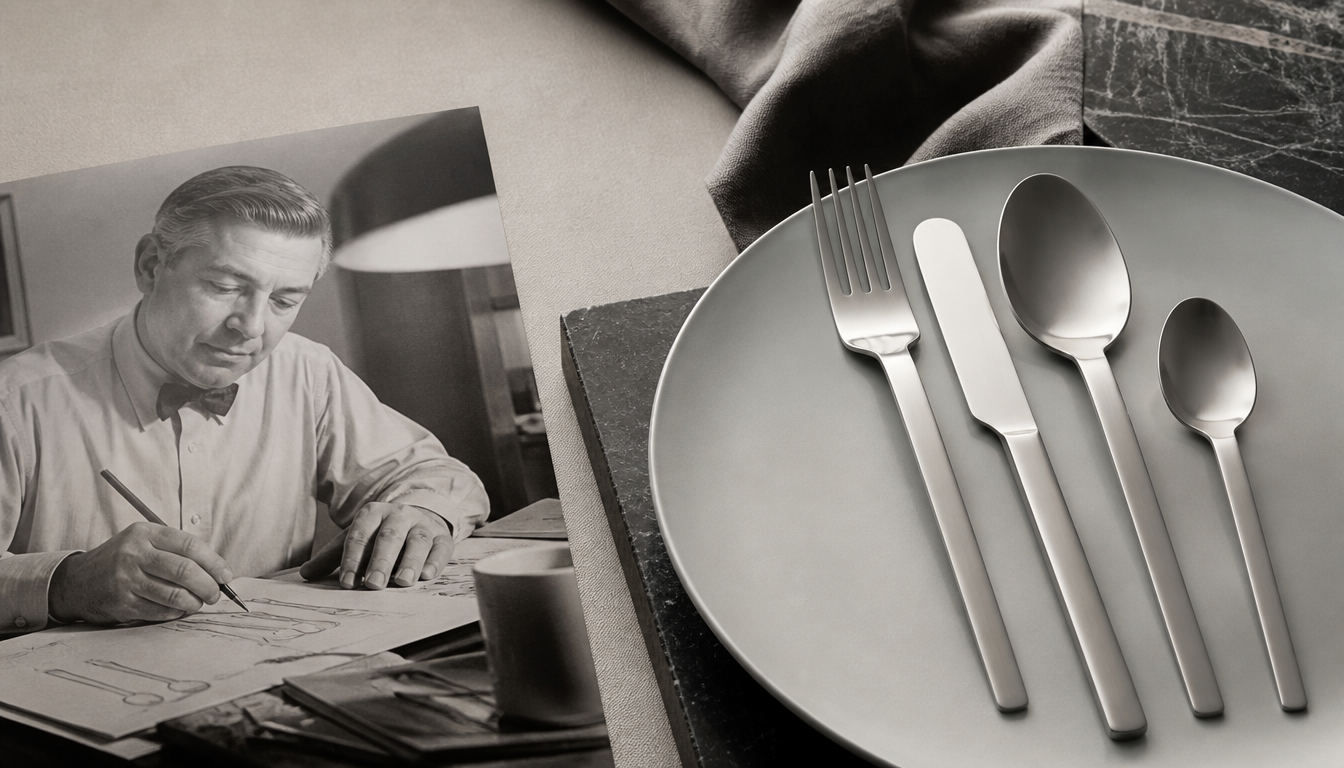
Arne Jacobsen (1902–1971) designed the Cylinda-Line for Stelton in 1967, which won the ID Prize of the Danish Society of Industrial Design in the same year and the International Design Award of the American Institute of Interior Designers in 1968. With the Cylinda-Line, Jacobsen proved that uncompromising minimalism and precise proportions are not at odds with everyday use. As an architect who himself designed door handles and cutlery for his total works of art such as the SAS Royal Hotel in Copenhagen, he never thought of objects in isolation, but always as part of a coherent whole. For you as a design enthusiast, this means: every piece of the Cylinda-Line carries the same design philosophy as his world-famous furniture classics “Ant”, “Swan” and the Series 7.
Stelton Cutlery & Arne Jacobsen: Minimalist Cutlery as a Design Manifesto 1964–1980
Arne Jacobsen (1902–1971) designed the Cylinda-line for Stelton in 1967, a cocktail and table series in stainless steel that received the Danish ID Prize from the Danish Society of Industrial Design in the same year and was awarded the International Design Award of the American Institute of Interior Designers in 1968.
The Key Fact: Proportion as a Guiding Principle
Jacobsen, born in 1902 in Copenhagen, studied at the Royal Danish Academy of Fine Arts from 1924 to 1927 and brought from this training an unusually precise sense of proportion. This sense ran through his entire body of work, from buildings to individual table objects. The Cylinda-line is a direct example: pure cylinders, no ornaments, no superfluous gesture. Jacobsen himself put it this way: “The primary factor is proportion.”
What this meant for cutlery and table culture was radical for the time. While European silverware of the postwar decades often still featured historicising elements, Jacobsen relied on functional geometry as the sole means of expression. In doing so, he placed himself in the direct lineage of architects Le Corbusier, Mies van der Rohe and Walter Gropius, whose work he had encountered on travels through France and Germany in the 1920s.
What You as a Consumer Should Know
1. Original designs have a traceable history of creation Jacobsen’s furniture and objects, including the “Ant Chair”, the “Swan” and the “7 Series”, were originally created as parts of specific architectural projects, not as standalone products. The Cylinda-line was also embedded in this holistic approach. Whoever buys a piece is therefore also buying a document of this design philosophy.
2. Understanding the total work of art as a purchasing argument The SAS Royal Hotel in Copenhagen is the most well-known example of Jacobsen’s ambition: he designed the building, interiors, furniture and even door handles and cutlery there as a unified whole. This principle is known as a “Gesamtkunstwerk” (total work of art). Collecting Jacobsen objects therefore follows an inner logic that goes beyond individual products.
3. Using awards as a point of orientation The Cylinda-line was honoured with two internationally recognised design awards in 1967 and 1968. Such awards provide guidance when you are weighing up different design classics.
4. Thinking the design language further in your own home Those with an interest in clear formal language and Scandinavian modernism will also find points of connection in wall décor and home accessories. The Bauhaus exhibition poster or the Bauhaus advertising poster build a visual bridge to the movements that influenced Jacobsen. The Kandinsky poster in yellow, blue and red also fits into this context. Those wishing to explore the Scandinavian design language further will find suitable prints and wall art in the reetro shop.
For a clean, geometric aesthetic in the living space, it is also worth taking a look at the Bauhaus hexagon picture or the Scandinavian pattern hexagon.
Sources
FAQ
Who was Arne Jacobsen, and why is he considered a legend in design?
Arne Jacobsen (1902–1971) was a Danish architect and designer from Copenhagen. He studied at the Royal Danish Academy of Fine Arts from 1924 to 1927, where he developed his unmistakable sense of proportion. Jacobsen saw himself primarily as an architect, but always thought holistically: on major projects such as the SAS Royal Hotel in Copenhagen, he designed not only the building but also the interior, furniture, door handles and cutlery. This consistent, all-encompassing concept made him synonymous worldwide with modern functionalism.
What does Arne Jacobsen have to do with Stelton?
In 1967, Arne Jacobsen designed the Cylinda-Line for Stelton, a cocktail and table series featuring clean cylindrical forms. The collaboration was no coincidence: Jacobsen’s entire body of work was driven by the desire to merge architecture and everyday design into a coherent unity. The Cylinda-Line was awarded the ID Prize of the Danish Society of Industrial Design in the same year and received the International Design Award of the American Institute of Interior Designers in 1968.
What design philosophy lies behind Jacobsen's cutlery and table series?
For Jacobsen, proportion was the foundation of all good design. His approach was functionalist, but never cold: he drew inspiration from the organic forms of nature and combined rigour with a subtle expressiveness. Whether furniture, lighting, textiles or cutlery, he approached every project with the same uncompromising perfectionism. The cutlery is therefore not merely a tool, but a rigorously conceived design manifesto.
Where does Jacobsen's affinity for total-work-of-art projects come from?
Even during his training, Jacobsen travelled through France and Germany and came into contact with the works of Le Corbusier, Mies van der Rohe and Walter Gropius. These encounters shaped his view of architecture as a social and aesthetic unity. As early as 1929, he won the competition for the visionary ‘House of the Future’ together with Flemming Lassen, uniting modernism and machine aesthetics. This ambition to think everything together ran through his entire body of work, right down to table cutlery.
Were Jacobsen's furniture and cutlery designs really created for specific projects?
Yes, and that is an important point. Iconic pieces of furniture such as ‘The Ant’, ‘The Swan’ and the ‘7 Series’ were originally designed not as standalone products but as part of specific architectural projects. The same applies to the table design for Stelton: Jacobsen thought from the space outwards, not from the individual object. The fact that his designs are now regarded as timeless classics was more a happy consequence of his consistency.
This article was generated automatically by an AI system. Disclosure pursuant to Article 50 of the EU AI Act.