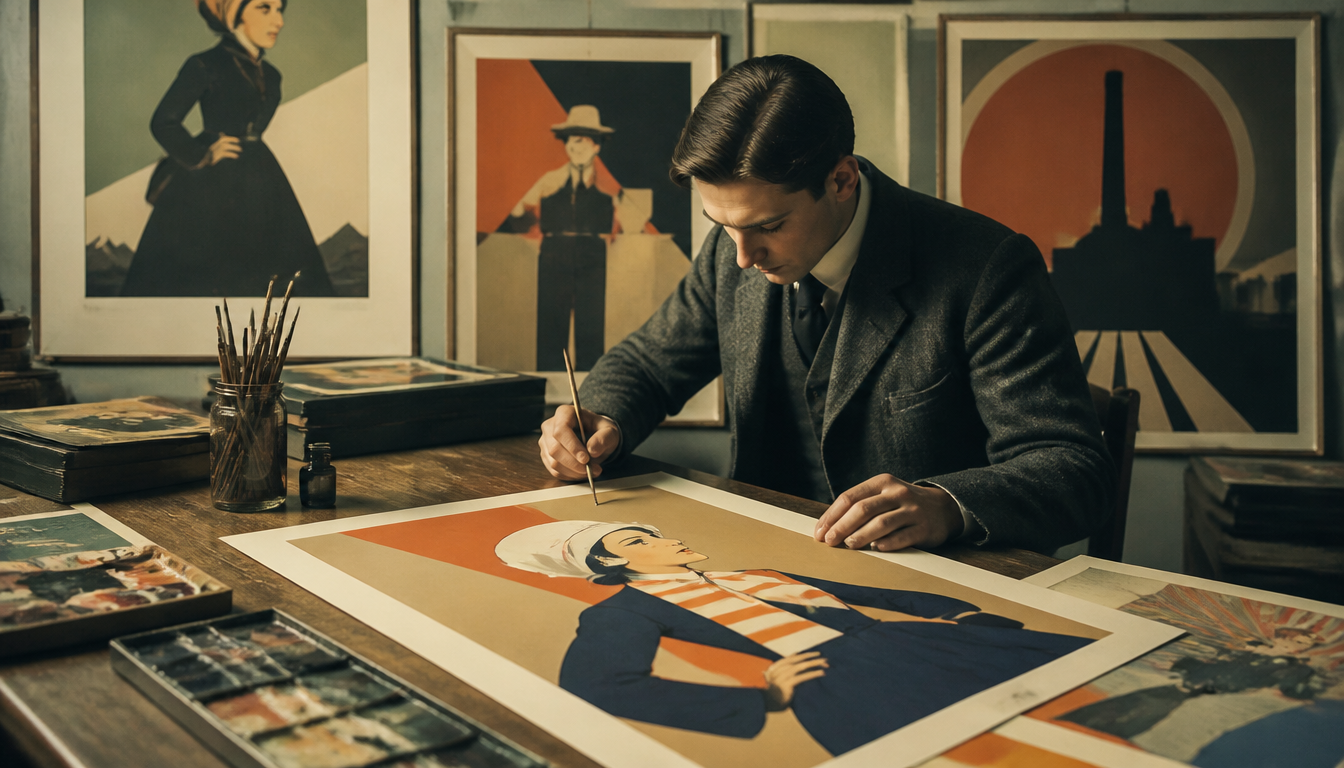
Ludwig Hohlwein (1874–1949) was one of the most important German poster designers of the early 20th century and, as a pioneer, shaped the Sachplakat style that revolutionised visual communication between 1900 and 1930. Hohlwein started out as an architect in Munich and only switched to poster art in 1911. His Sachplakat style dispensed with overloaded ornamentation and instead relied on clear flat areas and bold colours. For us at reetro, this is more than art history: it is precisely this design language, which appeared in the Jugend magazine around 1900, that continues to influence how brands tell their stories visually. Those who understand vintage know: good design does not age.
Ludwig Hohlwein and the Sachplakat: How an Architect Reinvented German Poster Art
Ludwig Hohlwein was born on 27 July 1874 and died on 15 September 1949. His life spanned exactly those decades in which the modern poster matured into an art form in Germany. What set him apart from his contemporaries: he did not start out as a painter or graphic artist, but as an architect. Until 1911 he trained and worked in Munich as an architect before moving to Berlin and switching to poster design. This background shaped his eye for surface, structure and proportion in a way that is immediately felt in his work.
The Sachplakat Pioneer and His Style
Hohlwein is regarded as one of the most important German poster designers of the early twentieth century and as a key figure of the Sachplakat style. What exactly is that? The Sachplakat dispenses with elaborate ornamentation. Instead, it relies on clear forms, strong colour contrasts and a direct visual language. No decorative embellishment for its own sake — the motif itself carries the message.
As early as around 1900, Hohlwein published illustrations in the Jugend magazine, including the well-known “Three Foxes”. These early works still show clear influences of Art Nouveau, yet the later Hohlwein is already discernible: flat colours, strong silhouettes and an almost architectural compositional logic.
His most famous work in the field of animal posters is the Zoologischer-Garten poster for Munich, which to this day is considered a prime example of German Sachplakat design. If you would like to have a piece like this on your wall, take a look at the Hohlwein Poster Zoologischer Garten.
What Does This Mean for You as an Art Lover?
1. Historic Poster Art is Affordable Wall Art with a Story
Hohlwein posters are not museum artefacts that belong only behind glass. Reprints and stylistically related works can easily be integrated into modern living spaces. The Sachplakat style looks surprisingly timeless precisely because of its restraint. Browse our poster range, which brings together many works from this era and in this spirit.
2. The Style Continues to Influence Graphic Design and Advertising Today
Anyone who knows the origins of the Sachplakat sees it everywhere: in modern branding design, in film posters, in retro illustrations. The Bauhaus exhibition poster or the Bauhaus advertising poster of the art school are direct relatives of this design thinking that Hohlwein helped to shape.
3. Animal Motifs in the Hohlwein Style as a Room Accent
Hohlwein was famous for his animal motifs featuring strong colour planes and precise silhouette effects. You can find a similar visual language today in vintage animal posters such as the snarling tiger vintage poster or the black leopard retro poster.
4. Historic Advertising Posters as Collectibles and Décor
The era between 1900 and 1930 produced some of the most iconic advertising posters in history. Alongside Hohlwein, artists from various European movements — from Art Nouveau to Art Déco — shaped the visual identity of the period. Related pieces such as the Dunlop retro advertising poster, the Zenith watches advertising poster or the Porto Constantino Jean Dylen illustrate just how broad and rich this epoch was.
Vintage poster art from this period does not have to gather dust in an archive. Browse our entire shop range and find the piece your wall deserves. If you are unsure about delivery and formats, you will find all the information under Shipping & Delivery.
Sources
- Ludwig Hohlwein – Google Arts & Culture
- Designer Ludwig Hohlwein – Design Reviewed
- “Three Foxes” – Ludwig Hohlwein, Jugend Magazine, ca. 1900 – Facebook Group Art Nouveau & Liberty
FAQ
Who was Ludwig Hohlwein and why is he considered a pioneer of German poster art?
Ludwig Hohlwein was born on 27 July 1874 and was one of the most important German poster designers of the early 20th century. Before switching to poster art, he worked as a trained architect in Munich, which strongly influenced his later style. From 1911 he moved to Berlin and devoted himself entirely to poster design. As a key figure of the Sachplakat style, he laid the foundations for a modern, clear visual language that continues to influence the history of graphic design to this day.
What is the Sachplakat style that Hohlwein helped to shape?
The Sachplakat style, also known in English as the ‘object poster’, was a revolutionary design movement in the early 20th century. It placed the advertised object clearly and directly at the centre, without overloaded ornamentation. Hohlwein was a pioneer of this direction: he combined flat colour planes, strong contrasts and an almost architectural composition — which is hardly surprising when you consider that he was originally an architect.
When did Hohlwein begin designing posters and illustrations?
Hohlwein’s creative beginnings as an illustrator date back to around 1900. At that time, his first works appeared in Jugend magazine, including the well-known motif ‘Three Foxes’ (ca. 1900), which already clearly displays his playful yet precise style. His breakthrough as a poster designer then came in the years after 1911, when he relocated to Berlin and focused entirely on poster-making.
Which art styles influenced Hohlwein's work around 1900?
Hohlwein worked in a particularly inspiring era: around 1900, Jugendstil, Art Nouveau, Belle Époque and early Modernism were all flourishing simultaneously. These movements left clear traces in his early illustrations, such as those in Jugend magazine. Over time, Hohlwein developed his own unmistakable style, combining flat colour design with matter-of-fact clarity and thus going far beyond decorative Art Nouveau.
What sets Hohlwein's poster style apart from other designers of his time?
What distinguished Hohlwein from many of his contemporaries was his architectural eye for composition and surface, which he brought from his time as a Munich architect. He worked in that profession until 1911 before switching to poster design. This background knowledge is reflected in the structural clarity and the reduced yet effective use of colour in his posters, which made him a central figure of the Sachplakat style.
This article was generated automatically by an AI system. Disclosure pursuant to Article 50 of the EU AI Act.