
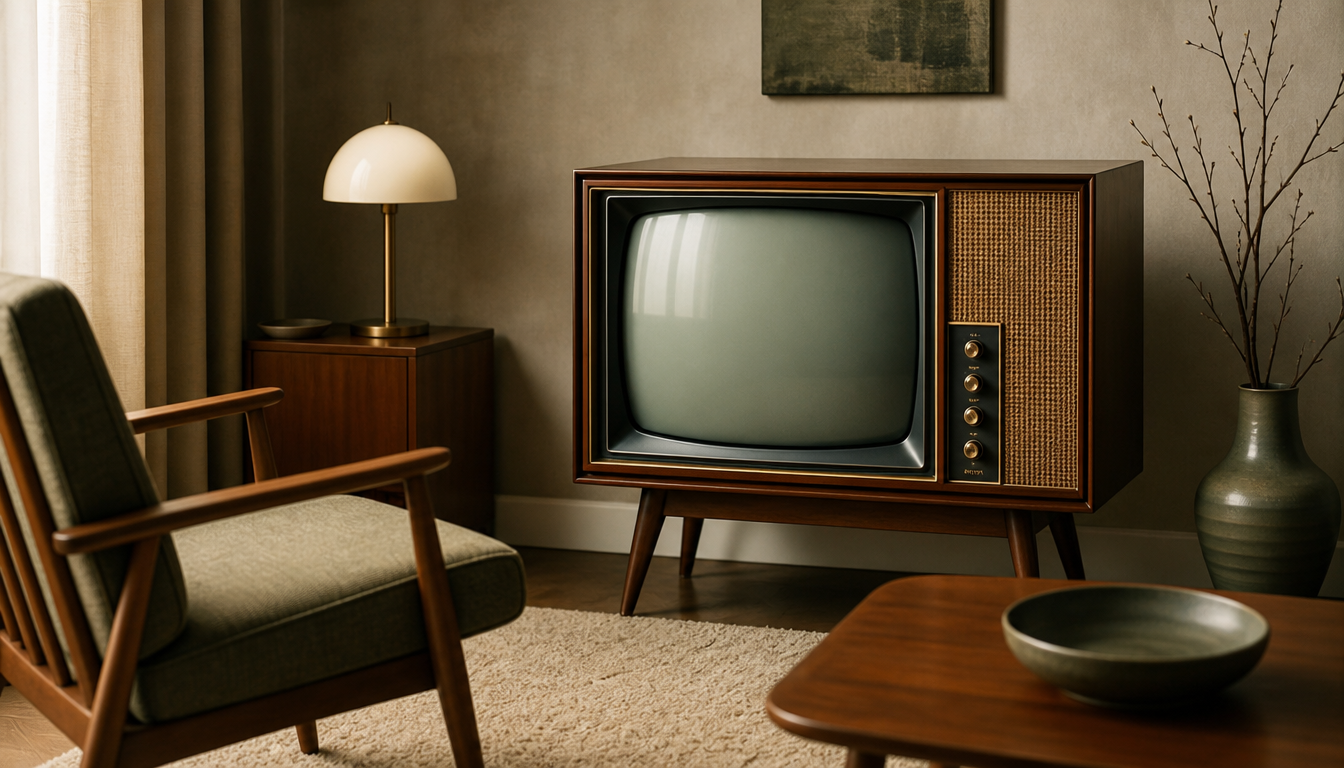
Since 1923, Loewe has been manufacturing consumer electronics in Germany: The televisions from the Kronach plant produced between the 1950s and 1970s remain iconic to this day for their combination of precise engineering and timeless design. Anyone who collects vintage technology—or simply understands that great things are built rather than merely sold—cannot ignore Loewe. The devices from those decades show how a German company thought of picture, sound and form as a unified whole long before the word “premium” became a marketing buzzword. For those who see retro not as a trend but as an attitude, these devices are genuine historical documents with real substance.
Loewe Televisions of the 1950s to 1970s: German Quality Design Between Broadcasting and Form
Loewe has existed as a German electronics company since 23 January 1923. What Siegmund and David Ludwig Loewe founded in Berlin back then as Radiofrequenz GmbH became, decades later, the blueprint for what we now know as “premium consumer electronics made in Germany”. It was particularly during the decades between 1950 and 1970 that Loewe developed a design philosophy that consistently brought technology and aesthetics together.
From Radio to Television: A Consistent Vision
Loewe started out as a radio manufacturer. As early as 1926, Siegmund Loewe collaborated with the young physicist Manfred von Ardenne. The result was the Loewe 3NF, an early attempt to integrate multiple functions into a single component. This philosophy—of internalising complexity while projecting clarity outward—ran throughout the entire history of the company.
After the Second World War, Loewe relocated its headquarters to Kronach in Upper Franconia, Bavaria, in 1948. From there, the company developed televisions in the 1950s and 1960s that were not only technically sound but also formally compelling. Housings in light wood veneer, matter-of-factly proportioned fronts, understated controls: Loewe devices of this era never appeared ostentatious, but rather confidently restrained.
What This Means for You as a Vintage Enthusiast
1. Loewe devices from this period are genuine collector’s items. The company produced everything under one roof in Kronach. Design, engineering and manufacturing were all in one place. This level of vertical integration was unusual even in the 1950s to 1970s, and makes well-preserved devices particularly interesting for collectors and enthusiasts today.
2. The design heritage is still visible today. Loewe describes its current design language as a continuation of an engineering tradition spanning over 100 years. Placing an old device from the 1960s next to a current OLED model, you immediately recognise the formal kinship: reduction, commitment to quality, no superfluous gestures.
3. Kronach as a production site remains active to this day. Unlike many European electronics manufacturers, Loewe never fully relocated its production abroad. According to the company, TV production—including OLED panels—continues to take place in Germany. This is relevant for vintage enthusiasts, as it draws a direct line from the historical craft tradition to the present day.
4. The interior aesthetic of the era suits a particular living sensibility. A Loewe television from the 1960s was never just placed anywhere. It was furniture and appliance in one—often on wooden legs, often with sliding doors. Those furnishing living spaces in a mid-century style today will find Loewe devices of this period to be authentic period documents. To complement the look, wall art with a clear formal language—such as a Bauhaus poster or a Kandinsky print—adds a harmonious touch. Bauhaus hexagon wall art also works well as a contemporary echo of the design era.
Retro Ambience for Your Living Room
Anyone wishing to bring the spirit of those decades into their home doesn’t necessarily need to track down an original device. Vintage posters, canvas prints and decorative cushions with period-inspired design create the same reference to the era. In our poster shop you’ll find a selection ranging from Bauhaus to retro film posters. For fans of the rigorous design sensibility of the 1960s, it’s also worth taking a look at the MCM Hexagon wall art or the Bauhaus advertising poster.
For a softer touch, the decorative cushions section offers motifs that bring retro aesthetics into everyday life—for example the vintage-style cushion or the geo retro cushion.
Sources
FAQ
When was Loewe founded, and what does that have to do with the televisions of the 50s to 70s?
Loewe was founded on 23 January 1923 in Berlin by the brothers Siegmund and David Ludwig Loewe. They started out as Radiofrequenz GmbH, right in the middle of the German radio boom. By the time the televisions of the 50s, 60s and 70s made their way into living rooms, the brand already had decades of experience with reception technology under its belt. You can still sense that in the devices of this era today.
Where were Loewe's televisions of this period actually produced?
Since 1948, Loewe has had its headquarters and production facilities in Kronach in Upper Franconia, Bavaria. It was there, in this small Franconian town, that the devices rolled off the production line that stood in German living rooms throughout the 50s to 70s. Design, engineering and manufacturing under one roof in Germany—that was the principle then, just as it is today.
What makes Loewe devices from the 50s to 70s still interesting for vintage enthusiasts today?
From early on, Loewe stood for the combination of thoughtful design and solid German engineering. The brand has over 100 years of experience in consumer electronics, and the devices of the middle decades of the 20th century wear that ambition visibly on the outside: clear forms, high-quality workmanship, a presence that makes no apologies. For lovers of retro electronics, these are genuine finds.
Did Loewe also set technical benchmarks during this period, or was it primarily about design?
At Loewe, the two always went hand in hand. As early as 1926, company founder Siegmund Loewe collaborated with the young physicist Manfred von Ardenne, which led to the development of the Loewe 3NF—an early attempt to integrate multiple functions into a single component. This culture of innovation continued through the following decades. The televisions of the 50s to 70s therefore rested on a technical foundation that had been laid long before the television age began.
Is Loewe still an active brand today, or is this pure nostalgia?
Loewe exists today as Loewe Technology GmbH and continues to produce premium televisions and audio products, still headquartered and manufactured in Kronach. OLED and LED TVs roll off the line there today, with the same commitment to picture quality and design that has defined the brand since 1923. With Loewe, nostalgia and the present are never far apart.
This article was generated automatically by an AI system. Disclosure pursuant to Article 50 of the EU AI Act.