
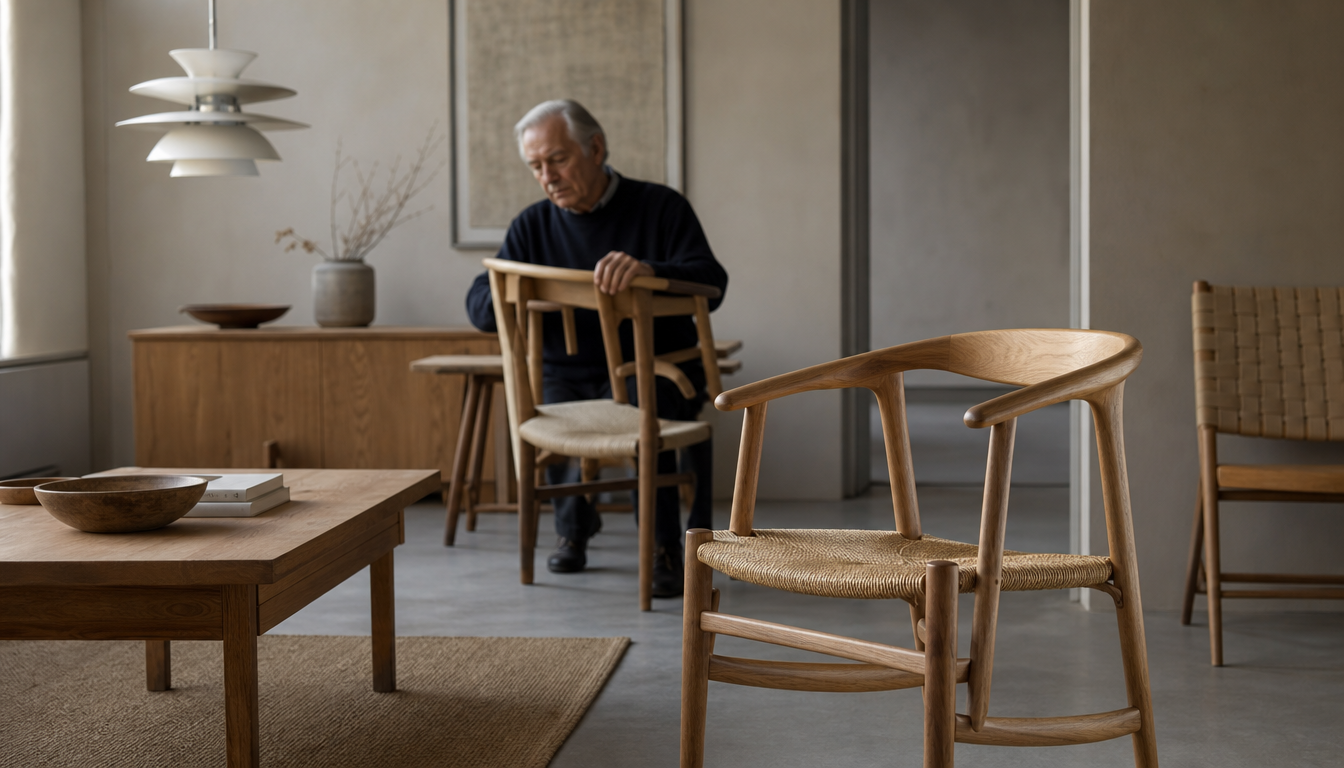
Hans J. Wegner designed over 500 chairs and more than 1,000 furniture models during 60 years of creative work, of which around 130 were still in production on his 90th birthday. Wegner, born in 1914 as the son of a cobbler in Tønder and apprenticed as a carpenter at 14, understood the chair not as decoration, but as the object closest to the human being. His Round Chair literally sat in the first televised US presidential debate in 1960, when Kennedy and Nixon took their seats in it. Anyone who wants to understand why Danish mid-century design is still considered the benchmark for functionalism and craftsmanship cannot ignore Wegner’s work.
Hans Wegner and the Scandinavian Chair: Seat Design between Craft and Functionalism 1940–1968
On 26 September 1960, John F. Kennedy and Richard Nixon sat in chairs designed by a cobbler’s son from Tønder during the first live-broadcast presidential debate in US history. The chair was originally called the “Round Chair,” until an American magazine simply put it on the cover and called it “the Chair.” The name stuck. Its creator: Hans Jørgensen Wegner, born on 2 April 1914 in Tønder, South Jutland.
Who was Hans Wegner?
Wegner grew up as the son of shoemaker Peter Mathiesen Wegner. At 14, he began an apprenticeship with master carpenter H. F. Stahlberg, carved wooden figures in his spare time, and built his first chair at 15. In March 1932, he passed his journeyman’s examination. This depth of craftsmanship, acquired before any formal academic training, shaped his entire body of work.
His formal education came later: from 1936 to 1938, he studied at the Copenhagen School of Arts and Crafts. He thus belonged to a generation that would bring Danish modernism to worldwide recognition. Names like Arne Jacobsen, Børge Mogensen, Finn Juhl, and Poul Kjaerholm stand for the same era.
Over 500 Chairs in Sixty Years
Wegner designed more than 500 chairs over his sixty-year career, totalling over 1,000 furniture models. Around 130 of these were still in production on his 90th birthday. No other designer in Denmark came close to this output, and hardly any single design feels like a filler project.
Among his most famous pieces are the Wishbone Chair, the Peacock Chair, and of course the Round Chair. Despite their often sober names, many of these chairs became icons of modern furniture design. Wegner’s style is frequently described as “Organic Functionality” — a modernist approach with a strong emphasis on function, aesthetics, and Danish craftsmanship.
His guiding principle: “A chair is the object that is closest to the human.” This statement explains why he worked so obsessively on the chair. No other piece of furniture stands in such direct physical dialogue with its user.
Awards and Recognition
The list of prizes is impressively long:
- 1951: Lunning Prize and Grand Prix at the Milan Triennale IX
- 1956: Gold Medal at the Milan Triennale and Eckersberg Medal
- 1961: Citation of Merit from the Pratt Institute, Prince Eugen Medal, AID Design Award
- 1969: Royal Designer for Industry
- 1980: Danish Furniture Prize
- 1982: C. F. Hansen Medal
- 1997: 8th International Design Award
The Vitra Schaudepot dedicated a solo exhibition to him in 2018: “Hans J. Wegner: Designing Danish Modern” (02.03. to 03.06.2018), showcasing his most important designs as well as historical objects that inspired him.
4 Practical Insights for Consumers and Interior Enthusiasts
1. Craft beats trend Wegner’s pieces have endured for decades because they emerged from a deep understanding of craftsmanship. Anyone looking for long-lasting furnishings would do well to ask: how was this object made, and by whom? Quality shows in the construction, not the price tag.
2. Functionalism doesn’t have to be cold Wegner’s chairs are functional and at the same time warm, organic, sometimes almost sculptural. Danish modernism shows that reduction and homeliness are not contradictions. Those who furnish their living space in this spirit combine clean forms with natural materials.
3. Wall art as a historical echo The Bauhaus idea, the Scandinavian design sensibility, and Danish post-war modernism are closely related. Those looking for wall art featuring geometric or organic forms from this tradition will find suitable options at reetro. For example, the Bauhaus Exhibition Poster, the Bauhaus Sun Poster, or the Bauhaus Hexagon Print draw directly on this visual language.
4. Scandinavian pattern as a room accent Anyone wishing to add something visual to the Nordic design heritage — without tracking down an original Wegner — can work with wall décor in the style of the region. The Scandinavian Pattern Hexagon or the Sweden Pattern Hexagon Wall Art do exactly that: they bring Nordic visual language to the wall without feeling heavy.
Those who want to browse will find more ideas in the reetro Shop.
Sources
- Hans Wegner – Wikipedia
- Hans J. Wegner: Designing Danish Modern – Design Museum
- Hans J. Wegner: Five Hundred Chairs – Scandinavian Design
FAQ
Who was Hans Wegner, and why is he considered a legend of chair design?
Hans Jørgensen Wegner was born on 2 April 1914 in Tønder, South Jutland, as the son of a cobbler. At 14, he began his training under master carpenter H. F. Stahlberg, built his first chair at 15, and passed his journeyman’s examination in 1932. He later studied at the Copenhagen School of Arts and Crafts. This combination of early craftsmanship and formal education shaped his style: organic functionality — that is, modernism with a clear focus on function and material. He designed over 500 chairs and more than 1,000 furniture models in total.
What is 'The Chair' and why does almost every American know it?
Wegner designed the chair in 1949. It was simply called the Round Chair, until a US magazine put it on its cover and called it simply ‘The Chair.’ The name stuck. On 26 September 1960, John F. Kennedy and Richard Nixon sat in this chair during the first live-broadcast presidential debate in American history. No marketing budget in the world could have bought that moment.
Which of Wegner's chairs are still considered classics today?
Among his most famous designs are the Wishbone Chair, the Peacock Chair, and of course the Round Chair. Despite their often sober names, these pieces combine expressive aesthetics, functionalism, and Danish craftsmanship in a way that has not dated to this day. Around 130 of his models were still in production on his 90th birthday.
What makes the Scandinavian chair design of this era so special?
Wegner belonged to a generation of designers that also included Arne Jacobsen, Børge Mogensen, Finn Juhl, and Poul Kjaerholm. Together, they brought Danish design international recognition. The approach: no ornament for ornament’s sake — instead, material, proportion, and the relationship between human and object at the centre. Wegner himself put it this way: ‘A chair is the object that is closest to the human.’
What awards did Wegner receive and where was his work exhibited?
Wegner collected international prizes early on: the Lunning Prize in 1951, the Grand Prix at the Milan Triennale IX in 1951, the Gold Medal at the Triennale in 1956, the Eckersberg Medal in 1956, and many further awards through to the 1990s. In 2018, the Vitra Schaudepot dedicated the exhibition ‘Hans J. Wegner: Designing Danish Modern’ to him, presenting his most important designs as well as historical sources of inspiration and photographs of his design process. Wegner died on 26 January 2007 in Copenhagen at the age of 92.
This article was generated automatically by an AI system. Disclosure pursuant to Article 50 of the EU AI Act.