
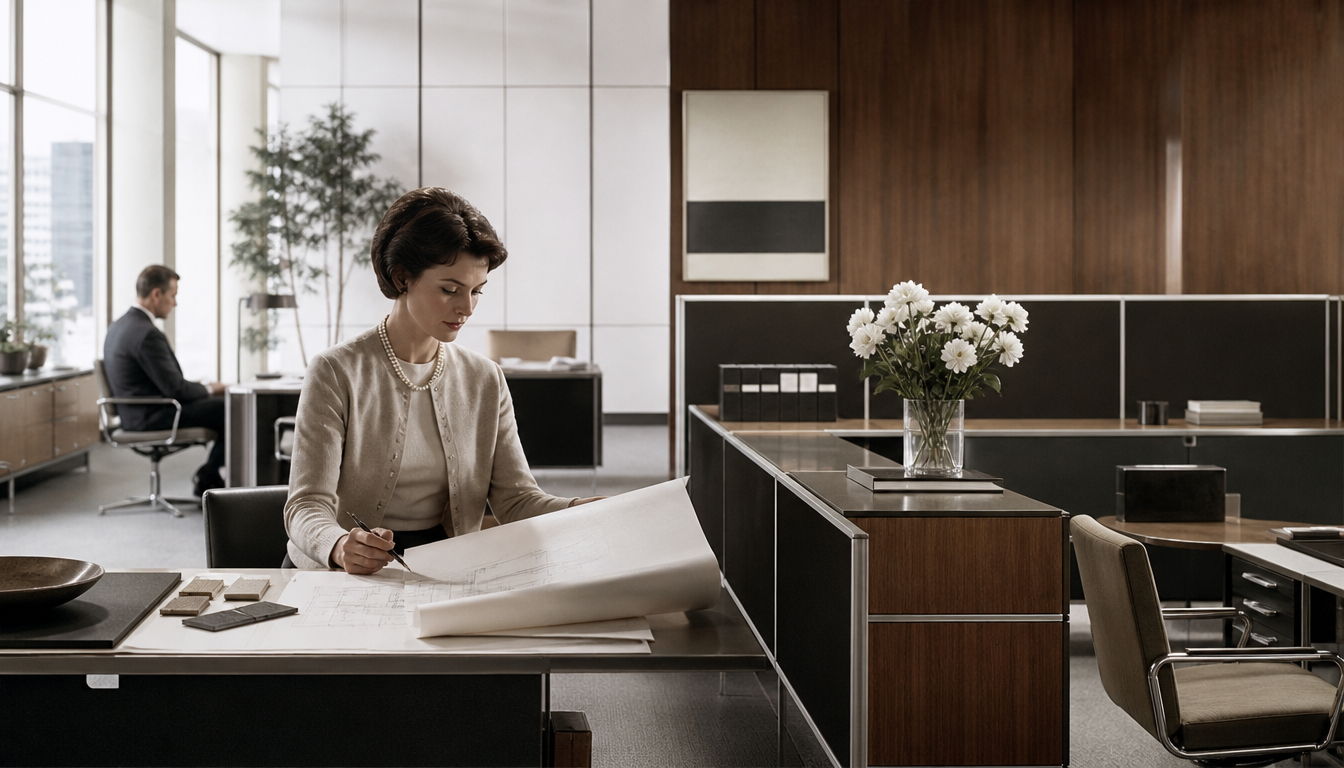
Florence Knoll set the standard for modern corporate interiors in post-war America with the Knoll Planning Unit starting in 1941 – major clients such as IBM, GM, and CBS entrusted their modular office concept to her team. Before Florence Knoll turned the design world upside down, the office was a chaotic jumble of bulky furniture with no system. Her method was radically different: before each project, the Planning Unit analyzed the client’s structures and workflows before a single chair was placed. Influenced by Bauhaus legend Mies van der Rohe and having grown up at the Cranbrook Academy, she brought architectural thinking into the office. The result is spaces whose impact is still felt today.
Knoll Planning Unit: How Florence Knoll Reinvented the American Office
Key Fact: Florence Knoll set the standard for modern corporate interiors in post-war America with the Knoll Planning Unit – not through decoration, but through uncompromising space creation. Her words on the matter were clear: “She did not merely decorate space. She created it.”
From the Cranbrook Campus to the Executive Suite
Florence Knoll’s path to becoming America’s most influential office designer begins at the Cranbrook Academy of Art. The architect Eliel Saarinen noticed her talent after the Kingswood School for Girls and brought her into his circle. There she studied side by side with Harry Bertoia as well as Ray and Charles Eames. Her understanding of form was further shaped by the Bauhaus tradition, above all by Ludwig Mies van der Rohe, who, according to Corporate Environments, gave her a “methodical and thorough approach to design.”
In 1941 she joined Knoll. What followed was not a gradual shift, but a systemic break.
The Planning Unit: Analysis Before Aesthetics
Florence Knoll founded the Knoll Planning Unit as a kind of design laboratory with a scientific ambition. Before a single chair was placed, the team systematically studied every client: needs assessment, usage patterns, corporate hierarchies. Only then came a comprehensive design concept built on the principles of modernism and consistently executed in the Knoll style.
This sounds obvious today. In 1945 it was a revolution.
The Planning Unit’s clients included IBM, General Motors, and CBS – some of the largest American corporations of the time. The Scandinavian functionalism that Knoll had brought from the Bauhaus tradition and the Saarinen environment met American pragmatism. The result was a distinctive, clearly recognizable style: open space planning, efficient furniture systems, and a consistent formal language.
1955 to 1965: Leadership Through Uncertain Years
Following the death of Hans Knoll in 1955, Florence Knoll took over the company’s leadership as president. In 1960 she stepped down from that role and focused on design development. In 1965 – after her marriage to Harry Hood Bassett in 1957, she was known as Florence Knoll Bassett – she retired. Her influence on the aesthetics of the American corporate office and on the rise of modernism in the United States is considered immeasurable, according to Knoll.
4 Practical Inspirations for You
1. Think Function and Form Together Knoll did not plan from the furniture outward, but from the space and its use. This principle applies to private living spaces too: clarify the need first, then furnish. What kind of wall design suits your everyday life? Our poster shop offers motifs ranging from Bauhaus to botanics that can be oriented around spatial concepts.
2. Geometry as a Design Tool The Knoll aesthetic thrived on clean forms and modular structures. Anyone looking to bring this look into their living room can work with geometric wall objects. The Bauhaus Hexagon Picture or the MCM Alu Hexagon draw directly on this tradition.
3. Use Bauhaus References Deliberately Florence Knoll learned from the masters of the Bauhaus. Those who appreciate this aesthetic will find direct historical references for the wall in the Bauhaus Exhibition Poster or the Bauhaus Art School Advertising Poster.
4. Desk and Workspace as an Integrated Concept The Planning Unit conceived the workplace as a whole. A home office also benefits from details that work together. A Kandinsky Mouse Pad or the Bauhaus Style Decorative Cushion fit into a thoughtfully designed environment without being intrusive. You can find the current shipping overview under Shipping.
Sources
FAQ
Who was Florence Knoll and how did she come to the Knoll Planning Unit?
Florence Knoll grew up with an unusually dense network of connections to the design world. After the Kingswood School for Girls, she caught the eye of the architect Eliel Saarinen, who brought her to the Cranbrook Academy of Art. There she studied side by side with Harry Bertoia as well as Ray and Charles Eames. Her methodical design thinking was shaped above all by Ludwig Mies van der Rohe. In 1941 she joined Knoll and founded the Knoll Planning Unit there, which was to redefine the American post-war office from the ground up.
What exactly made the Knoll Planning Unit different from anything that came before?
The Unit worked like an architecture firm, not a furniture store. Every commission began with a thorough analysis: what are the company’s workflows, how are hierarchies structured, who needs how much space? Only then was a comprehensive design concept developed based on modernist principles. Florence Knoll insisted: she did not decorate a space, she created it. Cluttered, fragmented office layouts were replaced by clear, functional space planning.
Which companies did the Knoll Planning Unit work for, and why were these such pioneering projects?
The Planning Unit designed interiors for some of the largest corporations in the United States, including IBM, General Motors, and CBS. These projects were pioneering because they demonstrated for the first time that a well-conceived spatial concept could be developed directly from a company’s own work processes. Aesthetics followed function, and the result set the visual standard for the modern corporate office in the post-war era.
What role did Florence Knoll play after the death of Hans Knoll in 1955?
Following the tragic death of her husband Hans Knoll in 1955, Florence Knoll took over the company’s leadership as president and steered Knoll through an uncertain period. In 1960 she stepped down from the presidency to focus entirely on leading design and development. In 1965, after some two decades during which she had shaped an entire industry, Florence Knoll Bassett – as she was known following her second marriage in 1957 – withdrew from the company.
How does the influence of the Knoll Planning Unit continue to resonate today?
The core principles that Florence Knoll established in the Knoll Planning Unit are today a firmly established part of modern office planning: systematic needs analysis, efficiency in spatial layout, and a holistic design approach that thinks architecture, furniture, and use together. Her influence is visible wherever an office is not simply furnished but is consciously conceived as a working space.
This article was generated automatically by an AI system. Disclosure pursuant to Article 50 of the EU AI Act.