
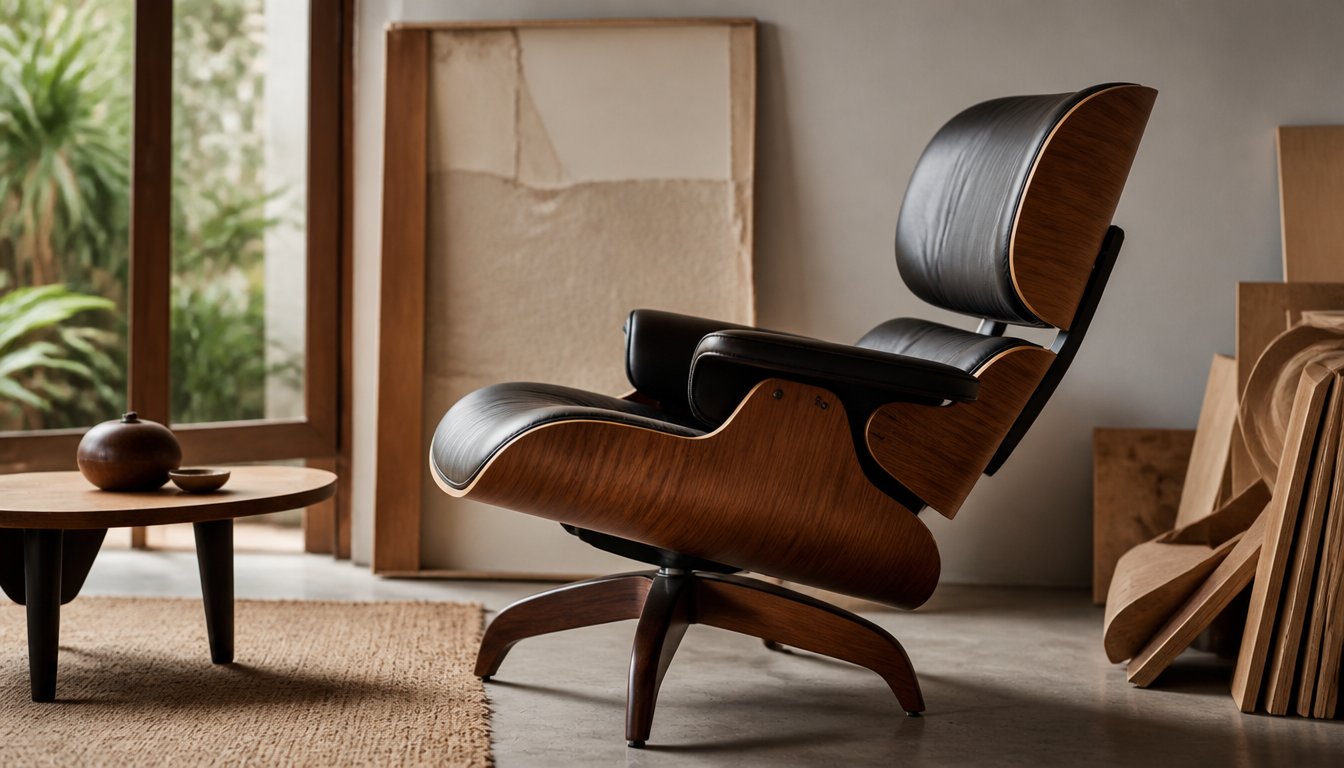
The Eames Lounge Chair Wood (LCW), designed in 1946 by Charles and Ray Eames, was named “Best Design of the 20th Century” by Time Magazine and still uses the same molded plywood technique the duo developed in the early 1940s. Two curved plywood shells, no upholstery, zero frills. The LCW shows how organic shaping can create genuine seating comfort from a hard material. If you want to understand why vintage design still feels so powerful today, here is the blueprint: honest materials, rigorous technique, timeless curves.
Eames Plywood Lounge Chair: How Plywood Reinvented Modernism in 1946
Time Magazine named the Eames Lounge Chair Wood (LCW) the “Best Design of the 20th Century”. That verdict is no marketing slogan — it is a judgment grounded in solid design history. What Charles and Ray Eames presented in 1946 was not simply a comfortable chair. It was the result of years of experimentation with a technique that was barely mastered at the time: the three-dimensional molding of plywood.
How the LCW Came to Be
The story of the LCW begins earlier than 1946. As far back as 1940, Charles Eames and his colleague Eero Saarinen entered — and won — the Museum of Modern Art’s “Organic Design in Home Furnishings” competition. Nothing was produced at the time. The United States’ entry into the Second World War put the furniture plans on ice, and Saarinen, frustrated, withdrew from the project.
Charles and Ray Eames moved to Venice Beach, Los Angeles in 1941. Charles worked as a set painter at MGM Studios, while Ray, trained as a painter and sculptor, continued the experiments with molded plywood. The wartime period paradoxically provided a technical boost: the forming processes they developed found military applications, while simultaneously sharpening the couple’s craft expertise.
The result of this long development is a chair made of just two pieces of molded plywood. Seat and back are pressed from five-ply plywood, the legs and back brace from eight-ply. Rubber shock mounts connect the parts and decouple them acoustically and mechanically. The gentle curvature is created not by padding, but by the form itself.
What This Means for You as a Consumer
1. Material is not an end in itself. The Eameses called their principle “honest materials”: a chair should not conceal what it is made of. Plywood is plywood. When buying furniture or home décor today, you can take this idea as your guide. Visible material honesty is not a drawback — it is often a mark of thoughtful design.
2. Ergonomics through form, not filling. The LCW needs no upholstery. The curvature of the plywood performs the body-conforming function. This remains a useful benchmark today: good design does not need thick padding to work.
3. Longevity is plannable. The current LCW is made to order by Herman Miller in the USA, weighs around 9 kg and comes with a five-year guarantee. The dimensions (25 × 21.65 × 26.38 inches) and material composition are openly stated. Transparent product data helps make informed purchasing decisions — whether for a chair or a wall print.
4. Design icons shape entire decades. What was achieved with plywood in 1946 set a standard for organic furniture design that runs through the entire post-war modern era. Anyone wanting to furnish an interior with a similar sensibility — clean forms, visible materials, no cluttered decoration — will also find inspiration in art prints and wall art from the Bauhaus era. Our Bauhaus Ausstellung Poster or the Kandinsky Poster Gelb Blau Rot are stylistically well suited to an interior aligned with the principles of organic modernism.
A Chair That Reached the Museum
The LCW is today on display at the Honolulu Museum of Art. For a piece of everyday furniture, that is no small thing. It shows that the piece broke down the boundary between applied art and everyday design early on. Furnishing your home with objects that embody this spirit means choosing things that endure — not objects that only work for a moment.
For wall art in the same spirit, it is worth browsing our Poster Shop or heading straight to the Bauhaus Hexagon Pictures. If you prefer something a little more playful while still holding the line of modernism, the MCM Alu Hexagon Wall Décor is also a fitting complement.
Sources
- Eames Molded Plywood Lounge Chair with Wood Base – Eames Office
- Eames Lounge Chair Wood – Wikipedia
- Eames Molded Plywood Side Chair – Herman Miller
FAQ
When was the Eames Lounge Chair Wood (LCW) designed and who is behind it?
The LCW was designed in 1946 by Charles and Ray Eames. The duo worked out of their Eames Office and developed plywood-molding techniques they had already been experimenting with before and during the Second World War. Ray, a trained painter and sculptor, was instrumental in driving the experiments with molded plywood forward, while Charles spearheaded the hands-on fabrication.
What makes the plywood molding in the LCW so special?
In the early 1940s, Charles and Ray Eames developed a method for pressing thin layers of plywood into three-dimensional curved forms. The LCW uses two separate pieces of molded plywood: a seat and a backrest, each five-ply. The legs and back brace are made from eight-ply plywood. Rubber mounts between the parts absorb movement and enhance seating comfort. The result is a hard material that feels body-conforming thanks to its curves.
What was the competition that influenced the development of the LCW?
In 1940, Charles Eames and architect Eero Saarinen jointly submitted a furniture group to the Museum of Modern Art’s “Organic Design in Home Furnishings” competition. They won. However, actual production was delayed by technical difficulties and then by the United States’ entry into the Second World War. Saarinen withdrew from the project out of frustration over the production problems.
What materials and finishes are available for the original LCW?
The LCW is still manufactured today by Herman Miller in the USA and is available in several wood variants: Walnut, Red-Stained Ash, Black-Stained Ash, Santos Palisander, White Ash and White Oak, as well as Deep Yellow. Seat and back are five-ply, while the legs and back brace are eight-ply. The rubber mounts between the components are also part of the original.
What awards has the LCW received and where can it be seen today?
Time Magazine declared the LCW the “Best Design of the 20th Century”. An example of the chair is today on display at the Honolulu Museum of Art. The chair is considered one of the most prominent examples of post-war organic modernism and, according to the Eames Office, laid the foundation for many subsequent developments in modern design.
This article was generated automatically by an AI system. Disclosure pursuant to Article 50 of the EU AI Act.