
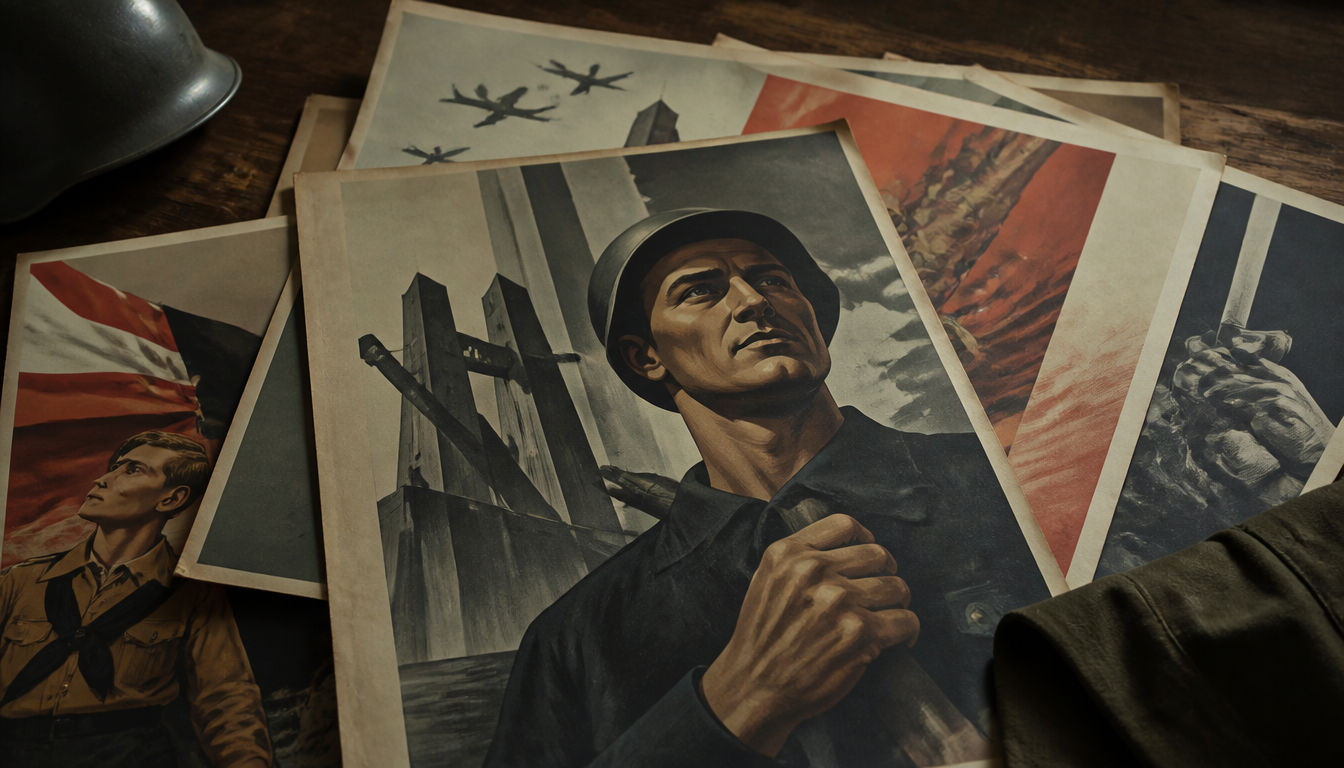
From 1936, membership in the Hitler Youth was compulsory. Propaganda posters such as “Youth Serves the Führer” (1940) drove this mobilisation forward. Reich Propaganda Minister Goebbels asked rhetorically in 1935: “Is propaganda, as we understand it, not also a form of art?” Over 1,000 Nazi posters from the wartime period (1939–1945) are held in the German Federal Archives alone. Art historian Sylke Wunderlich demonstrates in “Propaganda of Terror” that the deliberate use of visual language and design played a decisive role in inscribing ideology into everyday life. Understanding how visual design became a weapon helps us recognise more quickly today when aesthetics are being used for manipulation.
Wartime Poster Art: German Posters 1933–1945 between Propaganda and Design
The National Socialist regime used poster art as a central instrument of mass control. Reich Propaganda Minister Joseph Goebbels asked rhetorically in June 1935: “Is propaganda, as we understand it, not also a form of art?” By that point, the National Socialists had already held power for nearly two and a half years and had long since laid the design foundations of their propaganda machinery.
How the Poster Became a Weapon
Adolf Hitler drove military rearmament forward while simultaneously ensuring that the civilian population remained ideologically engaged. While new tanks, aircraft and submarines were being built, people on the home front saw propaganda posters quite literally everywhere. Sylke Wunderlich’s book Propaganda of Terror (with over 200 illustrations) shows how the artistic style of these posters was decisive in making the messages effective.
The posters served far more purposes than mere electoral advertising. They were meant to mobilise, intimidate and enforce a unified worldview. A 1940 poster, for example, bore the text: “Youth Serves the Führer. All Ten-Year-Olds into the Hitler Youth.” Membership in the Hitler Youth had been compulsory since 1936. Another poster from the same year, whose text referenced Heinrich von Kleist’s Prince of Homburg, read in essence: “Into the dust with all the enemies of Greater Germany!” According to German mood reports of the time, it was rated as particularly effective.
The German Federal Archives now holds over a thousand of these posters, accessible online. Further collections are held at the University of California and the University of Minnesota.
What You as a Poster Fan Can Take Away Today
1. Design Is Never Neutral
Most importantly: every poster conveys an attitude. Nazi propaganda deliberately used clear forms, strong contrasts and emotional imagery to manipulate viewers. Those who collect or display poster art today would do well to ask what message a motif carries and why certain design techniques are so powerful. Historical awareness when dealing with poster art is not a luxury, but a prerequisite.
2. The Sachplakat Has a Long — and Dark — History
The “Sachplakat” as a style — reduced to the essentials and working with clear flat areas — emerged in early 20th-century Germany. The National Socialists adopted and instrumentalised this aesthetic for their own purposes. Anyone wishing to understand the history of German poster design cannot avoid this chapter. For comparison, it is worth looking at the free, humane graphic design of the Bauhaus era: the Bauhaus Exhibition Poster or the Bauhaus Advertising Poster of the School of Art show how the same era also took entirely different design paths.
3. Classic Sachplakat Aesthetics Live On Today in Harmless Contexts
The reduced visual language that propaganda employed can be found today in many retro and vintage posters, without ideological baggage. Those who appreciate the clean, flat style of the interwar period will find motifs at reetro that draw on this aesthetic without trivialising history — for example the Bauhaus Sun Poster or the Kandinsky Poster in Yellow, Blue, Red. The Hohlwein Poster Zoologischer Garten also recalls Ludwig Hohlwein, one of the most influential German poster artists of the period, who later also worked for Nazi propaganda.
4. Historic Film Posters as a Counter-Model
Anyone wishing to contextualise poster art from the 1933–1945 era can deliberately set it against historical counter-models. Classic Hollywood cinema posters from the same period worked with similar means, but for entertainment rather than oppression. The Charlie Chaplin Cinema Poster or the Classic Retro Cinema Poster make this contrast tangible. Discover more vintage posters in our Poster Shop.
Sources
- How the Nazis used poster art as propaganda – Deutsche Welle
- Nazi Posters 1939–1945 – German Propaganda Archive, Calvin University
- German History in Documents and Images (GHDI) – German Historical Institute, Washington DC
FAQ
What does art have to do with Nazi propaganda?
Joseph Goebbels, Reich Minister of Public Enlightenment and Propaganda, posed precisely this question publicly in June 1935: ‘Is propaganda, as we understand it, not also a form of art?’ The answer was already embedded in practice. The National Socialists deployed poster design deliberately as a political tool, and the artistic style of the posters contributed significantly to their impact, according to author Sylke Wunderlich in her book ‘Propaganda of Terror’.
What role did propaganda posters play on the home front?
While the Wehrmacht was being rearmed with tanks, aircraft and submarines, the civilian population on the home front was targeted through multiple channels simultaneously: newsreels in cinemas, continuous broadcasts on the radio, and propaganda posters that were omnipresent. The posters therefore served far more than an electoral purpose. They were an active instrument of war mobilisation and social control.
What content did German wartime posters show between 1939 and 1945?
The range was wide. A 1940 poster shows the text ‘Youth Serves the Führer. All Ten-Year-Olds into the Hitler Youth.’ Membership in the Hitler Youth had already been compulsory since 1936. Another summer poster from 1940 carried the slogan ‘Smash the Enemies of Greater Germany’ and referenced Heinrich von Kleist’s ‘Prince Friedrich of Homburg’. According to German mood reports of the time, this poster was rated as particularly effective.
Where can I legitimately view historic Nazi posters from this period today?
Several academic institutions make digitised holdings available. The Federal Archives in Germany holds over a thousand posters online. The University of California Library has nearly 300 digitised examples, and the University of Minnesota holds a further extensive collection. Many holdings were photographically documented by Dr. Robert D. Brooks. The documents are also academically processed through German History in Documents and Images (GHDI), an initiative of the German Historical Institute in Washington D.C.
Is there solid academic literature on Nazi propaganda posters?
Yes. Sylke Wunderlich’s book ‘Propaganda of Terror’ is considered one of the most comprehensive analyses. It contains over 200 illustrations and examines the tension between art and ideology. Wunderlich concludes that the design style of the posters was decisive in their propagandistic impact. In addition, GHDI — produced in cooperation with the Deutsche Forschungsgemeinschaft, the ZEIT-Stiftung and the Max Kade Foundation — provides a broad corpus of primary sources on the Nazi era online.
This article was generated automatically by an AI system. Disclosure pursuant to Article 50 of the EU AI Act.