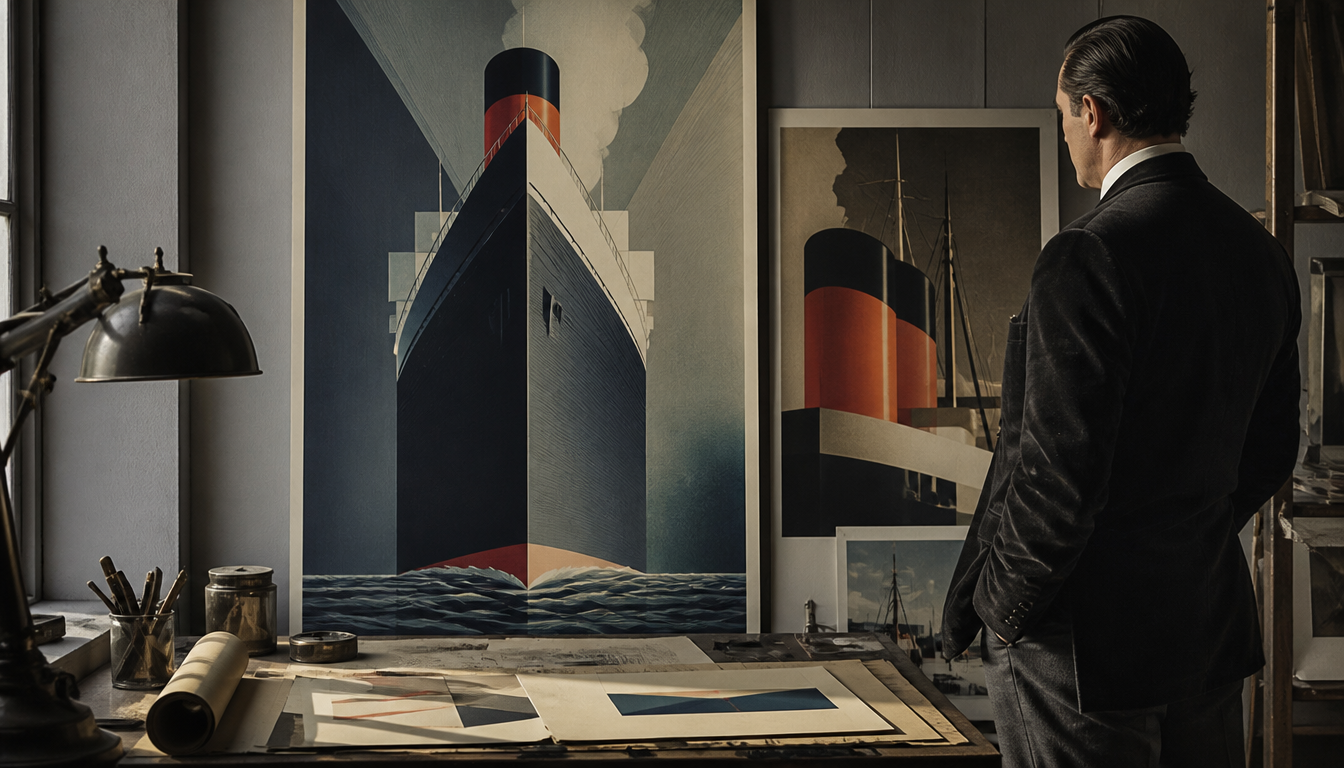
A.M. Cassandre’s 1935 Normandie poster is considered his most iconic work by the Victoria & Albert Museum, depicting the bow view of what was then the world’s largest superliner, which completed 139 transatlantic crossings in just four years. The poster is today held at MoMA and the V&A, making visible how closely Art Deco graphic design and engineering culture of the 1930s were intertwined. Cassandre developed a visual language that translated avant-garde art directly into mass media. Anyone who wants to understand how design once represented entire nations cannot overlook this image: the Normandie was France’s floating state emblem, financed with government support in the midst of the Great Depression, and its poster is the lasting document of that ambition.
A.M. Cassandre and the Normandie: How a Poster Became an Icon of Art Deco
Key fact: The Normandie poster by A.M. Cassandre from 1935 is considered by the Victoria & Albert Museum to be the graphic designer’s most iconic work and the most famous single image of the ocean liner ever created.
The Bow That Said It All
Adolphe Mouron, who worked under the pseudonym Cassandre (1901–1968), created a poster in 1935 for the Compagnie Générale Transatlantique that continues to appear in design textbooks to this day. The visual solution is deceptively simple: a frontal view of the ship’s powerful bow, symmetrical, monumental, in black, white and red against a blue sky and green sea. It was precisely this simplicity that conveyed the sheer size and streamlined elegance of the Normandie instantly and without explanation.
The SS Normandie was, in 1935, the largest superliner ever built. The piers had to be specially extended to accommodate her. The ship was conceived as a showcase of French Art Deco design and technological prowess, financed with substantial government support during the Great Depression. Artists such as Jean Dupas, René Lalique, Jean Dunand and Émile-Jacques Ruhlmann contributed to the interiors. On her maiden voyage on 29 May 1935, the Normandie won the Blue Riband for the fastest Atlantic crossing.
Cassandre had previously developed a visual language influenced by the Parisian avant-garde. MoMA in New York acquired the poster for its collection in the very year it was created (accession number 288.1935). The V&A in London describes his style as a frontal view that conveys gigantic scale through symmetry and reduction, and counts Cassandre among the most significant graphic designers of the 20th century.
The Normandie completed a total of 139 transatlantic crossings before being laid up in the port of New York on 28 August 1939 with the outbreak of the Second World War. Her years of service were brief; her visual legacy is not.
What This Means for You: 4 Practical Insights
1. Vintage Posters as Wall Objects Work Through Reduction
Cassandre’s strength lay in condensing complex subjects into a single, clear image. Those looking for vintage or Art Deco wall décor today will find the most timeless option in a reduced, symmetrical style. Interwar posters work even in modern spaces because they need no explanation. In our Poster Shop you’ll find wall art that follows the same design principles, such as the Retro Travel Poster Hong Kong or the Hot Air Balloon Poster Le Tricolore in French style.
2. Art Deco Lives on Strong Contrasts and Clean Lines
The Normandie poster works with hard contrasts: dark hull, bright sky, red lettering. This principle can be applied to many wall formats. Those opting for canvas will find motifs with similar graphic clarity in the Vienna Canvas Vintage Print or the Paris Canvas Retro Style.
3. The Bauhaus Principle “Form Follows Function” Met Cassandre’s Approach
Cassandre developed his visual language in parallel with the German Bauhaus movement. Both currents emphasised geometry, legibility and the rejection of unnecessary ornament. If this design context interests you, take a look at the Bauhaus Exhibition Poster or the Bauhaus Sun Poster, which stand directly in this tradition. As a decorative accessory in the same spirit, the Bauhaus Style Decorative Cushion makes a great companion.
4. 1930s Travel Posters as a Room Concept
The Normandie stood for wanderlust, speed and prestige. Travel posters of that era didn’t sell tickets – they sold a way of life. Those who want to furnish their room or office with this flair can combine, for example, the Porto Constantino Jean Dylen Poster or the Retro Travel Poster India. A full overview of travel motifs is available in the Shop.
Sources
- A.M. Cassandre & the SS Normandie, Swann Galleries
- Normandie | Cassandre | V&A Explore The Collections
- A. M. Cassandre. Normandie. 1935 | MoMA
FAQ
Who was A.M. Cassandre and why is he considered a legend of graphic design?
Cassandre, born Adolphe Mouron (1901–1968), is counted among the most significant graphic designers of the 20th century. He developed a distinctive visual language inspired by the avant-garde art scene in Paris, combining geometric rigour with emotional impact. His posters are today held in collections such as MoMA in New York and the Victoria & Albert Museum in London.
What makes the 1935 Normandie poster so special?
Cassandre chose a frontal perspective on the ship’s powerful bow, making the Normandie’s gigantic scale and streamlined elegance immediately perceptible at a glance. The plain symmetry and deliberate use of black, white, red and blue make the work arguably the most iconic image of the ocean liner ever created. The V&A London describes it as the most famous single image of the Normandie worldwide.
Who commissioned the poster and in what context did it appear?
The poster was created in 1935 on commission from the Compagnie Générale Transatlantique, the French shipping company that operated the Normandie. It was printed as a colour lithograph on paper by Alliance Graphique L. Danel. The Normandie entered regular service in 1935 and, on her maiden voyage on 29 May 1935, already claimed the Blue Riband for the fastest Atlantic crossing.
What did the SS Normandie embody in the context of Art Deco?
The Normandie was conceived as a floating showcase of French art and engineering. Artists such as Jean Dupas, René Lalique, Jean Dunand and Emile Jacques Ruhlmann designed the interiors. At the time of her construction, the ship was the largest superliner in the world, and harbour piers had to be specially extended to accommodate her. The French government had to provide substantial funds during the Great Depression to complete the build at all.
How long did the Normandie actually sail and what became of her?
The Normandie was in service for only four years, completing a total of 139 transatlantic crossings. On 28 August 1939, with the outbreak of the Second World War, she was laid up in the port of New York. Her end came far sooner than her spectacular debut as a proud symbol of France might have suggested. Cassandre’s poster outlived the ship and remains today the lasting visual memory of that brief, glamorous era.
This article was generated automatically by an AI system. Disclosure pursuant to Article 50 of the EU AI Act.