
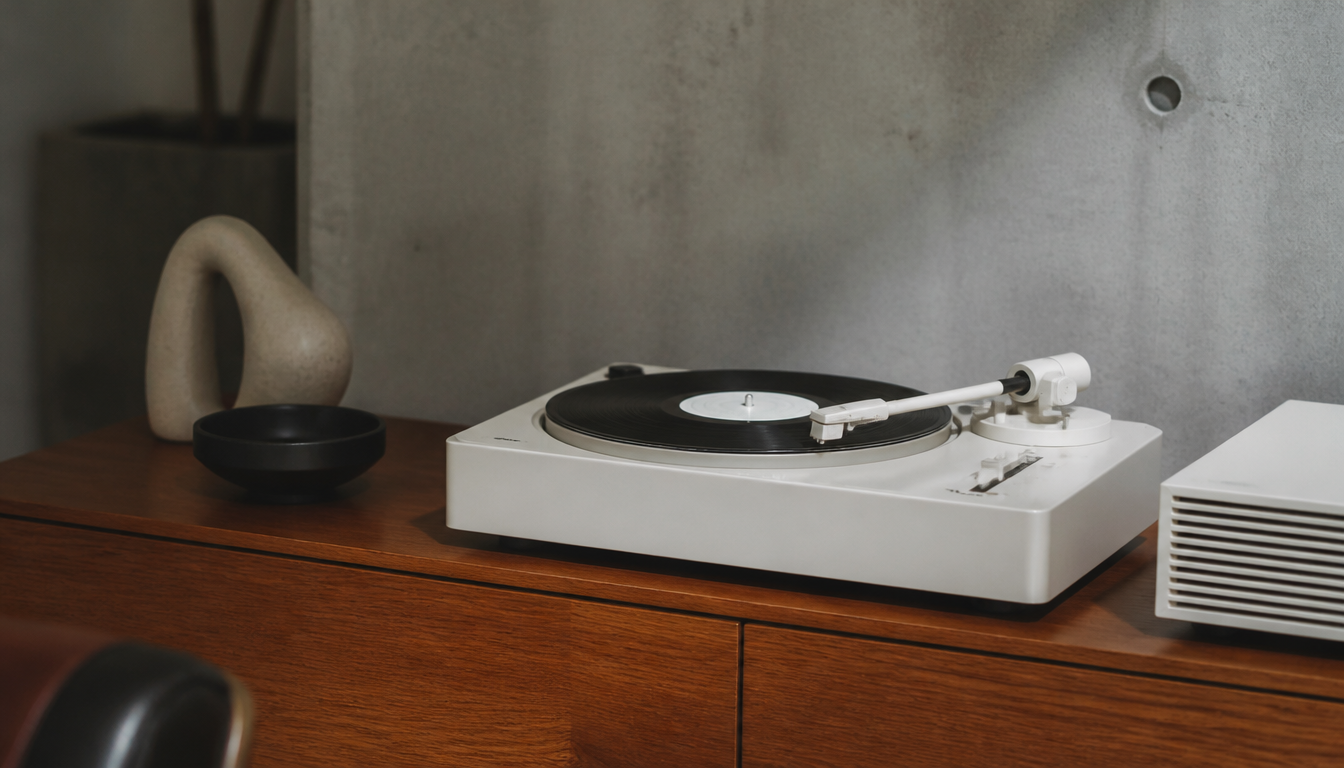
In 1956, Hans Gugelot and Dieter Rams presented the “Phonosuper SK 4” for Braun AG: a radio-record player combination device made of lacquered metal, wood, and a then entirely novel acrylic glass lid, today archived at MoMA under inventory number 205.1958 as a design icon. The SK 4, affectionately nicknamed “Snow White’s Coffin”, redefined what an everyday object could be: no longer a bulky music cabinet, but a reduced, functional sculpture measuring just 24.1 x 58.4 x 29.2 cm. Its transparent lid, originally born out of necessity because sheet metal rattled at high volume, became an icon of functionalism. Anyone who wants to understand today why Rams’ design language shaped the entire consumer goods industry right through to modern tech products will find the answer in this one device from Frankfurt.
Braun SK4: When Hans Gugelot and Dieter Rams Reinvented the Record Player
In 1956, Braun AG from Frankfurt introduced a radio-phonograph combination device that turned the world of consumer electronics upside down. The “Phonosuper SK 4”, designed by Hans Gugelot and Dieter Rams, housed a tube radio and record player together in a flat enclosure made of lacquered metal, wood, and plastic. Dimensions: 24.1 x 58.4 x 29.2 cm. No embellishments, no veneer pomp. Today, an example stands in MoMA in New York.
”Snow White’s Coffin” Instead of a Music Cabinet
People called it “Snow White’s Coffin”, and that was quite intended as a compliment. The white metal body and transparent acrylic glass lid looked like an object from another era at the time. Because that’s exactly what it was.
In the early 1950s, Artur and Erwin Braun, the sons of company founder Max Braun, decided to fundamentally renew the company’s design programme. They established a dedicated design department with a clear mandate: clean, functional products. The SK 4 was one of the first results of this new approach.
Gugelot and Rams had originally planned a metal lid. The problem: it rattled at higher volumes. Rams proposed an acrylic glass lid as the solution. A novelty for consumer devices of this kind. The transparent material became the device’s trademark and simultaneously a precursor to modern product design.
What the SK 4 Really Meant
The SK 4 was not simply a pretty device. It marked a break. Where contemporary music furniture was staged as decorative cabinets, the SK 4 presented itself as a technical object that openly displayed its function. The acrylic glass cover made the mechanism visible rather than concealing it.
MoMA describes the SK 4 in its collection as follows: The careful refinement of compact, plain designs secured Braun’s success in the post-war consumer electronics market and became a model for many competitors.
Max Braun had already combined radio and record player in the late 1930s with the “Phono Super 6740W”, though serial production remained limited at the time. The SK 4 built on this idea and brought it to a consistent conclusion.
4 Practical Implications for Consumers
1. Timeless Design Language as a Purchasing Argument Anyone who understands the SK 4 or its design philosophy buys objects differently. The question is no longer “does it look nice?”, but “does the form make sense from the function?”. This is a filter that can be applied to many purchasing decisions, from kitchen appliances to wall décor.
2. Material Quality Is Visible The combination of lacquered metal, wood, and robust plastic in the SK 4 was not solely an aesthetic decision — it was also a quality signal. Transparency in the literal sense: you can see what the device is. With vintage decorative objects, it’s worth applying the same principle.
3. Design History as a Source of Inspiration for Your Own Interior The Bauhaus-adjacent functionalism of Rams and Gugelot can also be carried forward into interior design. Clean lines, a reduced colour palette, deliberate material choices. Those who like this style will also find points of connection in modern wall objects, for example in the Bauhaus Hexagon Picture or the Bauhaus Exhibition Poster.
4. Vintage Objects Belong on the Wall, Not Just on the Shelf The SK 4 stands in MoMA today. That shows how seriously design history is taken. Those who want to design spaces with similar ambition will find at reetro vintage-style posters and canvas prints that convey the same attitude: form follows content.
Related Pieces at reetro
If the reduced formal vocabulary of the SK 4 appeals to you, you might also be interested in the Kandinsky Poster in Yellow-Blue-Red — a classic of constructivist visual language. Or the Bauhaus Advertising Poster of the School of Art, which leads directly into the origins of this design philosophy. For desks with character, there is the Kandinsky Mouse Pad with Abstract Forms.
You can find all products in the reetro shop.
Sources
- Braun SK4 Turntable – Kelley Byrne Blog
- Dieter Rams, Hans Gugelot: Radio-Phonograph (model SK 4/10), 1956 – MoMA
- The Braun SK Series Radiogramophones: A Landmark in Domestic Audio Equipment – Encyclopedia Design
FAQ
Who actually designed the Braun SK4?
The duo Hans Gugelot and Dieter Rams designed the Phonosuper SK 4 in 1956 for Braun AG from Frankfurt. Rams was still relatively new to the company at the time, and the SK4 was among the first products to publicly embody Braun’s entirely new design philosophy. A true origin moment in design history.
What makes the SK4 technically and materially special?
The Phonosuper SK 4 combines a tube radio and a record player in a single, flat enclosure made of lacquered metal and wood. What truly set it apart at the time: the transparent lid made of acrylic glass, also known today as Plexiglas. This was absolutely unusual for a consumer product of that era. Originally, a sheet metal lid was planned, but it began to rattle at higher volumes. Rams then proposed the acrylic glass solution.
Where does the nickname 'Snow White's Coffin' come from?
MoMA in New York, which holds an example of the SK4 in its collection, describes the nickname as follows: the white metal housing combined with the transparent lid reminded people of the glass coffin from the fairy tale. ‘Snow White’s Coffin’ is the English term for it. The nickname is affectionate and captures the appearance of the device quite well.
How large is the SK4, and where can it be seen today?
MoMA in New York owns an original of the model SK 4/10 from 1956, and its dimensions are documented: 24.1 x 58.4 x 29.2 cm. The device is therefore remarkably compact and flat for its time. MoMA received it as a gift from the manufacturer Braun AG. It bears the object number 205.1958 and was last on display in the exhibition ‘Making Music Modern’ from 2014 to 2016.
Why is the SK4 considered a milestone in design history?
Before the SK4, bulky music cabinets dominated living rooms. Braun, Hans Gugelot, and Dieter Rams broke with this tradition in 1956 through a sober, functional, and formally reduced enclosure. The idea of combining radio and record player in a compact, clearly designed housing was already present in Max Braun’s Phono Super 6740W in the late 1930s, but the SK4 brought it to design-historical maturity. The device became a model for many competitors and is still considered a reference point of functionalism today.
This article was generated automatically by an AI system. Disclosure pursuant to Article 50 of the EU AI Act.