
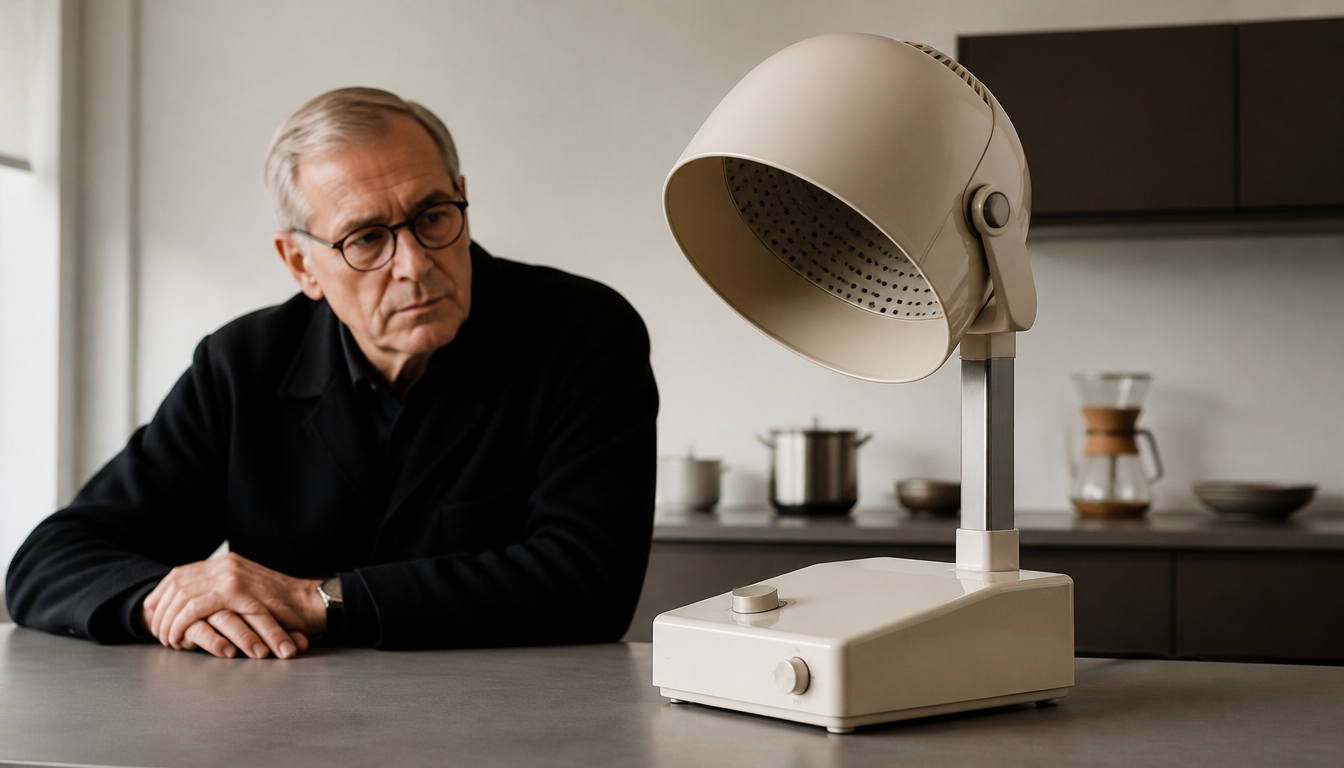
The Braun HLD4 hair dryer was released in 1970 and designed by Dieter Rams, who served as Chief Design Officer at Braun from 1961 to 1995. Rams’ design philosophy of “less but better” shaped an entire era: the HLD4 demonstrates how uncompromising minimalism can transform a simple household appliance into a timeless design object. Anyone who collects vintage products today or has a passion for honest craftsmanship will instantly understand, at first glance at the HLD4, why this approach has lost none of its appeal to this day.
Braun HLD4: How Dieter Rams Reinvented the Hair Dryer in 1970
The Braun HLD4, designed by Dieter Rams in 1970, is one of the most stylistically defining everyday appliances in German design history. What sounds like a simple household device is, in reality, a manifesto in plastic: functional, reduced, timeless.
The Key Fact: “Less but Better” as a Product Philosophy
Dieter Rams served as Chief Design Officer at Braun from 1961 to 1995. During this time, he developed his still-cited “Ten Principles of Good Design”, summarised under the motto “less but better”. The HLD4 is a tangible product of this attitude: no superfluous curves, no decorative elements, only form that follows function.
The HLD4 was released in 1970 and was not the first device in this line. Reinhold Weiss had already designed the HLD2 in 1964, and in 1972 Weiss followed up with the HLD5. The HLD4 thus sits in the middle of a consistent design evolution at Braun, one that took the bathroom shelf just as seriously as the living room shelf.
4 Practical Implications for Consumers
1. Using Design Classics as a Point of Reference
Anyone buying a hair dryer today is overwhelmed by curved handles, chrome strips, and colour gradients. The HLD4 shows that there is another way. Whoever asks themselves “Do I really need this?” before their next purchase is unconsciously aligning with Rams’ design principles. The device has no feature that its form does not justify.
2. Recognising and Appreciating Longevity
Design objects like the HLD4 are sought-after collector’s items today. This is not due to nostalgia alone, but because reduced design does not age. Whoever invests in timeless design — whether in appliances or wall décor — buys less frequently. Our Bauhaus Ausstellung Poster or the Bauhaus Sonne Poster follow the same logic: clear forms that will still work in twenty years.
3. Knowing the Brand History Behind the Product
Braun’s consistent design language during this era was no accident. Reinhold Weiss designed the HLD2 (1964) and the HLD5 (1972), Rams the HLD4 (1970). This was a deliberately managed design process with a clear signature. Anyone buying or collecting vintage Braun appliances should know the model numbers in order to correctly attribute designs.
4. Applying Rams’ Principles to Your Own Home
“Good design is as little design as possible” is not an empty quote. Whoever opts for clean forms when furnishing their home will enjoy them for longer. This applies to appliances just as much as to wall design. A Kandinsky Poster in Yellow, Blue and Red or a Bauhaus Hexagon Picture bring the same reduced energy into a room that Rams put into the HLD4. Those who prefer an even more minimalist approach will find further options in the reetro Shop that draw on design classics.
Sources
- Space Age Design | Braun HLD4, designed by Dieter Rams
- Braun HLD4 Hairdryer 1970 – Mediamatic
- Classic Braun Hairdryers – Salonmonster Blog
FAQ
Who designed the Braun HLD4 and when was it released?
The Braun HLD4 was designed by Dieter Rams, Braun’s Chief Design Officer. The hair dryer was released in 1970 and is a prime example of Rams’ design philosophy: clear, reduced, functional.
What makes the design of the HLD4 so special?
Rams consistently followed his principle of ‘less but better’. The HLD4 dispenses with everything superfluous — every form follows function. Compared to what comes to market as a hair dryer today, it feels almost timeless and surprisingly modern.
How long was Dieter Rams Chief Design Officer at Braun?
Dieter Rams was Chief Design Officer at Braun from 1961 to 1995. During this time, he shaped the brand’s visual identity for decades and formulated his well-known ten principles of good design.
Were there other classic Braun hair dryers from this era?
Yes, the HLD line had some fascinating models. The HLD2 was already designed in 1964 by Reinhold Weiss, and the HLD5 followed in 1972, also by Weiss. A variant of the HLD2 was sold in the United States under the name Gillette Promax.
Are these old Braun hair dryers still relevant today?
Absolutely. Design enthusiasts and vintage aficionados around the world collect classic Braun appliances for exactly this reason: they show how thoughtful and aesthetic everyday devices can be. The HLD4 is proof that good design has no expiry date.
This article was generated automatically by an AI system. Disclosure pursuant to Article 50 of the EU AI Act.