
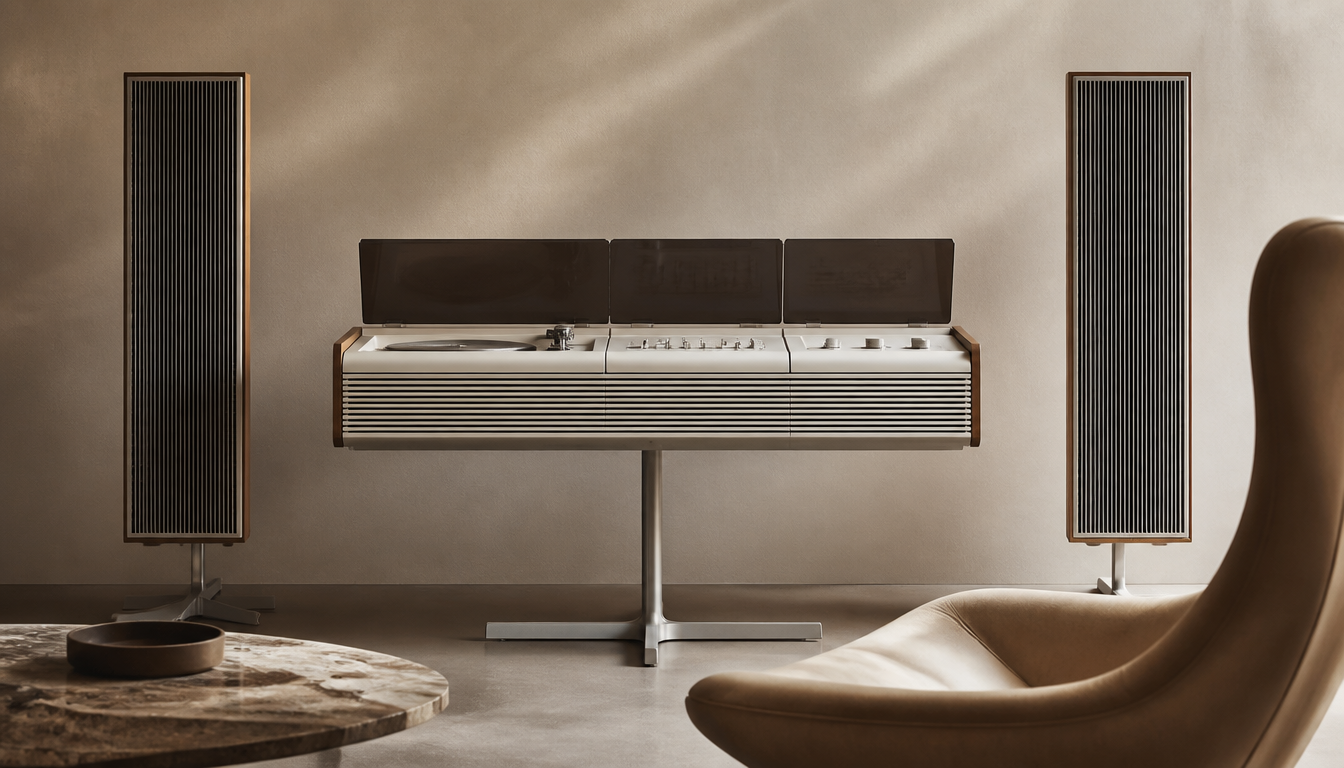
Bang & Olufsen, founded in Denmark in 1925, established a new design language in the HiFi sector from the 1960s onwards with designers such as Jacob Jensen and David Lewis: the Beogram 4000, introduced in 1972, is still considered a cult object among audiophiles and collectors today. If you want to understand why vintage HiFi is so coveted today, there’s no getting around B&O. The Danes were one of the first brands to prove that a turntable can create just as much of a spatial presence as a work of art. Pure aluminium, clean lines, seamless controls: the Beosystem of the 1960s to 1980s defined an aesthetic that consistently brought interior architecture and audio technology together. Anyone who has a Beogram 4000 on their shelf today doesn’t own an old device — they own a piece of design history that shows just how far ahead of their time some ideas were.
Bang & Olufsen Beosystem: Scandinavian Minimalism and the Aesthetics of High-End Audio Design 1960–1980
Key fact: Bang & Olufsen was founded in 1925 by Peter Bang and Svend Olufsen in Denmark. Their first product was a radio that could be powered by alternating current, at a time when most devices still relied on batteries. What came next changed the understanding of audio technology and interior design in equal measure.
Design as an Attitude, Not a Decoration
While many manufacturers in the 1960s and 1970s focused primarily on pure engineering performance, B&O pursued a different approach: music, the Danes believed, is not only experienced with the ears, but also with the eyes and the hands.
With designers such as Jacob Jensen and later David Lewis, the brand developed its own aesthetic language from the 1960s onwards. Clean lines, consistent use of aluminium, seamlessly integrated controls. Every detail was part of a whole that could stand on its own as an object in its own right.
In the 1970s and 1980s, the Beomaster, Beogram and Beovox systems became reference points for the union of technology and design. The turntable Beogram 4000, introduced in 1972, is emblematic of this ambition: a mechanical masterpiece with a tangential tonearm that challenged the standards of its time and today enjoys cult status among audiophiles and collectors.
4 Practical Tips for Consumers
1. Buying vintage B&O devices: pay attention to functional condition Original Beogram and Beomaster devices from the 1970s are available on the second-hand market, but are technically demanding. Belts, tonearm bearings and electronic components age. Anyone buying a device should check in advance whether spare parts and repair expertise are available. Tested units from specialist dealers are more reliable than unchecked private listings.
2. Know the design context: Bauhaus and Scandinavian tradition B&O’s formal language is no accident. It stands in direct lineage with the Bauhaus principle that form and function are inseparable. Anyone who wants to understand the aesthetic background of these devices would do well to look into the Bauhaus movement. Fitting for this: the Bauhaus Ausstellung Poster or the Bauhaus Werbeplakat Kunsthochschule convey this design spirit in your own home too.
3. Take the listening room concept seriously B&O designed its devices not for equipment racks, but for the living space as a total experience. An amplifier should have the effect of a sculpture, a speaker should become an element of the room. This idea can be realised even without a B&O budget: choosing wall décor with a clear, reduced formal language helps to visually frame a coherent listening space. A Scandinavian Pattern Hexagon Wall Art or a Bauhaus Hexagon Picture fits right into this thinking.
4. Modern B&O products: check for continuity The current Beosound Balance was created in collaboration with the design studio Benjamin Hubert (LAYER) and is intended to carry forward the connection between audio technology and interior aesthetics. B&O is today listed on the Nasdaq Copenhagen under the ticker BO B, employs around 1,000 people (as of 2023) and is present in 70 countries. Anyone wishing to buy a modern device should check whether the build quality and design promise live up to the brand’s historical standards, and read comparative reviews before investing.
Why This Aesthetic Is Still Relevant Today
B&O shaped a culture in which high fidelity enters into dialogue with interior architecture. That was a radical idea in the 1970s. It is less so today, but it remains effective. Anyone interested in the intersection of sound, object and space will find in the history of the Beosystem an early and consistent example of the fact that good design knows no compromises between function and appearance.
For those who want to feel this spirit in their own room without tracking down a vintage device: a Bauhaus Sun Poster or a Kandinsky Poster Yellow Blue Red brings the visual DNA of this design era directly to the wall. More options are available in the reetro Poster Shop.
Sources
- Bang & Olufsen – Wikipedia
- Beosound Balance – E-piphany Facebook
- HIFI RETRO – Instagram Reel about B&O history
FAQ
When was Bang & Olufsen founded and what was the brand's first major product?
Bang & Olufsen was founded in 1925 in Denmark by Peter Bang and Svend Olufsen. Their first significant product was a radio that could be powered by alternating current, at a time when most radios still relied on batteries. That was a genuine statement for the era.
Which designers shaped the distinctive look of Bang & Olufsen in the 1960s and 1970s?
Two names to remember: Jacob Jensen and David Lewis. Jensen established a completely new design language from the 1960s onwards, with clean lines, bold use of aluminium and seamlessly integrated controls. Every device was conceived as a coherent total work of art, not merely as a box of technology.
What makes the Beogram 4000 so special, and why is it still considered a cult device today?
The Beogram 4000, introduced in 1972, was a turntable with a tangential tonearm — an arm that guides the stylus parallel to the record groove, exactly as in the original cutting of the record. This was a mechanical feat and technically ahead of its time. Today it is a highly sought-after collector’s item among audiophiles worldwide.
Which product lines were representative of B&O's design philosophy in the 1970s and 1980s?
The Beomaster, Beogram and Beovox systems together formed the heart of the B&O era. Amplifiers, turntables and speakers were conceived as coordinated units in which sonic fidelity and interior design stood as equals. A speaker was meant to look just as good as it sounds.
How does Bang & Olufsen continue this design philosophy today?
With the Beosound Balance, developed in collaboration with Benjamin Hubert’s design studio LAYER, B&O carries the tradition forward: premium materials, Scandinavian formal language and high-performance audio in a single device that fits into the living room just as well as it sounds. The principle has been the same since 1925; the execution stays fresh.
This article was generated automatically by an AI system. Disclosure pursuant to Article 50 of the EU AI Act.