
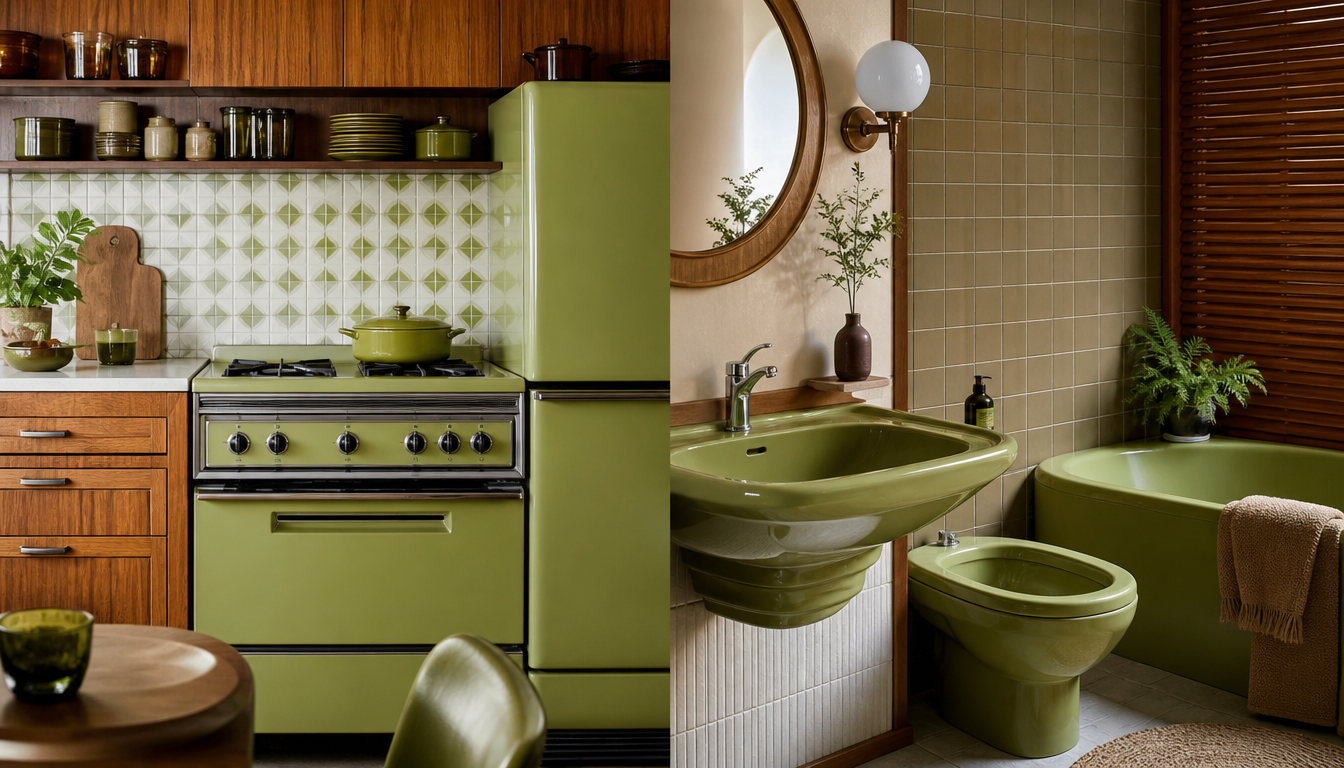
From the late 1960s to the mid-1970s, consumers demanded yellow-green hues in literally everything: ovens, countertops, and bathtubs were produced and sold in avocado green. What today looks like a playful retro joke was, at the time, a hard-hitting mass market. Avocado green was no niche accessory — it defined an entire generation of kitchens and bathrooms. Understanding the roots of this color boom also explains why shades like sage green and mustard yellow flooded hashtags and interior walls again in 2021, according to BBC Culture: color is never just decoration, it is the zeitgeist poured into wall paint.
Avocado Green in Kitchen and Bathroom: How the 1970s Revolutionized Household Colors
From the late 1960s to the mid-1970s, consumers demanded yellow-green hues in literally everything: ovens, countertops, bathtubs. That’s how a retrospective on Medium describes it. This was no coincidence and no bad taste — it was a collective statement.
The Key Fact: A Decade in Green
Avocado green was omnipresent in the late 1960s and early 1970s. According to a report on Medium, the color appeared everywhere from kitchen appliances and work surfaces to bathtubs and toilets. Entire bathrooms and kitchens were fitted out in this yellowish-green shade, which today is considered the epitome of the era. The color was no niche phenomenon — it was mass-market.
What was behind it? Author Kassia St Clair, quoted by BBC Culture, explains it this way: “Color constantly goes in and out of fashion.” But there’s more to it than that: color choices in the home are never purely aesthetic. Color psychologist Karen Haller told BBC Culture: “We never choose a color without meaning. We may not know why we do it.” The avocado green wave was therefore also an emotional expression of its time.
Practical Implications: What You Can Take Away Today
1. Earth Tones Are No Flash in the Pan
BBC Culture reported in May 2021 that muted earth tones were making a comeback, including smoky green and mustard yellow. The hashtags #sagegreen, #mustardyellow, and #avocadogreen ranked among the most used interior topics on Instagram. What dominated kitchens in the 1970s is returning today as a deliberately chosen living style. Anyone opting for greens or earth tones today is part of a long design history.
2. Ceramics and Household Appliances as Trendsetters
In the 1970s, avocado green wasn’t just wall paint. Ovens, refrigerators, bathtubs, and washbasins rolled off the production line in this color. This shows how deeply color trends can permeate product development. Anyone collecting vintage ceramics or retro household appliances today will find this decade a particularly distinctive treasure trove.
3. Learning to Read Color as a Historical Document
The popularity of certain shades in certain eras is, according to BBC Culture, more than a shift in trends: it reflects who we are and how we want to feel in our homes. Avocado green stood for a desire for naturalness and warmth during a time of social change. Understanding vintage interiors means understanding the people behind them.
4. Using Retro Aesthetics with Purpose
You don’t have to paint your entire kitchen avocado green to bring the spirit of the 1970s into your home. A single statement piece is often enough. A retro-style vintage cushion or a geo retro decorative cushion brings the feel of the decade without much effort. A Bauhaus poster or an abstract retro cushion also set subtle accents that fit right into an earth-toned color scheme.
Anyone who likes the look a little more lavish will find more pieces with vintage DNA in the retro cushion section and the poster shop.
Sources
- Why 1970s ‘avocado green’ is back for interiors – BBC Culture (Cassidy George, 13 May 2021)
- Photos: Before avocado toast, the young people of the 1970s were buying avocado kitchens – Medium/Timeline
FAQ
When was avocado green actually most popular as a household color?
The big hype ran from the late 1960s to the mid-1970s. During this time, consumers demanded the yellowish-green shade in literally everything: ovens, countertops, bathtubs. A true zeitgeist moment that swept through the entire range of household furnishings.
Why did people choose this color so massively back then?
According to color psychologist Karen Haller, we never choose colors without meaning, even if the reason isn’t always conscious to us. Colors reflect who we are, the moment we’re living in, and how we want to feel in our homes. In the 1970s, avocado green stood for an earthy, nature-inspired lifestyle that felt entirely fresh and modern at the time.
Is avocado green really making a comeback in interior design right now?
Yes, and it’s no coincidence. According to a BBC Culture report from May 2021, muted, earthy colors such as smoky greens and mustard yellow are experiencing a genuine renaissance. On Instagram, hashtags like #avocadogreen and #mustardyellow rank among the most used interior tags. Farrow & Ball confirms the trend toward matte, nature-inspired palettes.
What does it say about us when we bring avocado green back into our homes today?
Author Kassia St Clair explains that colors constantly go in and out of fashion. Our color choices are always a mirror of our times. Anyone choosing avocado green today is consciously seeking warmth, earthiness, and perhaps a little nostalgic amusement at the kitchen aesthetics of their grandparents’ generation.
Which other 1970s colors are currently making a comeback?
Alongside avocado green, mustard yellow is especially in demand again. Both shades were part of the absolute standard palette for household appliances and bathroom ceramics in the 1970s. In 2021, they re-emerged as dominant interior trends according to BBC Culture, this time often in more modern, somewhat more restrained nuances.
This article was generated automatically by an AI system. Disclosure pursuant to Article 50 of the EU AI Act.