
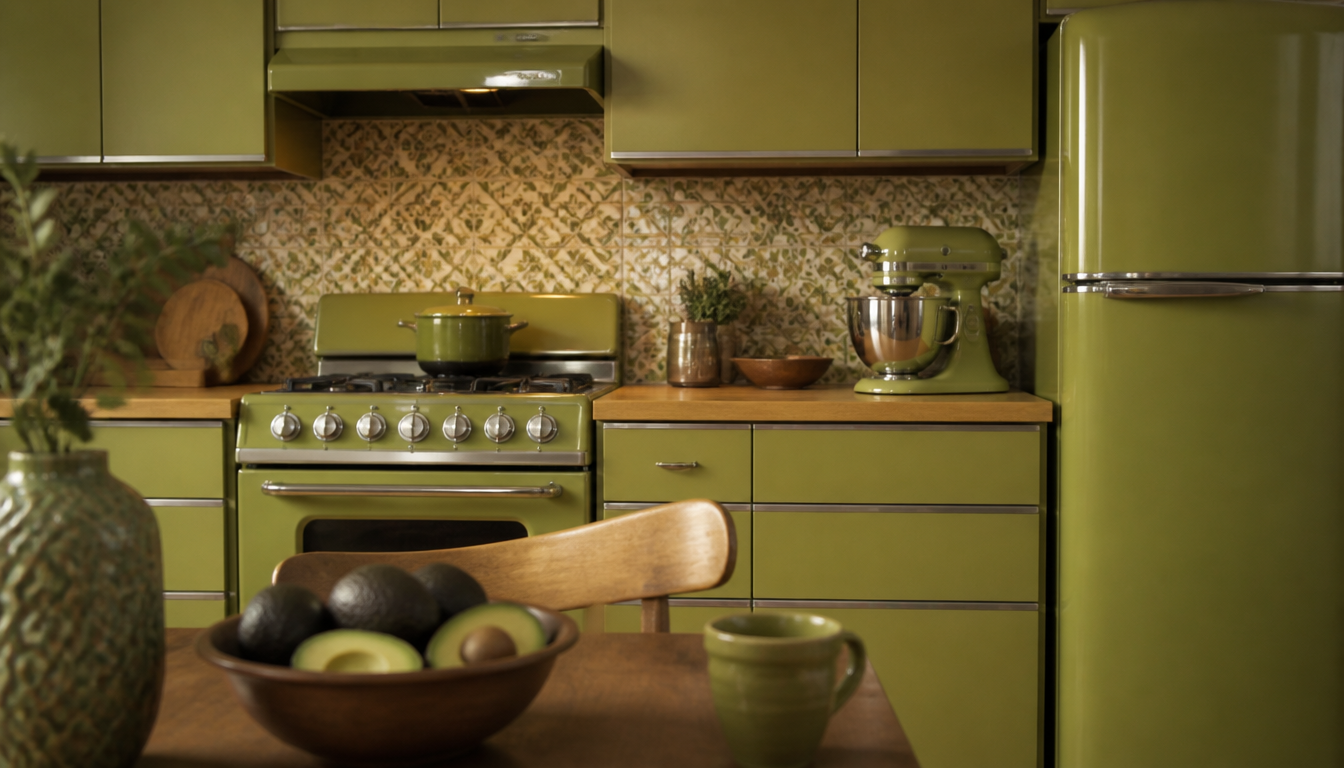
Avocado green is staging a wild comeback: According to search data from kitchen manufacturer CopperSmith, analyzed by Apartment Therapy, the color was searched more than 1,000 times per month as a kitchen color in 2026, with growth of more than 4,000 percent compared to the previous year. What once graced every refrigerator, countertop, and toaster in the 70s was considered the prime example of failed taste for decades. General Electric introduced the color to the world’s kitchens in 1966, but with the rise of white and stainless steel at the end of the 80s, avocado green became history. Now the wheel is turning again — and with momentum. For you, this means: anyone giving their kitchen appliances or accessories a new look right now is not only on trend with a touch of avocado green, but right in the middle of a genuine vintage revival with solid numbers to back it up.
Avocado Green Is Back: The 70s Kitchen Color Is Experiencing an Unexpected Revival
According to an analysis by kitchen manufacturer CopperSmith, referenced by Apartment Therapy, avocado green was searched more than 1,000 times per month as a kitchen color in 2026. Growth compared to the previous year was more than 4,000 percent. A color that was considered heavy and outdated for decades is suddenly the talk of the town again.
Where Does Avocado Green Actually Come From?
The story begins in 1966: GE (General Electric) introduced avocado green as an official appliance color, two years after the wood-toned Coppertone and two years before Harvest Gold. The shade spread incredibly fast. Refrigerators, ovens, stand mixers, crockpots, and more hit the market in this rich green tone. Cabinets, tiles, countertops, household appliances — everything was avocado. The 70s kitchen was a bold, colorful place.
That changed at the beginning of the 90s. GE launched a white-on-white line and promoted it with the slogan: “It’s a far cry from avocado. And it certainly isn’t harvest gold, either.” White displaced color, then came stainless steel, and avocado green sank into the drawer of tastelessness.
What Does the Revival Say About Us?
Color psychologist Karen Haller told the BBC that we never choose a color without meaning. In 2021, the BBC reported that muted, earthy tones like avocado green and mustard yellow were returning to interiors. Instagram hashtags like #avocadogreen and #mustardyellow visually confirm this trend. What once seemed like an inevitable zeitgeist is now revealing itself as a cyclical phenomenon: colors come, go, and return again.
4 Practical Tips If You Want to Jump on the Trend
1. Start small — don’t renovate the whole kitchen right away. A kitchen cabinet front is much harder to replace than a toaster, a wall color, or accessories. If you’re curious, test the tone with small items first. An avocado green kettle or a colored decorative cushion will give you a feel for the look before you make bigger decisions.
2. Dosage is everything. Avocado green looks elegant as an accent color but quickly becomes overwhelming as a complete solution. Combine the tone with natural materials like wood or linen to ground it. A single statement piece in the kitchen is often enough.
3. Use the retro character intentionally. Combining avocado green with other 70s elements — macramé, wood paneling, or geometric patterns — creates a consistent vintage look. For a more modern feel, pair the color with plain white or gray surfaces. Inspiration for geometric retro patterns can be found, for example, in the Geo Retro Style Decorative Cushion or the Abstract Retro Cushion.
4. Think about the walls too. Avocado green as a wall color works particularly well in combination with warm lighting and light wood tones. If you’re hesitant about the wall, hang a fitting picture instead. Botanical prints or vintage posters in earthy tones go well with it, such as a Peach Botany Poster or a Lavender Botany Poster. The Bauhaus style of the same era also harmonizes well with the look, for example as a Bauhaus Exhibition Poster.
If you generally love the vintage vibe, you’ll find many more ideas for walls and living spaces in the reetro shop.
Sources
- Trend from the 70s: This kitchen color was considered old-fashioned — now everyone suddenly wants it again (CHIP)
- Everyone Owned It In The ’60s And ’70s: The Appliance Color We’re Glad Stayed In The Past (Yahoo Shopping)
- Why 1970s ‘avocado green’ is back for interiors (BBC Culture)
FAQ
When did avocado green first appear in the kitchen?
General Electric introduced avocado green to the market in 1966, two years after the manufacturer had already launched the wood-toned Coppertone variant. Shortly afterward, many other appliance manufacturers adopted the color, and suddenly avocado green refrigerators, ovens, stand mixers, and cabinets could be found in countless homes.
Why did avocado green eventually disappear from kitchens?
At the beginning of the 90s, GE initiated the change: with a new white-on-white line, the company explicitly marketed its appliances as a departure from avocado green. The advertising message was, roughly: ‘A far cry from avocado.’ After that, white — and later stainless steel — established themselves as the dominant kitchen colors.
Is it true that avocado green is really making a comeback right now?
Yes, and the numbers speak clearly. According to search data from kitchen manufacturer CopperSmith, analyzed by Apartment Therapy, avocado green was searched more than 1,000 times per month as a kitchen color in 2026. Growth compared to the previous year was over 4,000 percent.
Does avocado green still suit modern kitchens today, or does it inevitably look dated?
It all depends on the dosage. Using the color across an entire kitchen front quickly results in a purely retro look. Used more sparingly — as a toaster, wall color, or individual accessories — avocado green fits in well with contemporary, earthy color palettes. According to the BBC, muted, natural tones like sage green and mustard yellow are generally making a comeback.
Was avocado green really the only striking kitchen color of the 70s?
No, avocado green had prominent companions. Mustard yellow, orange, brown, and the so-called Harvest Gold also counted among the typical colors of the era. Harvest Gold didn’t even come into fashion until two years after avocado green, in 1968. The kitchens of that time were overall a colorful, bold counterprogram to the white and stainless steel kitchens that followed.
This article was generated automatically by an AI system. Disclosure pursuant to Article 50 of the EU AI Act.