
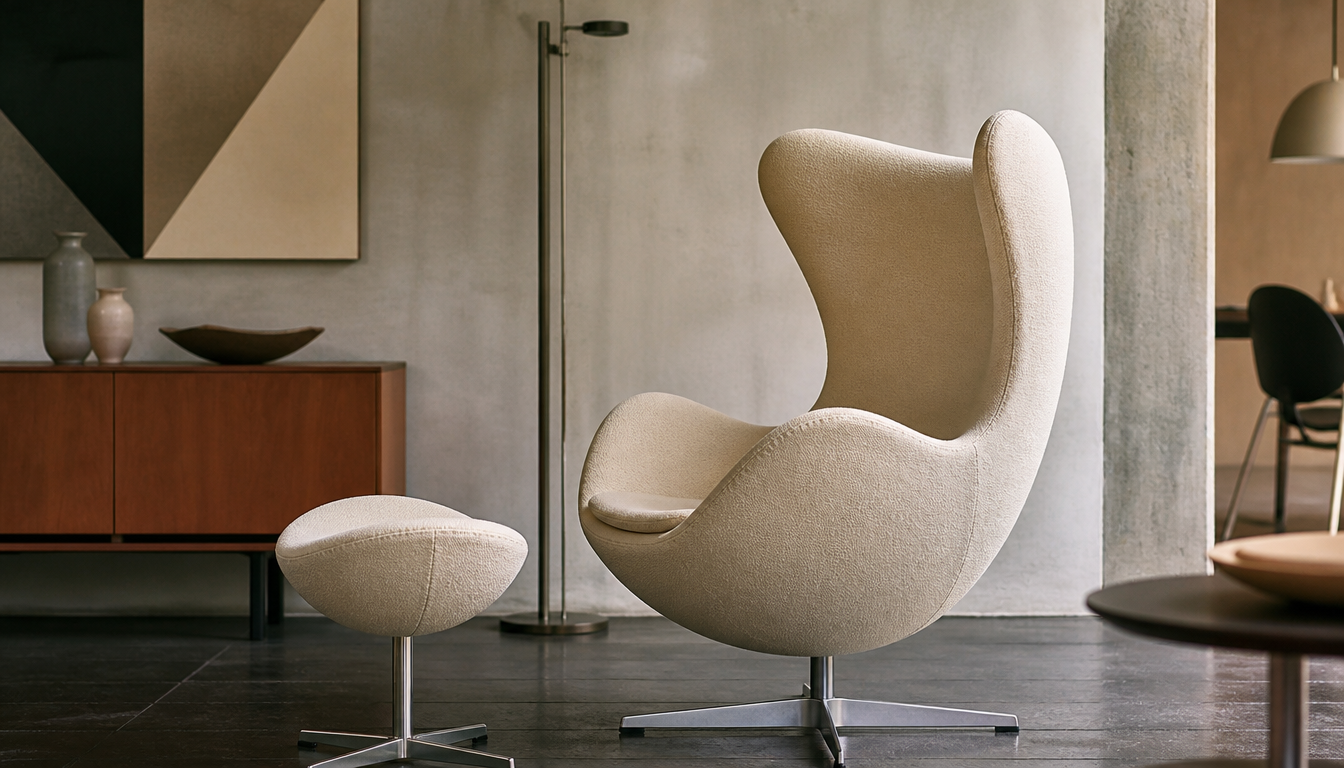
In 1958, Arne Jacobsen designed the Egg Chair for the SAS Royal Hotel in Copenhagen as part of a total work of art in which he conceived architecture, interior, and every individual piece of furniture as an inseparable whole. Jacobsen proved that Danish functionalism is far more than sober utilitarianism: his organic shell forms combined Bauhaus rigour with sculptural warmth, creating a design language that remains present to this day in museums, offices, and living rooms worldwide. Understanding his designs from 1958 to 1968 means understanding why Nordic design left such a lasting mark on global taste throughout the 20th century.
Arne Jacobsen’s Egg Chair: Organic Modernism Between Bauhaus and Danish Functionality (1958–1968)
The Egg Chair was created in 1958 as part of a comprehensive design concept for the SAS Royal Hotel in Copenhagen, which Arne Jacobsen designed in its entirety — from the façade down to the cutlery. One building, one designer, every detail coordinated: that was his hallmark.
Jacobsen Between Functionalism and Formal Experimentation
Arne Jacobsen is regarded as one of the central pioneers of Danish modernism. According to the Danish Architecture Centre, he always conceived buildings, interiors, and details as a coherent whole, consistently putting this into practice in projects such as the National Bank of Denmark and the SAS Royal Hotel. He laid the groundwork for this reputation as early as 1929, when he and his fellow student Flemming Lassen won the competition for the “House of the Future” — featuring circular floor plans, flat roofs, and interlocking terraces. The project still feels like a glimpse into the future today.
The Egg Chair draws on exactly this organic logic. The enclosed shell form with no straight edges was not merely a stylistic device, but a direct response to a functional question: how do you create a zone of privacy in a hotel lobby? The answer was a form that literally envelops the body.
Jacobsen’s designs continue to appear at auction to this day, testifying to his enduring relevance as a representative of Scandinavian functionalism.
What This Means for You: 4 Practical Perspectives
1. Total Concept Rather Than Individual Piece Jacobsen never designed a chair and then figured out where it might fit. He thought from the room outward. Anyone furnishing a living space can adopt exactly this approach: first the mood, then the objects. Wall art, cushions, and furniture have greater impact when they follow a shared formal language. Those who, for example, feel an affinity for the Bauhaus style will find starting points for a cohesive atmosphere in the Bauhaus decorative cushion or the Bauhaus hexagon picture.
2. Organic Forms as a Timeless Principle The curved silhouette of the Egg Chair has no sharp edges, no rectangles, no concessions to right angles. This formal language recurs in botanical prints, wave-pattern designs, and abstract colour fields. A wave-pattern cushion or a Fluid Lights decorative cushion applies the same logic without imitating Jacobsen.
3. Scandinavian Design as a Reference, Not a Cliché Danish modernism is not the minimalism cliché from a furniture catalogue. Jacobsen combined clear structures with warm materials and surprising proportions. Anyone wishing to continue this approach in their own home will find a direct connection to this design tradition with a Scandinavian pattern hexagon or a Swedish pattern hexagon wall picture.
4. Design History as a Starting Point for Your Own Decisions Jacobsen’s career shows that good design requires a stance, not trends. The ten years from 1958 to 1968 were particularly productive for him because he consistently followed his own logic. Anyone designing walls, tables, or desks benefits from the same principle: choose fewer things that work together rather than a great deal all at once. The reetro shop offers a wide selection that can be assembled according to exactly this principle.
Sources
- Arne Jacobsen: The Pioneer Behind Danish Modernism in Architecture and Design – Danish Architecture Centre, Ida Elva Hagen, April 2026
- Arne Jacobsen Auction Results – artnet
FAQ
Who was Arne Jacobsen, and why is he considered so significant to Danish design?
Arne Jacobsen was a Danish architect and designer and one of the central pioneers of Danish modernism. What set him apart: he always conceived buildings, interiors, and details as a coherent whole. From the chair to the façade — everything from a single hand. He achieved his international breakthrough with projects such as the SAS Royal Hotel in Copenhagen and the Danish National Bank. His iconic chairs, including the Egg Chair, remain in use to this day.
What does the Bauhaus have to do with Jacobsen's organic furniture forms of the late 1950s?
Jacobsen was deeply rooted in Scandinavian functionalism, which was itself strongly influenced by Bauhaus thinking: function and form belong together. At the same time, he departed from pure geometry and developed soft, body-conscious forms such as the Egg Chair (1958). This is the moment at which Danish cosiness and Bauhaus rationalism enter into an organic synthesis.
When did Jacobsen's interest in holistic design begin, and how early was that really?
By 1929, the direction of travel was already clear. Together with his fellow student Flemming Lassen, Jacobsen won a competition for the so-called House of the Future: circular floor plans, flat roofs, flowing terraces. A design that still feels futuristic today. Thinking in total concepts was therefore not a late idea, but his fundamental principle from the very beginning.
Are Jacobsen furniture pieces still traded on the art market today, and can original pieces from the 1958–1968 period still be found?
Yes, absolutely. Arne Jacobsen’s works appear regularly at international auctions. As one of the best-known representatives of Scandinavian functionalism, his original pieces from the late 1950s and 1960s consistently attract attention among collectors. Anyone interested in original works from this golden decade should keep an eye on reputable auction houses.
What distinguishes Danish modernism from other European design movements of the same era?
Danish modernism, for which Jacobsen stands as a representative, combined consistent functionality with craftsmanship and a strong sense of the overall picture. While other European movements were often heavily theoretical or ideologically charged, Danish design remained close to the body, the material, and everyday life. Jacobsen brought this approach onto the global stage and made Danish design a universally recognised term.
This article was generated automatically by an AI system. Disclosure pursuant to Article 50 of the EU AI Act.