
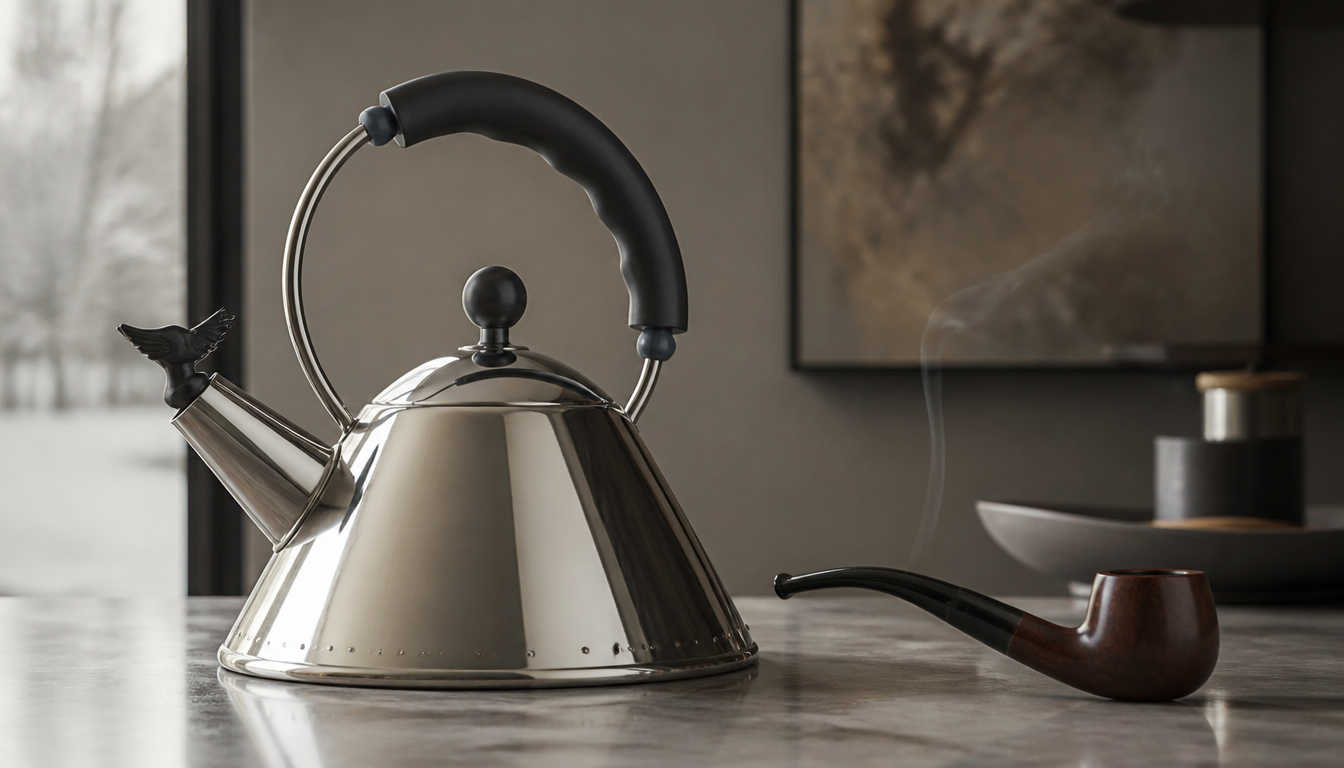
Richard Sapper’s Alessi kettle 9091 from 1983 whistles two harmonious notes while boiling, E and B, produced by a brass whistle that he deliberately integrated as a melodic element into the design. While Michael Graves’ kettle 9093 from 1985 brought postmodernism into millions of kitchens with its plastic bird whistle, Sapper took a different path: function and sound as an inseparable unit. Both kettles are today considered key objects of 20th-century industrial design. Anyone searching for an original example of Sapper’s 9091 should look for the Alessi lettering stamped into the metal on the base, the mirror-polished stainless steel body, and the solid brass whistle. Vintage pieces also often feature a copper base, which is no longer found in current production.
The Whistle as Design Manifesto: Alessi Kettle and Richard Sapper
In 1983, Richard Sapper designed the Alessi kettle 9091 with a brass whistle that plays two harmonious notes when it whistles: E and B. Two years later, in 1985, Michael Graves’ kettle 9093 followed with an injection-moulded plastic bird whistle. Two kettles, two tones, two attitudes towards post-war modern design.
The Key Fact: Two Notes That Made History
Richard Sapper was a German industrial designer. His kettle 9091 for Alessi was created in 1983 and is, alongside Michael Graves’ later kettle, one of the most significant kitchen objects of the late 20th century. The twist: the whistle is made of brass and plays two notes in harmony when steam passes through it, E and B. This was no accident, but entirely intentional.
In 1985, Michael Graves’ 9093 kettle joined the lineup. Alessi personally invited Graves, and the result was a conical stainless steel kettle with a plum-shaped plastic bird as the whistle. According to Alberto Alessi, the 9093 brought postmodernism into millions of households and transformed an everyday gesture into a design icon. In 2025, Alessi is celebrating the 40th anniversary of the 9093 with two new, fully black editions.
Sapper also worked on the Tizio lamp for Artemide, the IBM ThinkPad, and a television set for Brionvega. According to Rarify and Be Original Americas, his work cannot be clearly assigned to strict modernism or postmodernism, but instead draws its life from functionality and a beauty driven by function.
Practical Tips for Consumers
1. How to Identify an Original Sapper 9091
Anyone looking for a vintage 9091 should pay attention to the following details:
- Alessi stamp on the base of the kettle
- Mirror-polished stainless steel body (no matte finish)
- Brass whistle (no plastic, no cheaper metal)
- Rubber guard on the opening for the finger. Note: This may have come loose on older examples.
- Vintage examples often had a copper base, while current production uses steel.
2. Original or Imitation: What to Look Out for When Buying
The original kettle has a sound. Anyone who cannot hear the E–B interval of the brass whistle, or who perceives a dull, monotone whistling, should be sceptical. The brass element is the heart of the original and a reliable mark of authenticity.
3. Graves vs. Sapper: Which Kettle Is Which?
Both kettles come from Alessi, but they differ fundamentally:
| Sapper 9091 | Graves 9093 | |
|---|---|---|
| Year of design | 1983 | 1985 |
| Whistle | Solid brass, two notes (E + B) | Plastic bird |
| Body | Mirror-polished stainless steel | Conical stainless steel |
| Base (vintage) | Copper | — |
| Style | Function-driven | Postmodern |
4. Design Icons at Home: More Than Kitchen Tools
Kettles like the Sapper 9091 and the Graves 9093 represent an era in which everyday objects were consciously conceived as design statements. Anyone who wants to furnish their home with a similarly timeless visual language will find suitable wall prints and decorative pieces at reetro in the Bauhaus and vintage style. For example, the Bauhaus Ausstellung Poster or the Bauhaus Sonne Poster, which embody the same commitment to clear form and function. The Deko Kissen im Bauhaus-Stil also fits well in rooms that align with the formal vocabulary of this era.
More inspiration can be found in the reetro Shop.
Sources
- Rarify on Instagram: Identifying an Original Richard Sapper 9091 Kettle for Alessi (Pt. 5)
- Movie: Alberto Alessi on Michael Graves’ 9093 kettle, Dezeen
- Forty and still whistling: Alessi celebrates 40 years of the 9093, Facebook
FAQ
What makes the Alessi 9091 by Richard Sapper so special?
The 9091 was designed in 1983 by German industrial designer Richard Sapper and is one of the most significant kitchen design objects of the 20th century. Its unique selling point: a whistle made of solid brass that sounds two notes simultaneously while boiling, namely E and B. Not a random whistle, but a deliberately composed chord. The body of the kettle is made of mirror-polished stainless steel. For Sapper, function and beauty are not opposites — they are one and the same.
What is the difference between the Sapper 9091 and the Michael Graves 9093?
Both kettles were created for Alessi and are considered icons of their time, but they come from entirely different worlds. Sapper’s 9091 from 1983 is function-driven, with a brass whistle and a mirror-polished stainless steel body. The 9093 by Michael Graves arrived in 1985 and brought postmodernism into the kitchen: a conical stainless steel body, a bird-shaped whistle made of plastic, and a playfully colourful formal language. Sapper builds on sound and material honesty. Graves builds on symbolism and pop.
How do I identify an original Alessi 9091 by Richard Sapper?
There are three things to check. First: the name Alessi should be stamped into the base of the kettle. Second: the body must be made of mirror-polished stainless steel, and the whistle of solid brass. Third: a rubber cover for the finger should be present on the opening mechanism. On vintage examples, however, this may be missing, as it tends to detach over time. Older kettles also feature a copper base, while current production uses steel.
Who was Richard Sapper, exactly?
Richard Sapper was a German industrial designer whose work extended far beyond the Alessi kettle. He designed the Tizio lamp for Artemide, the IBM ThinkPad, and a television set for Brionvega. His design cannot be clearly assigned to strict modernism or postmodernism. What connects his works is a consistent focus on function, from which a very distinctive aesthetic emerges.
Is Michael Graves' Alessi 9093 celebrating an anniversary in 2025?
Yes, the 9093 turns forty in 2025. Alessi has announced the anniversary with two new all-black editions that remain true to the original in spirit but have been given a visual refresh. The kettle first appeared in 1985 and, according to Alessi, brought postmodernism into millions of households. A kettle as a movement on the shelf — that is quite a story in itself.
This article was generated automatically by an AI system. Disclosure pursuant to Article 50 of the EU AI Act.