
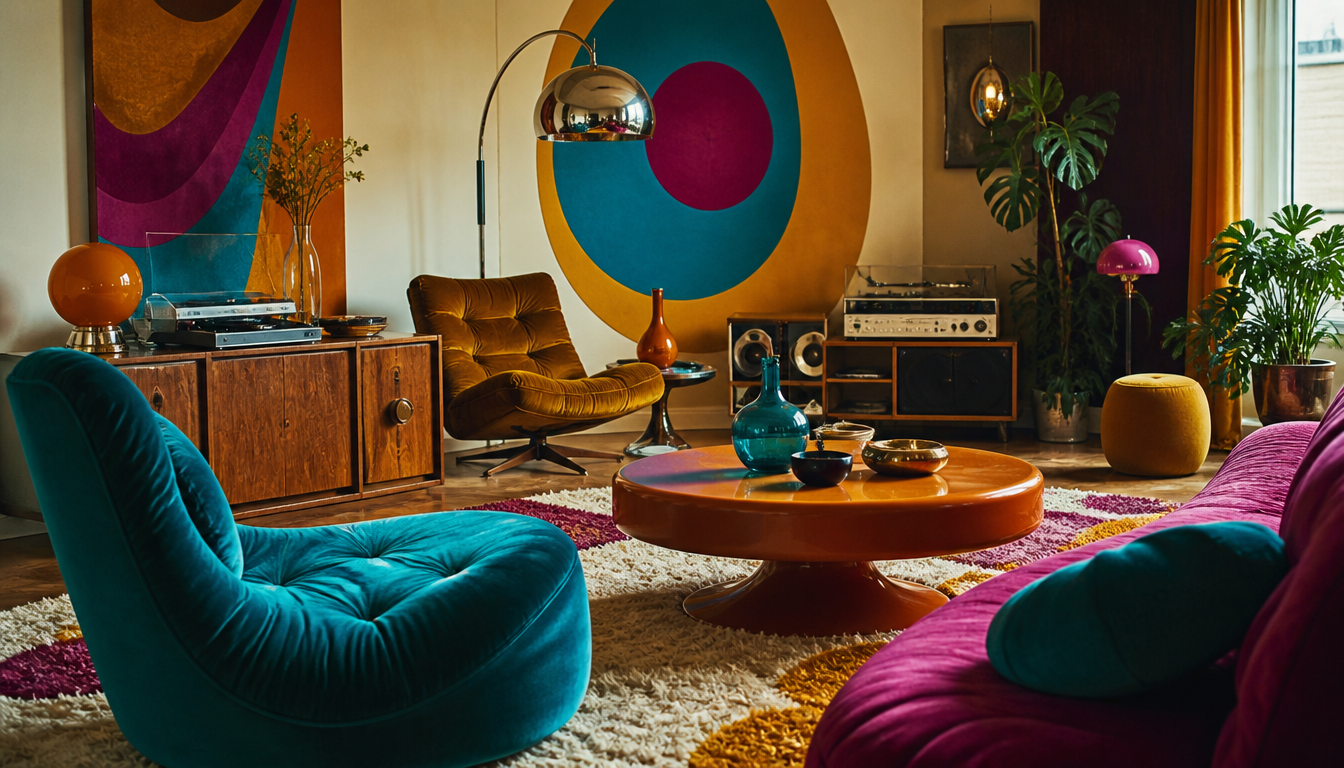
In 1960s Berlin, an endless stream of beat bands filled smoky clubs, while the record industry and media initially missed the movement entirely – at the same time, a color palette of turquoise, golden brown, and rich magenta swept into the living rooms of an entire generation, turning four walls into a statement. The Berlin Wall, the Cold War, and the student revolts shaped a way of life between 1965 and 1972 that was reflected not only in music but in every detail of interior design. Anyone placing a vintage sneaker silhouette from that era on the table today is wearing on their feet the very same color space that jukeboxes, transistor radios, and record sleeves once brought into the living room. The Psychedelia palette is no coincidence: it was a stance.
60s Living Room: The Psychedelia Color Revolution – Turquoise, Magenta, and Golden Brown as a Way of Life 1965–1972
In the late 1960s, the spirit of an entire generation expressed itself not only through music, but directly on the walls and sofas of the living room. The post-war era, the Cold War, the Berlin Wall, and the student revolts shaped – according to the Kreuzberg Museum – a youth searching for new forms of expression within a rigid post-war society. What was beat music on stage became a color revolution in the home: turquoise, magenta, and golden brown displaced the muted grays and beiges of 1950s interiors.
Color as a Stance: What Lies Behind the Palette
The colors of the Psychedelia era were no coincidence. They reflected a break with what came before: louder, more colorful, more provocative. Turquoise as a cool counterweight to conformism. Golden brown as a warm nod to craftsmanship and authenticity. Magenta as a direct statement against the Schlager mainstream that, according to the Kreuzberg Museum, had long dominated the music industry as well.
Living rooms became stages. Record sleeves, band photos, and audio clips shaped the visual vocabulary of an era that is kept alive today in exhibitions such as “Generation B” – complete with jukeboxes, transistor radios, and stage costumes of Berlin bands.
4 Practical Implications for Consumers
1. Use Color Deliberately, Not Overwhelmingly
The typical Psychedelia look of the years 1965 to 1972 worked through contrast. A turquoise cushion on an ochre-yellow sofa, not every wall simultaneously in neon colors. Anyone wanting to bring the spirit of the era home is better off using individual accents. The Decorative Cushion Fluid Lights or the Cushion Pink Lava hit this color code without overwhelming the space.
2. Choose Abstract Art as a Wall Anchor
In the living rooms of the late 60s, landscape photographs were nowhere to be found. Abstract compositions, flowing forms, and bold color fields were the medium of choice. Today, this look can be authentically captured with an abstract retro cushion or a poster such as the Kandinsky Poster in Yellow, Blue, Red – both stand directly in the tradition of the era.
3. Don’t Shy Away from Patterns and Geometry
Psychedelia also meant: visual restlessness as a program. Wave patterns, interlocking squares, flowing ornaments. A cushion with wave pattern or the decorative cushion with monochrome 3D cube pattern adopt this visual language directly without historically copying it.
4. Vintage Posters as Historical Documents and Décor
Poster art was one of the most important visual media of the 1965 to 1972 era. Band posters, film posters, and exhibition prints hung in every Berlin club and every teenager’s bedroom. Anyone wishing to recreate this atmosphere will find a wide selection in the poster shop, including the Bauhaus Exhibition Poster and the Alice in Wonderland Poster, which fits directly into the psychedelic visual language of the era.
Sources
- Generation B – The 60s and Beat in Berlin – Band Stories, Contemporary History, Spirit of the Age, Kreuzberg Museum
FAQ
Where did the spirit behind the wild colors of 60s living rooms come from?
The post-war era, the Cold War, the Berlin Wall, and the student revolts shaped an entire generation – especially in Berlin. Young people wanted to break free from the rigid post-war society, and that showed not only in beat music but also in the home. Turquoise, magenta, and golden brown were no coincidence – they were a clear signal: we’re doing things differently from your Schlager-and-beige world.
What role did beat music play in the color and interior sensibility of the time?
Beat bands filled smoky clubs in the 60s, with fans lining up outside. The record industry and media initially missed the movement entirely because they were focused on Schlager. The spirit of this subculture – with record sleeve aesthetics, stage costumes, and jukeboxes as living room objects – flowed directly into the language of interior design. Golden brown and turquoise were essentially the record sleeve colors for your own home.
What are the typical objects that define a psychedelic 60s living room?
Record players, reel-to-reel tape decks, transistor radios, and jukeboxes were all fixtures. These were complemented by record sleeves used as wall décor and fabrics in richly saturated colors such as turquoise, white, and golden brown. These objects created an authentic atmosphere that can be experienced today in exhibitions such as ‘Generation B’ at the Kreuzberg Museum in Berlin.
Was the psychedelic color world limited to West Berlin, or did it exist in East Berlin too?
Beat music and the lifestyle that came with it existed in the 60s in both East and West Berlin alike. An ever-growing number of bands and their aesthetics shaped both sides of the Wall. The colors and style were therefore not a purely Western phenomenon, but a city-wide Berlin rebellion against the constraints of post-war society.
Can I still put together an authentic 60s living room today?
Yes, and it’s surprisingly achievable. Abstract compositions in turquoise, white, and golden brown – such as those available from artists like Joriali on canvas or ArtFrame – capture the color spirit of the era very precisely. Combine that with a vintage record player and a transistor radio, and you’ve brought the feeling of 1965 to 1972 directly into your room.
This article was generated automatically by an AI system. Disclosure pursuant to Article 50 of the EU AI Act.