
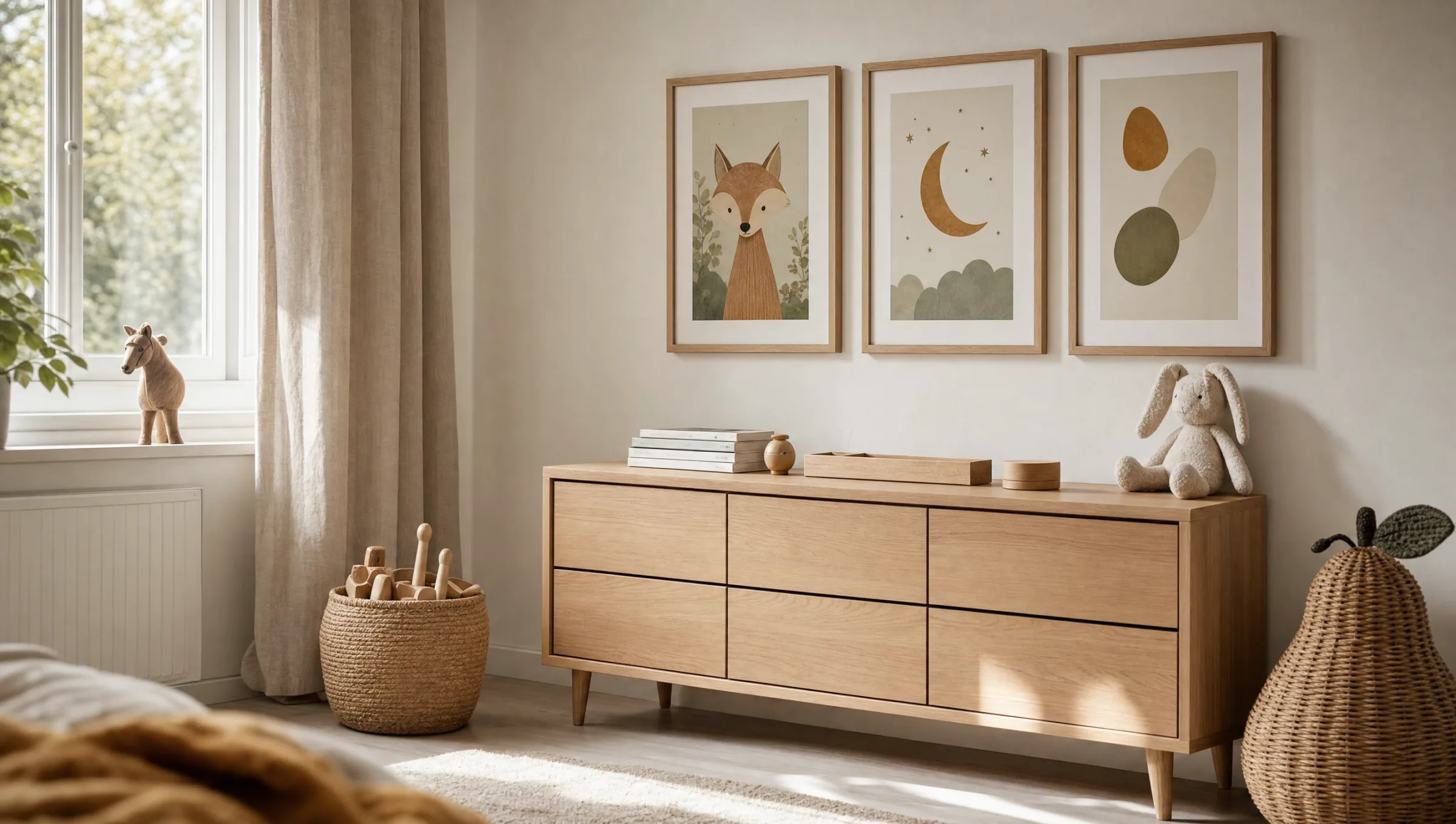
Children's Room Prints for Calm, Grow-With-You Spaces
Children's room prints shape a child's space more than almost any piece of furniture. This editorial overview organises common illustration styles, outlines suitable formats and materials, and offers guidance on how wall art can remain relevant across several stages of childhood.
What makes children's room prints work
Children's room prints are more than colourful decoration. They form the visual framework in which children play, read, fall asleep and wake up. A considered selection accounts not only for the child's current tastes but also for the room's light conditions, wall colours and the overall level of visual stimulation. Illustrations with clean, reduced lines tend to hold up better in most rooms over time than densely detailed scenes.
It is also worth distinguishing between active zones — the play corner or desk — and quieter zones such as the bed or reading nook. Above the bed, calmer subjects tend to work better: animals in profile, landscapes, abstract shapes. High-contrast scenes in that position can continue to stimulate visually in the evening, potentially making it harder for children to settle.
Style directions for children's room prints
The four style directions below cover the majority of typical requests for children's rooms and can be combined well, provided the colour palette and line quality remain related.
Scandinavian illustrative
Reduced animal and nature motifs in muted tones, often with a hand-drawn quality. Works well with light wood furniture and neutral wall colours, and ages visually slowly.
Playful narrative
Scenes with small stories — hot-air balloons, forest animals at a tea party, underwater worlds. These children's room prints suit younger children who enjoy narrating what they see.
Educational typographic
Alphabet charts, number posters, world maps or simple anatomy illustrations. They combine decoration with gentle learning and often remain relevant well into primary school age.
Abstract geometric
Geometric compositions, dots, arcs, moon and sun forms. This direction is frequently underestimated, but holds up particularly well in children's rooms and can transition naturally into a teenager's space.
Formats, sizes and hanging
For the wall above a child's bed, landscape formats between 50 × 70 cm and 70 × 100 cm have proved reliable — they echo the width of the bed without overwhelming the room. Above dressers and changing tables, two smaller portrait-format prints often feel calmer than a single large one. Picture ledges are a practical alternative when children's room prints are likely to change frequently.
Hanging height should ideally be guided by the child's seated or standing eye level, not an adult's. A picture centre between 110 and 130 cm from the floor is a workable compromise in most cases and one that can reasonably be retained as the child grows.
Children's room prints rarely succeed through boldness. The real question is how well they work in the same room in the morning, at noon and in the evening.
Reetro Editorial
Materials and print quality for children's room prints
In a child's room, the material of wall art matters more than in many other spaces. Matte surfaces reduce reflections under ceiling lighting and read as less harsh both in person and in photos. Paper weights from 200 g/m² with FSC certification frame well without buckling — all Reetro prints are printed to order by our production partner in the EU to these standards.
For areas where children are likely to brush against the wall — beside a desk, for instance — more robust substrates are worth considering. Canvas prints and aluminium wall art tolerate contact better than framed posters behind glass and are often the quieter choice from a safety perspective too.
Choosing children's room prints that grow with the child
One frequently overlooked point: children's room prints do not need to be replaced wholesale every year. A more practical approach is to choose one or two timeless anchor pieces — a reduced landscape or an abstract composition — and pair them with smaller, rotating prints that reflect the child's current interests.
The result is a wall arrangement that ages alongside the child rather than being discarded with every new enthusiasm. This is easier on the budget and, over time, tends to produce visually quieter, more considered rooms.
Häufige Fragen
-
01
Which children's room prints work best in a nursery?
For a nursery, calm, low-contrast children's room prints tend to work best: soft animal illustrations, moon and cloud motifs, or reduced landscapes in muted colours. High-contrast black-and-white designs can be useful as small-format cards near a changing area in the earliest months, but are generally less suitable as large-format wall art above the cot. Matte surfaces are usually the better choice, as they avoid bright reflections and read more quietly from a lying-down perspective.
-
02
How many prints should hang in a children's room?
As a general guide, two to four carefully chosen pieces tend to work better than a densely packed gallery wall. Above the bed, a single larger print is often sufficient, complemented by one or two smaller pieces above a dresser or in the play corner. A shared colour palette or a consistent stylistic thread connects the works without requiring them to match exactly. This keeps the room visually calm and avoids overloading the child with too many simultaneous impressions.
-
03
Are typographic children's room prints like alphabet posters a good idea?
Typographic children's room prints can accompany the transition from toddler to preschool and primary school age well. Alphabet charts, number posters and simple world maps combine decoration with incidental learning. Restrained design matters here: legible typefaces, a limited colour palette and an uncluttered layout ensure the print continues to work even after the child has long since memorised the content, reducing the need for early replacement.
-
04
What size should children's room prints be above the bed?
Above a standard 90 cm children's bed, landscape formats between 50 × 70 cm and 70 × 100 cm generally look well-proportioned, occupying roughly two-thirds of the bed's width. For bunk beds or larger frames, bigger formats are possible but should be securely fixed. Hanging with the picture centre between 110 and 130 cm from the floor brings the image into the child's field of view, rather than positioning it purely at adult eye level.
-
05
How do I care for wall art in a children's room?
Framed posters behind glass can be wiped with a soft, lightly dampened cloth. Canvas and aluminium prints are best cleaned with a dry or barely damp microfibre cloth; aggressive cleaning products are unnecessary and can damage the surface. Reetro's children's room prints are printed to order by our production partner in the EU on FSC-certified papers from 200 g/m² with a matte coating, which makes them comparatively resilient to light contact and everyday light exposure.