
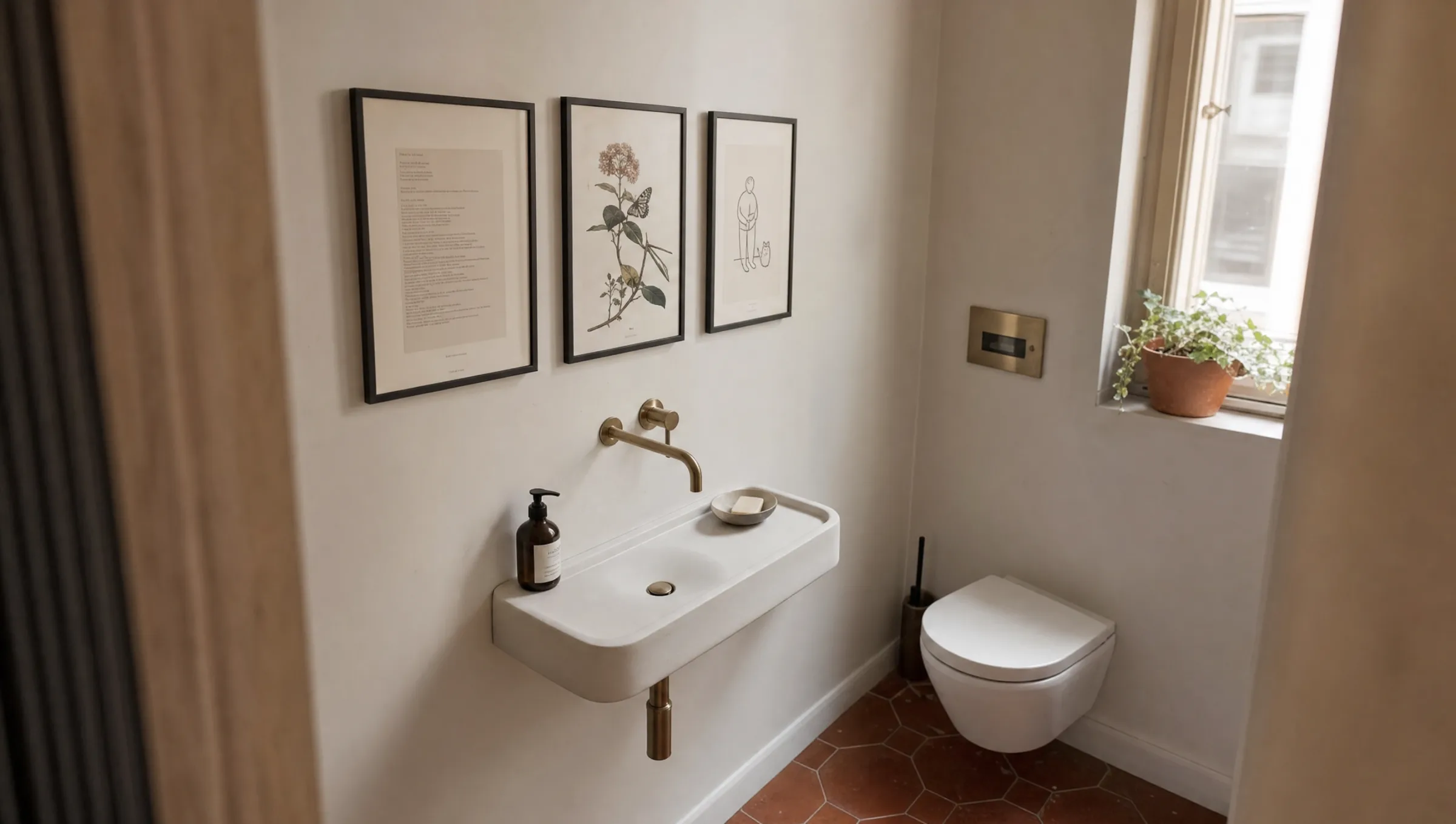
Funny Bathroom Art: Motifs, Formats and Hanging with a Wink
A bathroom is small, but visually potent: anyone who hangs pictures here is decorating a room where guests actually stop and look. This overview covers which motifs work, which formats suit the space, and what to keep in mind regarding humidity, light and placement.
Why funny bathroom art works especially well in guest WCs
The bathroom is one of the few rooms where visitors spend several undistracted minutes looking at a single wall. That is precisely why funny bathroom art is a sensible choice: it takes the edge off a purely functional space without requiring much floor area or furniture. Even a single well-placed print can noticeably shift the atmosphere of a narrow guest WC.
Humour also lands more naturally in the bathroom than in a living room or dining area. An ironic typographic piece, an offbeat illustration or a period-style subject with an absurd detail can be a touch more pointed here. The key is that the motif still fits the wider interior: in a pared-back apartment with original features, a restrained ink drawing reads more cohesively than a loud pop-art poster.
There are practical advantages too. Walls are usually clear, and natural light is limited – both of which protect printing inks and paper over time. Follow a few basic rules on format, material and hanging, and you have a small, focused gallery on just a few square metres.
Four motif directions for funny bathroom art
The four categories below cover most tastes and combine well – for example, a typographic centrepiece flanked by two smaller illustrations.
Typography with a twist
Short phrases, house rules gone sideways, or black-and-white text posters. Work particularly well in minimalist bathrooms and suit almost any frame style.
Vintage illustrations reinterpreted
Botanical plates, antique anatomical drawings or period advertising, each hiding a quietly humorous detail. Feel grown-up rather than silly.
Animals in absurd roles
Dogs in suits, lobsters reading broadsheets, frogs in black tie. Classics of British-style humour that almost always raise a smile in a guest WC.
Minimal cartoons and line art
Stripped-back line drawings with a sharp wit. A natural fit for modern bathrooms featuring concrete, terrazzo or matte-black fixtures.
Formats and hanging: placing funny bathroom art correctly
In the bathroom, every centimetre counts. Above the cistern or facing the toilet is usually the main sightline. A portrait format in the range of 30 × 40 cm to 50 × 70 cm works particularly well here, as it visually elongates a narrow wall. Square formats suit situations where a window or shelf already breaks up the wall.
A small gallery of three to five prints loosens up a longer wall. The important thing is a shared visual thread: identical frames, uniform mounts or a consistent colour palette. This makes the wall feel curated rather than randomly assembled.
The centre of the print should sit roughly at eye level for a seated person – usually between 110 and 125 cm from the floor. That is lower than you might be used to from living rooms, but it gives the most comfortable viewing angle in a bathroom. When combining several prints, allow 4–6 cm of space between frames.
A bathroom tolerates more humour than any other room in the house – provided the motif holds up to a second and third look.
Reetro Editorial
Material and care: what funny bathroom art needs to withstand
Bathrooms are more humid and subject to greater temperature swings than other rooms. Standard poster paper without any protective finish will eventually warp, especially when hung directly above the cistern or opposite a shower. A matte coating or a frame with glass or acrylic glazing significantly extends the life of a print.
Canvas is unproblematic in a guest WC without a shower, but should not be hung directly against a persistently damp wall. Aluminium and hexagonal wall panels cope best with moisture and can be wiped clean with a damp cloth – useful when the occasional splash or dust reaches the surface.
With paper, it is worth checking the weight. From around 200 g/m² upward, a print sits flat in the frame, is less prone to warping and feels noticeably more substantial. FSC-certified papers with a matte surface also reduce glare, which can quickly become distracting in the confined space of a small bathroom.
Style directions at a glance
If you are still undecided, start with the existing interior. In a Scandinavian-influenced bathroom with light wood and white tiles, minimal line-art cartoons or typography in black on off-white work well. The print stays an accent; the room keeps its calm.
Period bathrooms with cornicing or dark wall colours benefit from vintage illustrations in gilt frames. Here, funny bathroom art can deliberately feel antiquated – the wit comes from the contrast between a serious aesthetic and an absurd detail.
Modern bathrooms with concrete, terrazzo or microcement surfaces suit more graphic motifs: bold colour fields, risograph-style prints or photographic still lifes with an ironic edge. The key, as always, is to avoid several prints competing for attention at the same time.
Häufige Fragen
-
01
What types of funny bathroom art work best in a guest WC?
For a guest WC, the best motifs are those that prompt a quiet smile on first glance without becoming tiresome under repeated viewing. Typographic posters with short, dry phrasing, vintage illustrations with an absurd detail and minimal line-art cartoons have all proved popular choices. It matters that the motif fits the broader interior: in a pared-back, light bathroom, black-and-white prints generally read better than loud, colourful posters. If you are unsure where to start, a single portrait-format print above the basin or facing the toilet is a reliable first step.
-
02
What format is best for funny bathroom art?
In most bathrooms the walls are narrow and relatively tall, which means portrait formats between 30 × 40 cm and 50 × 70 cm tend to look most balanced – they also visually elongate the wall. On a wider wall, a small gallery of three to five smaller prints (around 21 × 30 cm each) works well. Square formats are a good option when the wall is already divided by a window, mirror or shelf. Large formats above 70 × 100 cm are only really suitable in bigger bathrooms with correspondingly more wall space.
-
03
Can posters and prints cope with humidity in a bathroom?
In a dedicated WC or guest bathroom without a shower, humidity levels are usually low enough to be unproblematic. A framed print behind glass or acrylic glazing will comfortably last many years in that environment. Where a shower or bath is in the same room, prints should not hang directly in the splash zone or above the bath. In those situations, aluminium wall panels or coated formats are more resilient than unprotected paper. Ventilating the room after showering also helps prevent moisture and foxing marks on mounts or paper.
-
04
At what height should bathroom art be hung?
In a bathroom, viewing tends to happen more while seated than standing. This means the centre of the print can sit lower than in a living room – ideally between 110 and 125 cm from the floor. Above a washbasin, leaving 20 to 30 cm between the top edge of the basin and the bottom of the frame feels comfortable. When hanging a group of prints, allow 4 to 6 cm between frames and align either the top edges or a shared horizontal centre line for a tidy result.
-
05
How many prints should hang in a bathroom?
Less is generally more. In a narrow guest WC, one to three prints, well positioned on the sightline from the toilet, is usually enough. More pieces in a confined space quickly feel busy and dilute the impact of each individual motif. Anyone wanting to display a small collection should focus on one wall and leave the others clear. A consistent visual principle – the same frame colour, matching mounts or a unified colour palette – keeps even a small group of funny bathroom art prints feeling coherent.
-
06
What should I look for in the quality of prints for a bathroom?
The most important factors are paper weight, printing method and surface finish. Prints on paper from 200 g/m² upward lie flat in the frame and resist warping even with minor humidity fluctuations. A matte surface reduces glare, which can be distracting in a small bathroom under ceiling lighting. Reetro prints its posters and wall art in Germany on FSC-certified papers from 200 g/m² with a matte coating – a robust setup that stays dimensionally stable long-term, even in humid spaces like a bathroom or guest WC.