
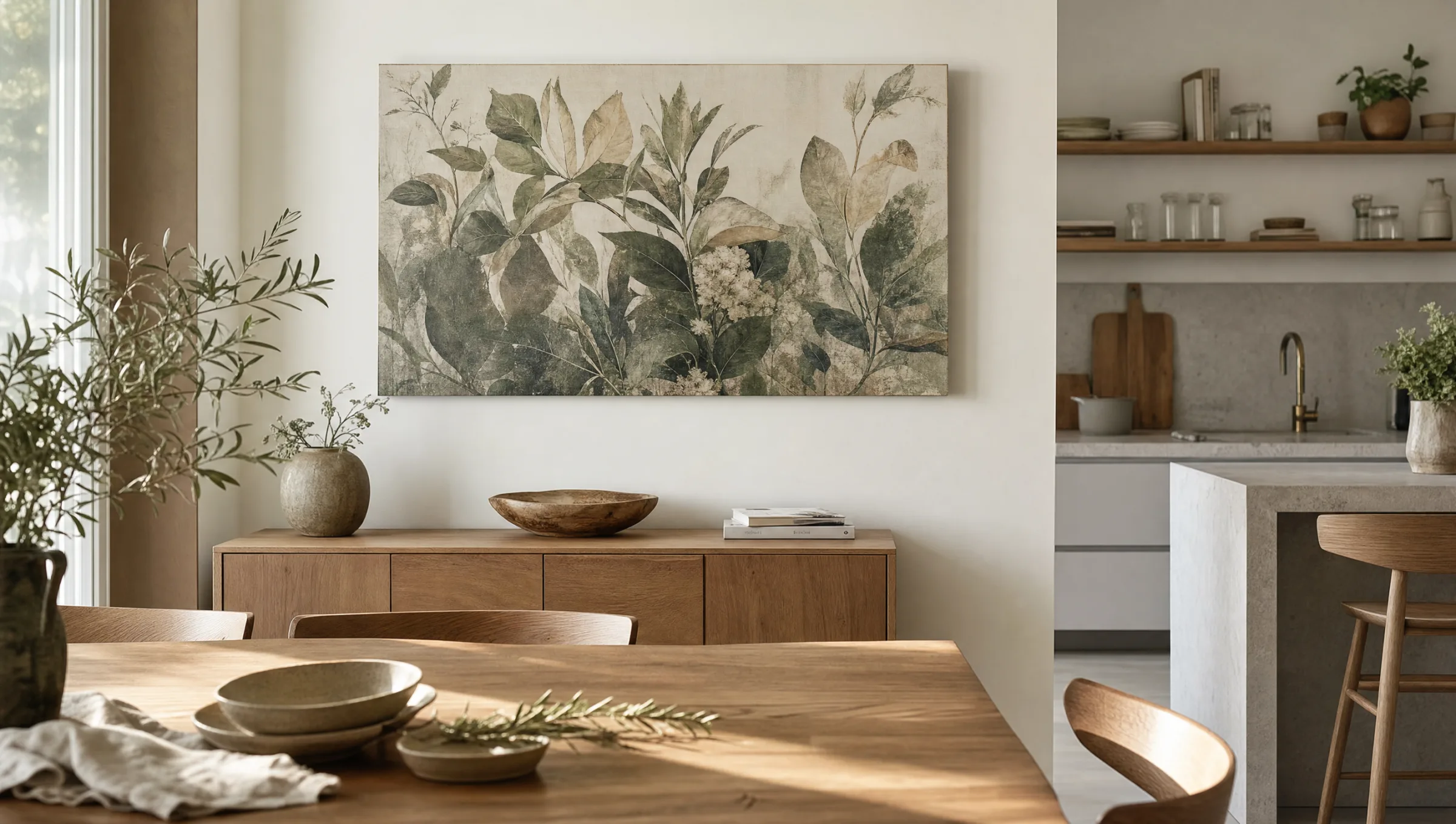
Canvas Prints for Kitchen: Motifs, Formats and Placement
The kitchen has long been more than a functional room. It is a dining space, a gathering point and sometimes a workspace. Anyone who decorates the walls here creates atmosphere that reaches well beyond cooking. This guide covers what matters when choosing canvas prints for the kitchen — from selecting a motif and picking the right size to everyday care.
Why Canvas Prints for Kitchen Work Particularly Well
Canvas responds to light differently than framed paper behind glass. The textile surface absorbs reflections, which becomes noticeable in a kitchen with spot lighting, pendant lamps above the dining table and daylight through the window. Rather than mirroring its surroundings, the motif remains legible from every angle. Anyone who has tried to position a glass-fronted poster beside a hanging lamp will know the problem of harsh light patches.
A second practical advantage concerns weight and installation. A stretched canvas is comparatively light, requires no breakable glass and can be securely fixed with a single nail or a rail. In rented homes where drilling should be kept to a minimum, that is a real argument in its favour.
There is also the quieter visual quality to consider. Canvas prints for kitchen settings feel less like a gallery and more like a living space. That suits open-plan kitchen-diners where the dining table and sofa flow into one another, and where a classic poster in a glass frame can quickly feel too formal.
Motif Categories for the Kitchen Wall
Four motif directions have proved themselves in kitchens. They differ in mood and placement recommendation, but can also be combined when the wall is large enough.
Botanical Prints & Herb Studies
Detailed drawings of rosemary, sage or citrus fruits draw on the tradition of historical botanical plates. They feel restrained and suit the wood tones and natural materials found in country-style and Scandinavian-influenced kitchens.
Still Life & Food Photography
Calm images of bread, wine or fruit carry the visual language of classical still lifes into a modern, photographic vocabulary. Well suited above a sideboard or dining table.
Typography & Menu Cards
Black-and-white lettering, old French menu cards or espresso-style typography work quietly in kitchens with a reduced colour palette and an industrial edge.
Landscape & Coastal Scenes
Wide horizons, olive groves and coastlines open a room visually. Recommended for interior kitchens with few windows, where the motif creates a second view.
Sizes and Hanging Heights: Placing Canvas Prints for Kitchen Correctly
The choice of size depends less on personal taste than on the available wall space. As a general rule, a canvas hung above a sideboard or dresser should span roughly two thirds of the furniture's width. For a 160 cm wide buffet, the ideal print width therefore falls between 100 and 120 cm. Above the dining table you can be more generous, since no piece of furniture dictates the width.
Hanging height should follow seating position. In the kitchen people are alternately standing and sitting, so the centre of the canvas should sit between 145 and 155 cm above the floor. Above the dining table, bring the canvas closer: around 25 to 35 cm of clearance from the tabletop creates a clear relationship without the image intruding when someone sits down.
For multi-panel arrangements, a rehearsal on the floor is worthwhile. Anyone combining two or three canvases should first lay them out in front of the wall, photograph the arrangement and then decide on the spacing. Four to six centimetres between prints usually reads more calmly than generous gaps.
In kitchens, the prints that work best are the ones that do not need to be loud. One quiet canvas above the dining table contributes more to the mood than three competing motifs all vying for attention.
Reetro editorial team
Materials, Care and Choosing the Right Spot
Kitchens are demanding environments. Grease, steam and temperature fluctuations act on every surface over the years. A high-quality canvas print with a matte protective coating therefore has a clear advantage over untreated prints. The coating can be gently wiped with a dry or very lightly dampened microfibre cloth without damaging the print pigments. All Reetro canvas prints are printed to order by our production partner in the EU on FSC-certified material weighing at least 200 g/m².
Directly above the hob or next to the sink, however, canvas prints have no business being. The ideal position is at least 60 to 80 cm away from the cooking area — preferably on the dining wall, the sideboard wall or at the transition to the living area. In an open-plan kitchen, the canvas can also be deliberately placed in the living zone so that it is viewed from the counter.
Lighting also affects the appearance. Low-UV LED lighting is now standard, but canvas prints should still not hang in direct midday sun. Pigment inks last for decades, yet every print ages more slowly in partial shade than in the full glare of a south-facing window.
Style Directions: Which Canvas Prints for Kitchen Suit Which Interior
A purist kitchen with handle-free cabinet fronts and a concrete worktop can carry large, near-monochrome motifs: a single landscape, an abstract black-and-white photograph, a calm expanse of tone. The principle here is reduction — one print, but large and with presence.
Country-style and vintage kitchens respond more warmly to softer motifs. Botanical prints, old market scenes or muted still lifes in sepia and cream tones connect with the materiality of wood, ceramics and linen. Several smaller canvas prints in a loose gallery arrangement feel more at home here than a single oversized motif.
Scandinavian-influenced kitchens sit somewhere in between. Pastel colour fields, minimalist line drawings or delicate watercolours complement light woods and white cabinet fronts without visually weighing the room down.
Häufige Fragen
-
01
What canvas prints for kitchen walls work best?
Four motif directions have proved themselves: botanical prints and herb studies, calm food still lifes, typographic motifs such as old menu cards, and wide landscapes or coastal scenes. Which suits best depends on the kitchen's style. Pared-back kitchens can carry large, near-monochrome canvases. Country-style and vintage interiors look more cohesive with several smaller botanical or sepia still-life prints. Scandinavian-influenced kitchens benefit from delicate line drawings and watercolours. The key is that the motif does not compete with crockery, curtains and cabinet colours, but instead forms a calm visual anchor.
-
02
What size should canvas prints for kitchen spaces be?
As a guide, a canvas above a sideboard or dresser should span roughly two thirds of the furniture's width. For a 160 cm wide buffet, the right format falls between 100 and 120 cm wide. Above the dining table you can be more generous, since no piece of furniture dictates the width. If the canvas hangs freely on a large wall, it should measure at least 80 cm on the longer edge so that it holds its own against the depth of the room. Multi-panel arrangements of two or three smaller prints are a good alternative to a single oversized motif.
-
03
How do I clean a canvas print in the kitchen?
A high-quality canvas print with a matte protective coating can be carefully wiped with a dry or very lightly dampened microfibre cloth, always in one direction and without pressure. Cleaning agents, glass cleaner and wet sponges are off-limits because they can attack the pigments and coating. For heavier soiling, a soft brush helps to lift dust from the canvas texture. More important than cleaning, however, is the choice of location: keeping the canvas at least 60 to 80 cm from the cooking area prevents grease and steam from reaching the print surface in the first place.
-
04
At what height should a canvas print hang in the kitchen?
The centre of the canvas should sit between 145 and 155 cm above the floor. This range corresponds to average eye level and works well in kitchens where people alternate between standing and sitting. Above the dining table, bring the canvas closer to the tabletop: 25 to 35 cm of clearance creates a clear relationship without the print getting in the way when someone sits down. In rooms with low ceilings, a portrait-format canvas helps to visually stretch the wall. Doing a test hang with masking tape before drilling avoids unnecessary holes.
-
05
How do canvas prints differ from framed posters in the kitchen?
Canvas prints require no glass and therefore reflect less light from spots and pendant lamps. They read as softer and tend to integrate more naturally into kitchen-diner spaces than framed prints with a sharp edge. Glass frames, on the other hand, are easier to wipe clean and offer more protection against cooking grease. In areas directly above sideboards and dining tables — at a safe distance from the hob — canvas is generally the quieter choice. Reetro canvas prints are printed to order by our production partner in the EU on FSC-certified material with a matte protective coating and a solid stretcher frame, which supports both ease of care and longevity even in kitchen environments.