
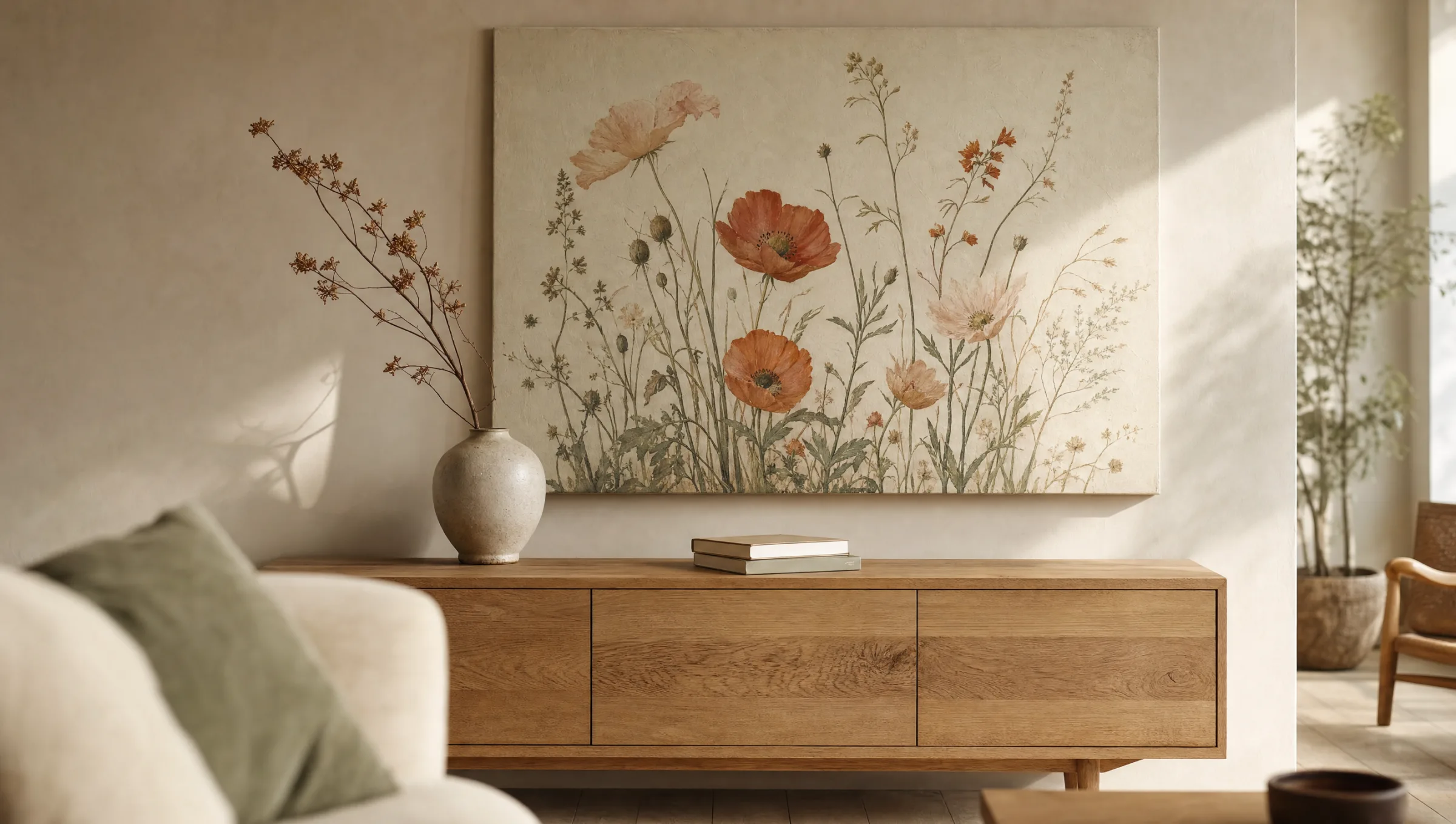
Floral Canvas Print: Botanical Motifs for Your Wall
Flower motifs on canvas are among the most enduring subjects in wall art. This overview outlines the styles that can be distinguished, how format and room interact, and what to look for in materials and printing – all before making a concrete choice.
Why Floral Canvas Prints Are a Timeless Wall Art Subject
Botanical motifs have accompanied pictorial art for centuries – from Maria Sibylla Merian's hand-coloured plant studies to Karl Blossfeldt's photograms. Transferred onto canvas, these subjects gain a calm, painterly presence that differs noticeably from the smooth effect of a poster. The subtly textured weave absorbs light more softly and allows fine colour gradients to read as more organic.
Unlike trend-driven graphics, flower motifs age well. A well-chosen floral canvas print continues to work over many years because it is not anchored to a specific decorating trend but to a subject that exists outside of time. This makes it one of the few motif categories that functions equally in classically furnished period apartments and in pared-back new builds.
There is also an emotional dimension: plant imagery has been linked in perception research to relaxation and lower stress levels. Anyone designing spaces intended to feel calm – bedrooms, reading corners, consulting rooms – will find botanical subjects a thematically coherent choice.
Four Style Directions for Floral Canvas Prints at a Glance
Not every flower suits every interior. The four directions below cover most decorating styles and help narrow down the initial selection.
Botanical Study
Fine line drawing or watercolour on a neutral background, often with Latin labelling. Feels considered and suits classically or Scandinavian-style rooms with light-coloured walls.
Still Life in Oil Style
Dense floral arrangements in the tradition of Dutch painting. Deep colours, dramatic lighting. Works well with dark wall colours, libraries and dining rooms with wooden furniture.
Macro Photography
Close-up shots of individual blooms, often filling the entire frame. Clean lines, high contrast. Well suited to modern interiors, loft apartments and rooms with a lot of metal or glass surfaces.
Abstracted Botany
Reduced floral forms, flat colour fields, sometimes risograph-like in character. Suits Japandi-, Bauhaus- or contemporarily curated rooms with restrained furnishings.
Format, Hanging and Spatial Effect
The impact of a canvas depends almost as much on its format as on the motif itself. Portrait formats emphasise vertical wall surfaces and work well in narrow spaces beside doors or wardrobes. Landscape formats are effective above sofas, sideboards and beds, as they echo the horizontal line of the furniture. Square canvases are the most flexible option, but can look too small on very large walls.
As a general guide, the midpoint of the image should sit at roughly 145 to 150 cm from the floor. Above furniture, the canvas moves closer to the top edge of the piece – typically 20 to 30 cm of clearance. A single large canvas usually reads more calmly than several smaller ones, provided the wall offers enough surface area.
With a floral canvas print it is also worth factoring in the light conditions. Warm evening light brings out earthy tones such as terracotta, mustard and sage, while cool daylight makes blues, violets and greens appear more distinct. Hanging the piece on a wall that receives changing light throughout the day gives the image a livelier quality.
A flower motif does not need to demand attention from every eye. It is enough if it adds one small, quiet observation to a room each day.
From the Reetro editorial team
Material and Printing: What to Look for in a Floral Canvas Print
The quality of a printed canvas comes down to three factors: the fabric, the coating and the stretcher frame. High-quality canvases use a cotton-polyester blend with sufficient weight so that the fabric does not show through and does not warp when stretched. A matte coating prevents glare, which is especially disruptive on detailed floral motifs.
The stretcher frame should be made from solid wood – typically FSC-certified spruce or pine – and fitted with corner bracing. At Reetro, floral canvas prints are printed to order by our production partner in the EU using pigment-based inks whose lightfastness is rated by the manufacturer at several decades. This matters because red and violet floral pigments are often the first to fade in lower-quality prints.
The image edges also deserve attention. With a gallery wrap, the motif continues around the sides of the canvas, so no additional frame is needed. Those who prefer a more traditional look can opt for a white or black border and add a floating frame later.
Combining Floral Canvas Prints: Rooms and Companions
In the bedroom, floral canvas prints work best when they are tonally coordinated with the bed linen. A canvas in muted rose and beige tones harmonises with natural linen bedding, while stronger poppy motifs need a calm wall colour as a counterweight. In the dining room, the wall can carry more contrast – dense bouquets in the style of classic still lifes set a clear accent against a wooden table and chairs.
In the hallway, often underestimated as a transitional space, a narrow portrait-format canvas featuring a single branch or tulip study can provide a composed introduction to the home. Here, less is usually more: one image at eye level is sufficient to give the space a clear editorial focus.
Anyone planning a picture wall often combines botanical canvases with framed black-and-white photographs, small abstract prints and occasionally a textile work. The important thing is that not every piece shows flowers – the botanical canvas should remain the calm centre around which other visual languages are arranged.
Häufige Fragen
-
01
Which floral canvas prints suit a bright living room?
In light-filled rooms with plenty of daylight, floral canvas prints with a restrained colour palette tend to feel most balanced. Botanical studies in sepia, watercolours in muted pastels or black-and-white macro shots of individual blooms all complement pale walls without overwhelming the space. Those who want more colour can choose poppy, tulip or sunflower motifs at medium saturation. A matte surface coating is important so that sunlight does not create reflections. As a rule of thumb, the motif should occupy roughly two thirds of the available wall space so that it reads as a calm focal point.
-
02
How large should a floral canvas print above a sofa be?
Above a sofa, a canvas looks most balanced when it spans roughly 60 to 75 per cent of the sofa's width. For a three-seater 220 cm wide, a format of between 130 and 160 cm wide is appropriate. The lower edge should hang around 20 to 30 cm above the back of the sofa so that the image and the furniture read as a single unit. For smaller sofas or armchairs, a triptych of three narrow canvases that together form one floral composition can also work well.
-
03
What styles are available for floral canvas prints?
Floral canvas prints are available in many style directions. Classic options include botanical illustrations in the manner of the 19th century, with fine line drawings and labelled studies. There are also watercolours with soft colour gradients, abstract floral forms in a reduced palette, and photography ranging from macro close-ups to still-life compositions. In the Japandi style, a single branch against a neutral background dominates, while maximalists tend to favour dense bouquets in an oil-paint aesthetic. Which style fits depends on the surrounding interior and the desired mood.
-
04
How do you care for a floral canvas print?
A canvas requires little maintenance, but should not hang in direct sunlight as UV radiation can cause colours to fade over time. Dust can be removed with a dry, soft microfibre cloth. Cleaning products, water and damp cloths should be avoided, as they can damage the matte surface coating. In kitchens or bathrooms, adequate ventilation is important to prevent moisture from accumulating in the stretcher frame.
-
05
What materials does Reetro use for floral canvas prints?
At Reetro, floral canvas prints are produced on a sturdy cotton-polyester fabric stretched over a solid spruce stretcher frame. The surface carries a matte coating to reduce reflections and keep the fine tonal gradations of botanical motifs clearly visible. All printing is done to order by our production partner in the EU using pigment-based inks that the manufacturer rates as highly lightfast. The edges are neatly wrapped in a gallery-style finish, so the piece can be hung directly without an additional frame.