
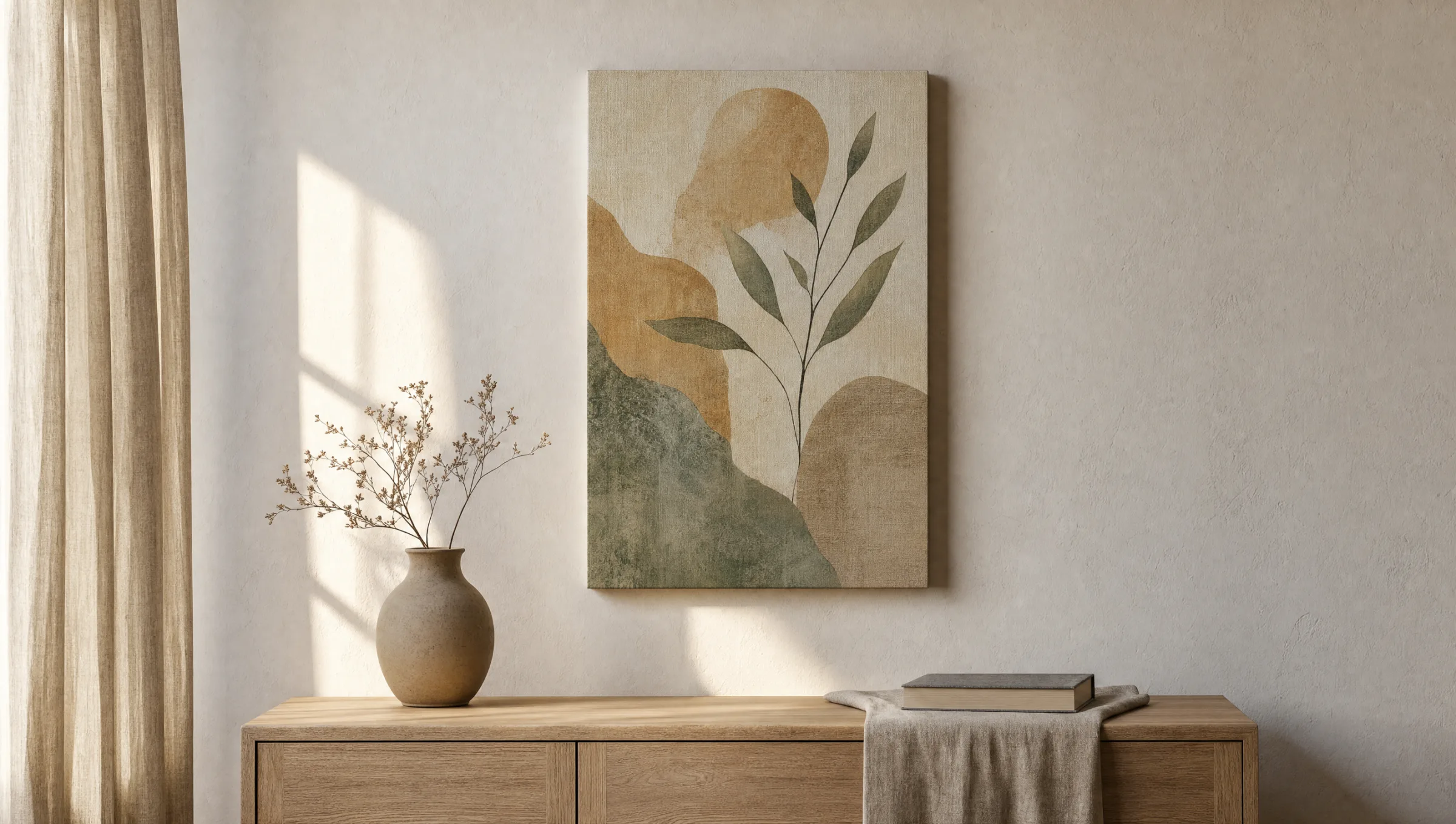
Canvas Print 40x60: Format, Motif and Placement at a Glance
The canvas print 40x60 is a mid-sized portrait format that works well in many interior situations: large enough to give a wall structure, compact enough to sit comfortably alongside existing furnishings. This overview looks at format, material properties, suitable motifs and placement in a straightforward editorial way.
Why the Canvas Print 40x60 Is a Versatile Standard Format
The 40 by 60 centimetre size is one of the most frequently requested wall art dimensions in Europe. It sits between smaller accent formats such as 30x40 and larger statement pieces from 70x100 upwards, offering a visual middle ground that neither gets lost on a wall nor dominates it. The 2:3 ratio corresponds to the classic 35mm photography format, which means motifs shot in that ratio can be reproduced without cropping.
A canvas print 40x60 works well on its own — as a single piece above a sideboard, for instance — or combined with other formats in a salon-style arrangement. Because the format is neither too narrow nor too wide, it fits equally into modern, Scandinavian and classic interiors. In flats and houses with standard ceiling heights of 2.4 to 2.6 metres, the proportions feel balanced without making the wall feel cluttered.
Four Rooms Where a Canvas Print 40x60 Works Well
The effect of any format depends heavily on the room it is placed in. These four situations show how a canvas print 40x60 can be used to good effect.
Above a Sideboard
In a living room, the portrait format complements a sideboard 140 to 180 cm wide, particularly when combined with a vase or lamp as an asymmetric counterpoint. The gap between the top of the furniture and the bottom of the canvas should be around 25 cm.
In a Hallway
Narrow hallways benefit from portrait formats because they draw the eye upward and make the wall feel taller. Two canvas prints 40x60 hung 10 to 15 cm apart form a calm mini-gallery without encroaching on the passageway.
In a Home Office
Above a desk, a restrained motif provides a visual resting point during screen work. Abstract colour fields or botanical studies are less distracting in this context than highly detailed photographs.
In a Bedroom
Above a bedside table, a canvas print 40x60 often replaces a second pendant light. The format sits well alongside lampshades with a diameter of 25 to 35 cm and creates a quiet symmetry towards the centre of the bed.
Material, Surface and Print Quality
A high-quality canvas print 40x60 consists of several layers: the base fabric in cotton or a cotton-polyester blend, a primer coat, the printed colour layer and a protective matte coating. At Reetro, the focus is on a finely textured canvas with a matte surface that produces no distracting reflections even under raking light. The stretcher frame is made from FSC-certified wood with a depth of around two centimetres. All prints are printed to order by a production partner in the EU.
A pigment-based printing process is used, which offers significantly greater light stability than dye-based inks. Combined with the matte coating, the motif remains colour-accurate for many years, provided prolonged direct sunlight is avoided. The edges of the canvas are either printed with a continuation of the image or held in a calm, colour-matched tone, so the side view looks as tidy as the front.
A format like 40x60 is rarely the focal point of a room, but it is often the piece at which the eye quietly settles upon entering.
From the Reetro editorial team
Choosing a Motif for Your Canvas Print 40x60
When selecting a motif, it pays to consider the existing colour palette of the room. Walls in white, light grey or warm off-white can carry motifs with clear accent colours — terracotta, sage or muted blue, for example. In rooms with stronger wall colours, a canvas print 40x60 tends to work better with restrained, monochrome or black-and-white motifs, so the artwork retains its own presence without competing with the wall.
In terms of subject matter, the portrait format suits motifs with a vertical composition: architectural details, single plants, stylised portraits, narrow landscape sections. Landscape-orientation photographs can technically be cropped to portrait, but this often compromises the original image. Anyone wanting to use an existing photograph should first check whether a 2:3 portrait crop retains the essential content of the image.
Canvas Print 40x60 Compared with Other Wall Objects
Compared with a framed poster, a canvas print 40x60 has more physical presence: the stretcher frame holds it visibly away from the wall, and no additional frame is needed, which reduces overall cost and maintenance. Compared with hexagonal aluminium wall prints, also available from Reetro, the canvas is warmer in character and considerably less reflective.
Anyone weighing up a canvas print 40x60 against an oversized poster from 70x100 upwards should factor in viewing distance. At seating distances under two metres, the mid-sized format usually feels more appropriate, as the eye can take it in comfortably. At greater distances — in open-plan living and dining areas, for example — a larger format may serve better.
Häufige Fragen
-
01
Which rooms suit a canvas print 40x60?
A canvas print 40x60 cm works well on mid-sized wall areas: above sideboards, desks, bedside tables or in narrow hallways. The portrait orientation reads as upright and composed, which also makes it a useful anchor piece in a gallery wall arrangement. In living rooms the size pairs naturally with smaller 20x30 or 30x40 prints. In a bedroom above the headboard of a single bed it creates a clear visual centre without overwhelming the wall.
-
02
How do I hang a canvas print 40x60 correctly?
The centre of the image should sit at roughly eye level, typically around 145 to 150 cm from the floor. For a canvas print 40x60, this means the top edge falls at approximately 175 cm and the bottom edge at around 115 cm. Above furniture, leave a gap of 20 to 30 cm between the top of the piece and the bottom of the canvas. A single nail or screw with a wall plug is usually sufficient; the low weight of the canvas makes specialist fixings unnecessary in most cases.
-
03
What motifs work well in the 40x60 format?
The portrait orientation suits motifs with a vertical composition: portraits, architectural details, botanical illustrations, abstract colour fields or landscapes with strong depth. Calm, graphic imagery tends to read particularly well at this medium size, whereas highly detailed photographs can sometimes benefit from more surface area. If you are unsure, mark the dimensions on the wall with masking tape and assess the motif mentally before committing.
-
04
How does a canvas print 40x60 differ from a poster of the same size?
The canvas is stretched over a wooden stretcher frame and sits roughly two to four centimetres proud of the wall, giving it a more three-dimensional, tactile quality with no additional frame required. A poster of the same dimensions is flat, lighter and usually less expensive, but needs a picture frame and mount to achieve a comparable finish. The surface of the canvas has a subtle texture that renders photographic motifs with a softer quality and makes painterly motifs feel more natural.
-
05
How do I care for a canvas print 40x60 over time?
Dust can be removed with a dry, soft microfibre cloth, working from top to bottom. Cleaning sprays, damp cloths and liquid products should be avoided as they can damage the colour layer. Prolonged direct sunlight — many hours every day — reduces colour stability in all print formats and should be avoided where possible. If the canvas hangs in a kitchen or bathroom, ensure adequate ventilation so that moisture does not accumulate on the stretcher frame.
-
06
How is the canvas print 40x60 from Reetro produced?
Reetro has its premium canvas prints produced to order by a production partner in the EU. A matte-coated canvas material is stretched over an FSC-certified wooden stretcher frame, and printing is carried out using a pigment-based process that delivers high colour depth and long-term light stability. Each canvas print 40x60 is individually finished, quality-checked and packed for dispatch so that the edges stay clean and the motif lies flat on the frame without distortion.