
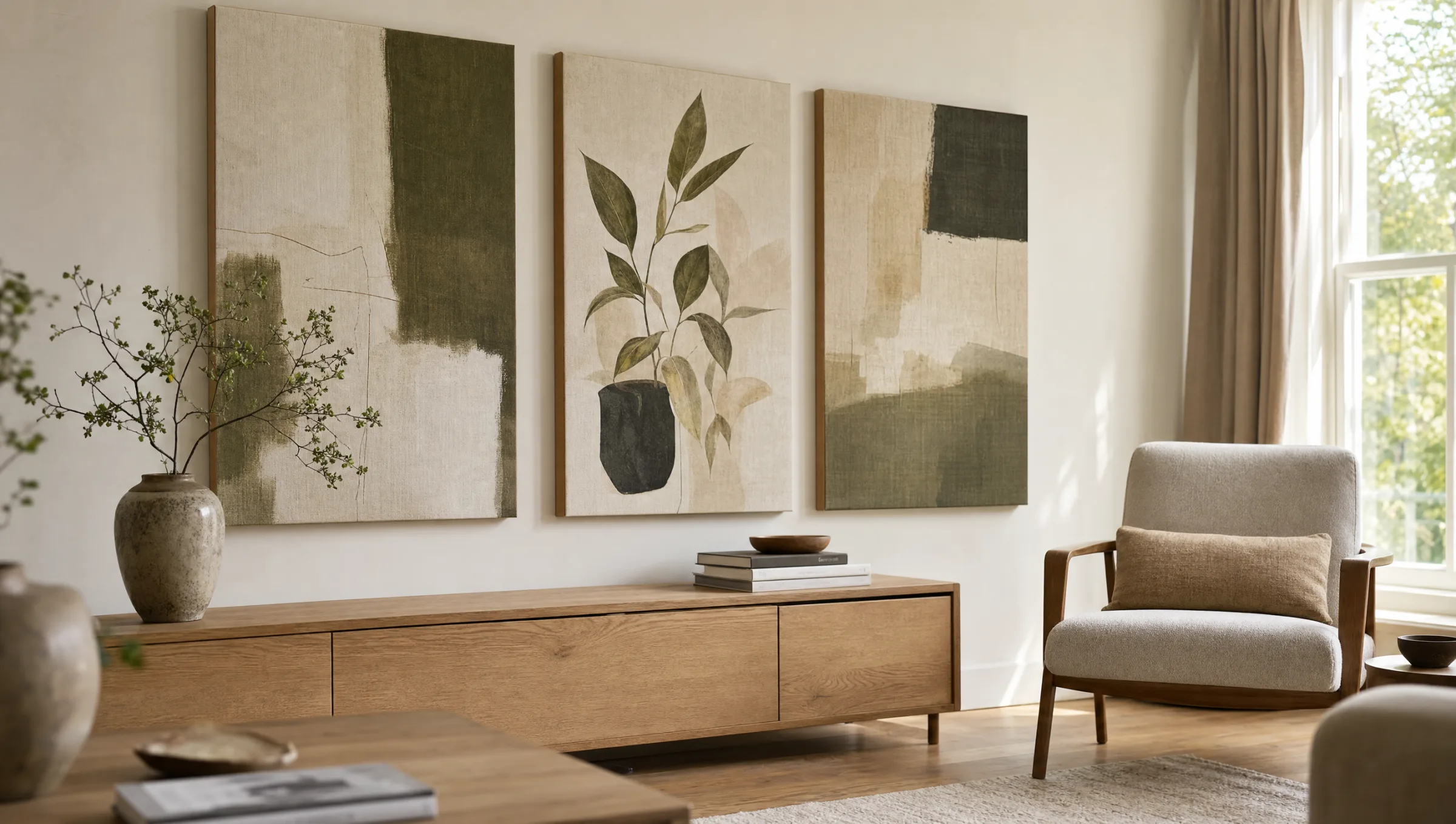
Acrylic Prints on Canvas – Styles, Formats and Hanging
Acrylic prints on canvas combine the depth of painterly expression with the tactile quality of a textile surface. This overview gives an editorial assessment of styles, formats and materials — so that your choice suits the room, the light and your own visual language, rather than following short-lived trends.
What Makes Acrylic Prints on Canvas Distinctive
Acrylic prints on canvas bring together two pictorial traditions: the painting technique of fast-drying, opaque acrylic colour and the classic support of stretched fabric. The result is a surface that reads more quietly than glass or metal — the textile weave absorbs light softly and prevents the hard reflections that often disturb the viewing of glazed prints.
Unlike original acrylic paintings, Reetro produces high-resolution reproductions and curated editions printed directly onto canvas. The colour application is pigment-based, UV-stable and matte-coated. This preserves the impression of a hand-painted work while reproducibility ensures consistent quality across every piece.
For the impact on a wall, the interplay of motif, fabric texture and stretcher-bar depth is decisive. Deeper frames (around 2 cm and more) allow the canvas to stand deliberately proud of the wall; shallower profiles read more graphically and integrate more quietly into gallery-style arrangements.
Styles That Work Particularly Well as Acrylic Prints on Canvas
Not every motif benefits from a textile surface — but certain styles gain considerably from the soft light absorption and tactile depth that canvas provides.
Abstract Colour Fields
Broad colour gradients, palette-knife textures and reduced compositions feel especially physical on canvas. The fabric structure complements the motif rather than competing with it.
Botanical Studies
Leaves, grasses and floral still lifes take on a slightly desaturated, painterly character on canvas — well suited to nature-inspired interiors featuring wood, linen and muted tones.
Modern Landscapes
Wide horizons, misty atmospheres and reduced coastal motifs gain depth through the matte weave. Reflections that fragment the pictorial space in glazed frames are entirely absent.
Line Art & Ink-Style Work
Black-and-white line work reads less stark on canvas than on glossy paper. The surface takes some of the hardness from the stroke and emphasises the drawn quality of the mark.
Formats, Proportions and Hanging Acrylic Prints on Canvas
With acrylic prints on canvas, format plays a significant role in how the image reads. Portrait orientations (e.g. 50 × 70 or 70 × 100 cm) work well alongside vertical furniture such as narrow sideboards or hallway units. Landscape formats suit the space above sofas, beds or long dining tables — a useful rule of thumb is an image width of roughly two-thirds of the furniture width.
For multi-piece arrangements, consistency is key: either align all canvases along a shared top edge, or centre them on a common horizontal axis at roughly 145 to 155 cm from the floor. Gaps between individual canvases should be 4 to 8 cm, so they read as a group without appearing cramped.
When hanging, the stretcher bar carries the weight. Two screws or picture hooks set in a horizontal line are more stable than a single fixing point and prevent the canvas from gradually tilting over the years.
A canvas is not a picture behind glass — it is an object that absorbs light rather than throwing it back. That changes the feel of a room in a perceptible way.
Reetro Editorial
Materials and Care for Acrylic Prints on Canvas
Quality comes from three components: the fabric, the primer and the colour application. Reetro uses a tightly woven cotton-polyester blend with multiple primer layers, mounted onto solid spruce stretcher frames. The matte coating protects against UV exposure and reduces dust adhesion. All production is printed to order by our production partner in the EU.
For everyday care, a dry microfibre cloth is all that is needed — gently wiped along the direction of the weave to remove surface dust. Cleaning agents, water and damp cloths are unnecessary and can damage the coating. As with any print, prolonged direct sunlight over many hours a day should be avoided.
Anyone storing acrylic prints on canvas for an extended period should keep them upright, with the image faces turned away from one another and acid-free tissue paper placed between them to prevent any surface contact.
Häufige Fragen
-
01
How do acrylic prints on canvas differ from acrylic glass prints?
Despite the similar naming, these are two distinct products. Acrylic prints on canvas are works printed or painted onto a textile fabric stretched over a wooden frame — the surface is matte and absorbs light softly. Acrylic glass prints, by contrast, are prints mounted behind a transparent acrylic sheet; they appear glossy, high-contrast and more reflective. Anyone looking for a painterly, calm presence on the wall will favour canvas; those who want photographic sharpness and a sense of luminous depth tend to prefer acrylic glass.
-
02
What size acrylic prints on canvas work well above a sofa?
A useful guideline is an image width of roughly two-thirds of the sofa's width. For a 220 cm sofa that means approximately 140 to 150 cm, either as a single large canvas or a two-panel arrangement with a gap of 4 to 8 cm. The bottom edge of the image should sit around 20 to 30 cm above the sofa back, creating a visual connection between furniture and wall art without making the canvas appear to rest on the upholstery.
-
03
Are acrylic prints on canvas lightfast?
High-quality acrylic prints on canvas are produced with pigment-based, UV-stable inks and finished with a protective matte coating. Under normal domestic conditions — indirect daylight and standard artificial lighting — the colours remain stable for many years. With prolonged, direct sunlight any print can fade over time, so rooms with south-facing windows and unshaded walls are generally less suitable for displaying artwork of any kind.
-
04
What is the best way to clean a canvas print?
In normal use, a dry, soft microfibre cloth is sufficient — gently wipe along the direction of the weave to lift surface dust. Water, cleaning sprays and damp cloths should be avoided, as they can damage the matte coating and leave marks. For heavier dust build-up, a soft brush or the brush attachment of a vacuum cleaner set to its lowest power can help — without making direct contact with the canvas surface itself.
-
05
Can acrylic prints on canvas be hung in a bathroom or kitchen?
Generally yes, with some reservations. In kitchens, canvases should be kept well away from the hob and extractor hood, since grease and steam can settle on the surface over time. In bathrooms, a guest WC or a well-ventilated room is preferable; sustained high humidity can cause wooden stretcher frames to expand and contract, altering the tension of the canvas.
-
06
What does Reetro focus on when producing acrylic prints on canvas?
Reetro has its prints printed to order by its production partner in the EU on a tightly woven cotton-polyester blend that is multiply primed and mounted onto solid spruce stretcher bars. Pigment-based, UV-stable inks are used throughout, finished with a matte protective coating that reduces reflections and repels dust. Motifs are drawn from an editorially curated selection, so that style, format and material quality are matched to one another — rather than being the product of undifferentiated mass manufacturing.