
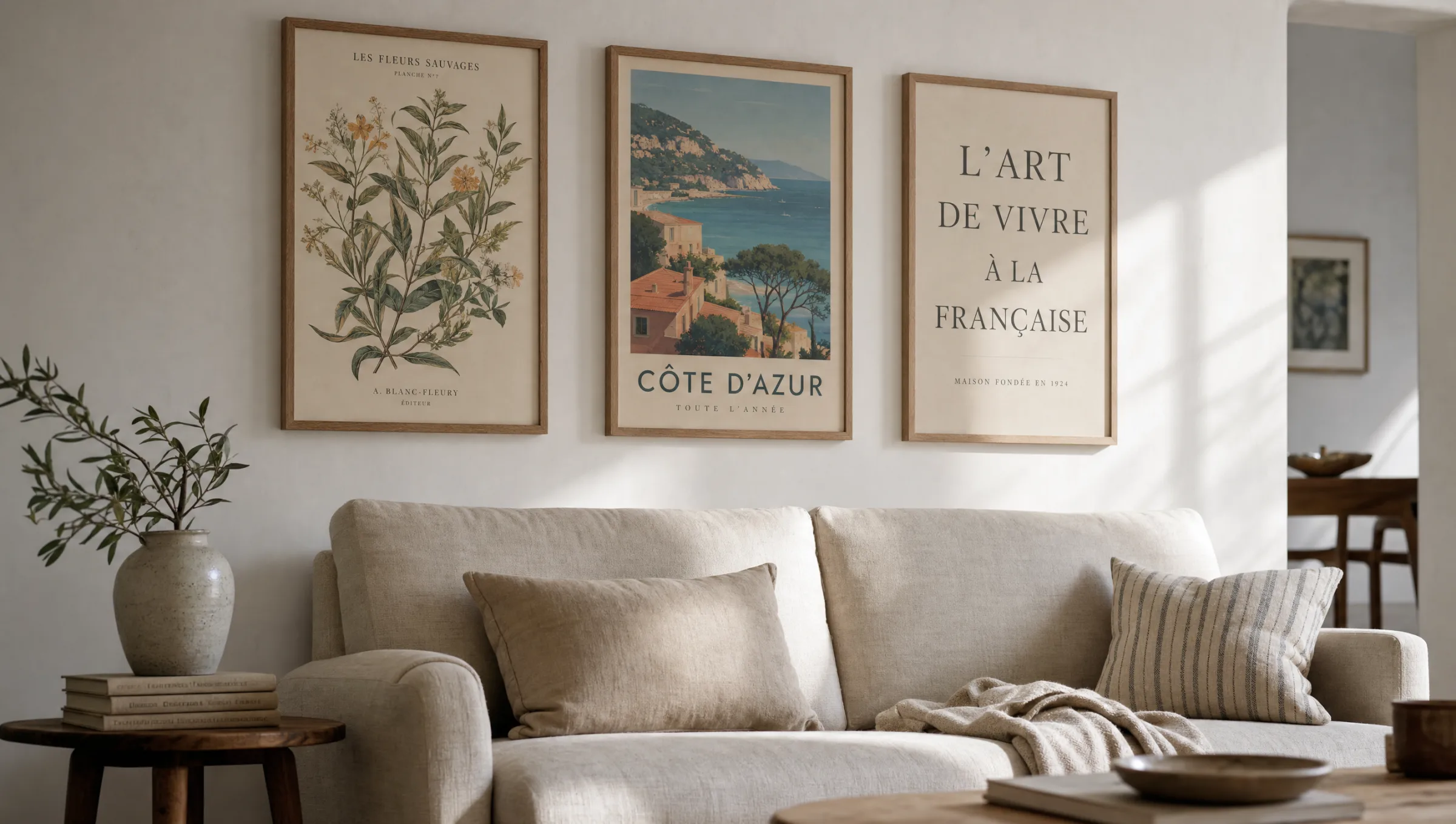
Vintage Posters – Timeless Motifs for Contemporary Walls
A vintage poster brings visual history into a room without veering into nostalgic kitsch. Whether botanical illustrations, 1930s travel prints or restrained typographic graphics: the aesthetic of aged print originals feels remarkably fresh in contemporary interiors. Reetro prints these motifs on FSC-certified paper from 200 g/m² with a matte coating – printed to order by our production partner in the EU.
What defines a vintage poster?
The term refers to prints that either reproduce original historical source material or deliberately adopt its visual characteristics. Typical hallmarks include muted colour palettes, serif typefaces from the letterpress era, visible halftone screens and slightly softened outlines. These formal qualities originally arose from the technical constraints of lithography and screen printing – today they are applied intentionally to evoke a particular atmosphere.
In terms of subject matter, several main categories can be distinguished: travel and tourism posters from the first half of the 20th century, botanical and zoological plates from natural-history atlases, art-exhibition posters, music and film prints, and advertising graphics from the interwar period. Each category carries its own typographic and chromatic language.
For the home wall, the choice between a faithful reproduction and a stylistic reinterpretation matters. Reproductions of historical prints are in the public domain and therefore licence-free, provided the source material is old enough. Reinterpretations offer greater creative latitude and can be adapted more readily to current formats and colour schemes.
Four styles of vintage poster for the wall
The range divides broadly into four visual directions. Each has its own spatial requirements and suits different interior concepts.
Botanical Plates
Illustrations from the 18th and 19th centuries depict plants with sober precision. Muted greens and ochre tones sit comfortably in bright, nature-inflected interiors. Well suited to kitchens, bathrooms or home offices.
Retro Travel Posters
Flat colour fields, simplified perspectives and bold headline typography are the defining features of the great railway and aviation posters of the 1920s to 1950s. On a living-room wall they make a calm yet present statement.
Typographic Prints
Posters that work almost entirely with text – quotes, slogans, alphabets – offer a minimalist alternative to image-based prints. Their effect depends heavily on typeface and paper tone.
Exhibition and Art Posters
Posters from early 20th-century art exhibitions – from the Bauhaus circle or the Wiener Werkstätte, for instance – combine a reduced formal language with strong recognisability. They suit clean, architecturally emphatic spaces.
Formats, paper and framing – practical guidance
A vintage poster realises its full effect largely through the chosen format. Smaller sizes such as 30 × 40 cm work well in grouped arrangements – so-called gallery walls – where several prints are combined in a loose composition. Mid-range formats from 50 × 70 cm function as standalone pieces in hallways or above desks. XXL formats from 70 × 100 cm create a clear focal point and require sufficient uninterrupted wall space.
Paper has a considerable influence on perceived authenticity. Matte coatings on 200 g/m² stock reduce reflections and come closest to the tactile quality of historical prints. Gloss paper can intensify colours, but noticeably alters the character of a vintage poster motif – often to its detriment.
For framing, simple wooden frames in natural, black or white are the most reliable choice. Brass or copper metal frames add their own accent that suits the Art Deco influence found in many retro motifs. Off-white or cream mounts create visual breathing room between motif and frame, reinforcing the curated quality of the print.
A well-chosen print needs no explanation – it settles into the room as though it had always been there.
Reetro Editorial
Care and longevity of vintage poster prints
Quality printing starts with the paper. FSC-certified papers with acid-free coating yellow far more slowly than standard art papers. Reetro uses exclusively lightfast pigment inks, ensuring colour stability over many years – provided the print is not hung in direct sunlight.
If a print is stored unframed, keep it in an acid-free portfolio, lying flat and unfolded. For transport, posters can be rolled and placed in a sturdy cardboard tube. Never fold across the width – creases become permanently visible in matte coatings.
Dust can be removed with a dry, soft cloth or a lens brush. Water and cleaning agents should be avoided on uncoated papers. Prints framed behind glass remain in excellent condition for decades, provided the glass is UV-filtering.
Vintage posters in a gallery wall – composition tips
A gallery wall of vintage poster prints works best with one defined connecting element: a consistent frame colour, a shared colour palette or a thematic thread. Mixing styles without any common ground quickly looks restless. Before hanging, it is worth trying out the layout on the floor and testing it with paper templates taped to the wall.
The visual centre of the arrangement should sit at eye level – generally 150 to 160 cm, measured from the floor to the midpoint of the grouping. Gaps of 5 to 8 cm between frames feel calm and structured; wider gaps allow the individual works to read more strongly as independent pieces.
Häufige Fragen
-
01
What distinguishes a vintage poster from a regular art print?
A vintage poster refers visually or thematically to historical print sources – typically from the period between 1880 and 1970. Characteristic features include muted colours, classical typography, halftone-screen textures and an often flat compositional structure. A general art print, by contrast, can encompass any contemporary or abstract graphic without reference to a historical style. The difference lies less in the printing technique than in the visual language of the source material.
-
02
What paper quality should a vintage poster have?
For an authentic look and feel, matte paper weighing at least 200 g/m² is recommended. Matte surfaces avoid distracting reflections and come closer to the tactile quality of historical lithographs than gloss paper does. Acid-free coatings slow yellowing considerably. At Reetro, FSC-certified papers from 200 g/m² with a matte coating and lightfast pigment inks are used, ensuring long-term colour stability for every vintage poster print.
-
03
How do I hang a vintage poster correctly without damaging it?
Prints framed behind glass can be hung with standard picture hooks without any difficulty. For unframed posters, dedicated poster hangers in wood or metal – narrow rails that clamp the paper – are the best option. Adhesive strips and hooks should only be applied at the very outer edge of the paper, as they can lift the coating when removed. Direct sunlight noticeably shortens colour fastness even in high-quality prints.
-
04
Which room size suits which vintage poster format?
As a general guide: in smaller rooms such as hallways or bathrooms (under 10 m²), formats up to 40 × 50 cm work well, alone or in pairs. Living rooms between 15 and 25 m² can comfortably accommodate 50 × 70 cm prints as a single piece or as part of a gallery wall. In large, open-plan spaces from 25 m² or with high ceilings, formats of 70 × 100 cm or above are needed to prevent the motif from appearing lost.
-
05
Are vintage poster motifs free to use under copyright law?
Many historical prints whose creators died more than 70 years ago are in the public domain – meaning they can be reproduced without licence fees. However, high-resolution scans or digital reconstructions of such originals may carry their own related rights. Purchasing a print grants the right to private use, not commercial reproduction. At Reetro, only motifs with a verified rights status are used.
-
06
Where are Reetro's vintage posters produced?
Each print is printed to order close to the customer: by our production partner in the EU for EU orders and in the US for US orders. Reetro uses FSC-certified papers, lightfast pigment inks and matte coatings from 200 g/m². Printing close to the customer keeps delivery routes short – every vintage poster print is inspected before dispatch. This applies to all formats, from small cabinet pieces to XXL prints.