
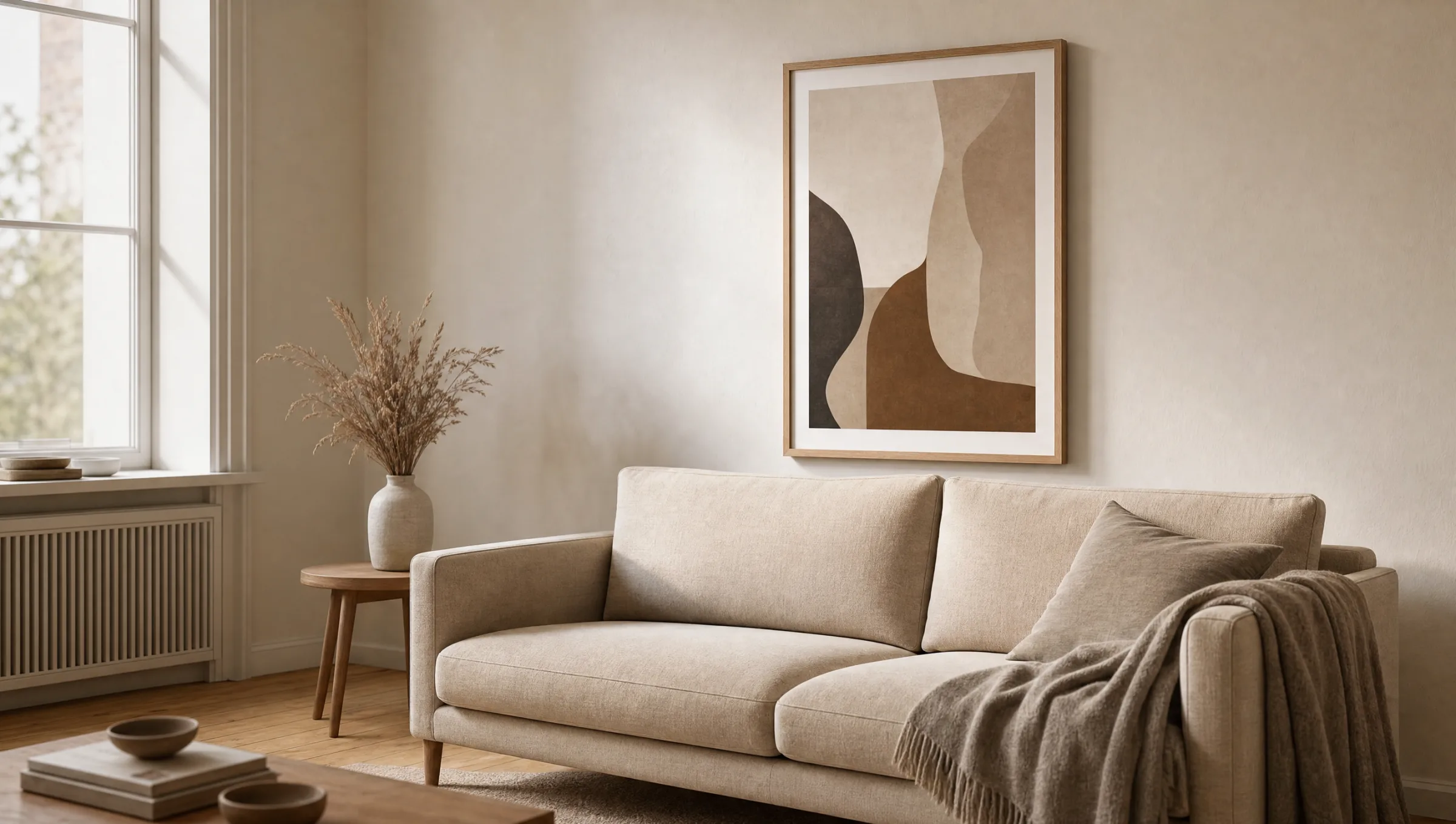
Poster 60x80: The Versatile Portrait Format for Living Spaces
The poster 60x80 is one of the most popular formats for wall art in residential spaces. Large enough to anchor a wall, compact enough to combine in a gallery arrangement. This overview offers an editorial look at the format, motif selection and framing considerations.
Why the Poster 60x80 Is So Popular
At 60 by 80 centimetres, this format sits precisely between the understated 50x70 classic and large-scale XXL prints. That middle position makes the poster 60x80 a flexible tool for wall design: above a two-seater sofa, alongside a dining table, or as a quiet anchor in the bedroom, it reads as present without visually dominating the room.
The ready availability of matching frames adds to its appeal. Many European manufacturers list 60x80 as a standard size, meaning off-the-shelf timber and aluminium frames can be used directly. This simplifies swapping motifs and supports a rotating, seasonal approach to wall arrangement.
Motif Categories That Work Well in a Poster 60x80
Not every motif benefits equally from a medium-sized portrait format. Four categories show themselves to be particularly well-balanced at this size.
Abstract Colour Fields
Reduced colour compositions and Bauhaus-influenced geometries gain volume in the 60x80 without tipping into the poster-like. The surface provides enough room for calm transitions.
Black-and-White Photography
Architectural and landscape photographs benefit from the vertical orientation. Details remain legible and the image structure does not feel cropped.
Botanical Illustrations
Single plants, leaf studies or herbarium motifs fill the portrait format naturally. In a dining room or hallway they create a quiet accent.
Typography and Editorials
Magazine-cover-style layouts and wordmarks need space for hierarchy. The 60x80 format allows generous white space around the typographic block.
Frames, Mounts and Hanging for the Poster 60x80
A poster 60x80 can be framed with or without a mount. With a mount opening of, say, 50x70, a calm border is created that settles the motif and produces a gallery-like effect. Without a mount the print reads more immediate and full-bleed — useful for abstract motifs that are composed right to the edge.
Three frame lines have established themselves: light oak for Scandinavian-influenced rooms, blackened mouldings for graphic motifs, and narrow aluminium profiles in anthracite or silver for photographic content. Profile width should sit between 15 and 25 millimetres so the frame carries the format without overwhelming it.
For hanging, a practical guide: the centre of the image sits approximately 145 to 150 centimetres above the floor. Above a sofa, a gap of 20 to 30 centimetres to the top of the backrest is recommended so that the poster 60x80 remains visually connected to the piece of furniture.
The 60x80 format is large enough to carry a wall, and small enough to be recombined later — a portrait format with genuine editorial flexibility.
Reetro Editorial
Paper, Print and Care
The quality of a poster is decided by the paper. For a poster 60x80, weights from 200 g/m² upwards are recommended — they remain dimensionally stable and frame cleanly. FSC-certified uncoated papers with a matte surface reduce reflections and render colours in a restrained yet precise manner.
Reetro prints its posters to order through its production partner in the EU on papers of 200 g/m² and above using pigment-based inks. The matte coating protects against fingerprints and minor abrasion during framing. For long-term preservation, a position away from direct sunlight and heat sources is advisable.
For cleaning, a dry microfibre cloth on the frame glazing is usually sufficient. The print medium itself should not be touched after framing, as matte surfaces are sensitive to skin oils.
Combining a Poster 60x80 in a Gallery Wall
Those wishing to combine several prints can use a central poster 60x80 as an anchor piece and group smaller formats such as 30x40 or 21x30 around it. A consistent frame style and a uniform gap of four to six centimetres between frames is important. Prints harmonise more easily when they share a common tonality — for example, muted earth tones, monochrome black and white, or a continuous pastel palette.
Häufige Fragen
-
01
What frame size fits a poster 60x80?
A poster 60x80 fits any frame with an internal dimension of 60x80 centimetres — this size is a widely available standard format across Europe. Those wishing to use a mount should choose a frame with an outer size of 60x80 and an inner opening of, for example, 50x70 or 40x60. A profile width of between 15 and 25 millimetres ensures the frame carries the format without visually overpowering it.
-
02
Above which pieces of furniture does a poster 60x80 look balanced?
The format works particularly well above two-seater sofas, narrow sideboards, console tables and double beds with a headboard. A useful rule of thumb: the piece of furniture should be at least one and a half times as wide as the poster for the proportions to feel balanced. Above dining tables with eight seats or wide three-seaters, a larger format or a combination of several 60x80 posters placed side by side tends to work better.
-
03
Which motifs are best suited to a poster 60x80?
Portrait-oriented motifs naturally work best: vertical landscape details, architectural photographs, botanical studies, abstract colour fields and typographic editorial layouts. Landscape-format ideas should not be forced into a portrait orientation, as important areas of the image will be lost in the process. For landscape motifs, the rotated 80x60 variant is the cleaner solution.
-
04
How do I hang a poster 60x80 correctly?
The centre of the image should sit approximately 145 to 150 centimetres above the floor — in line with average eye level. Above furniture, the bottom edge of the frame is placed 20 to 30 centimetres above the top of the piece, creating a visual connection. For a secure hold, two wall hooks spaced around 30 centimetres apart work well; for heavier frames with glass, wall plugs are preferable to adhesive hooks.
-
05
What paper quality makes sense for a poster 60x80?
From the 60x80 format upwards, paper should weigh at least 200 g/m² to remain dimensionally stable and avoid warping during framing. Matte FSC-certified papers with pigment-based printing reproduce colours precisely and with minimal reflection. Reetro prints its posters to order through its production partner in the EU on papers of 200 g/m² and above with a matte coating — a standard suited to both framed wall art and extended display periods.