
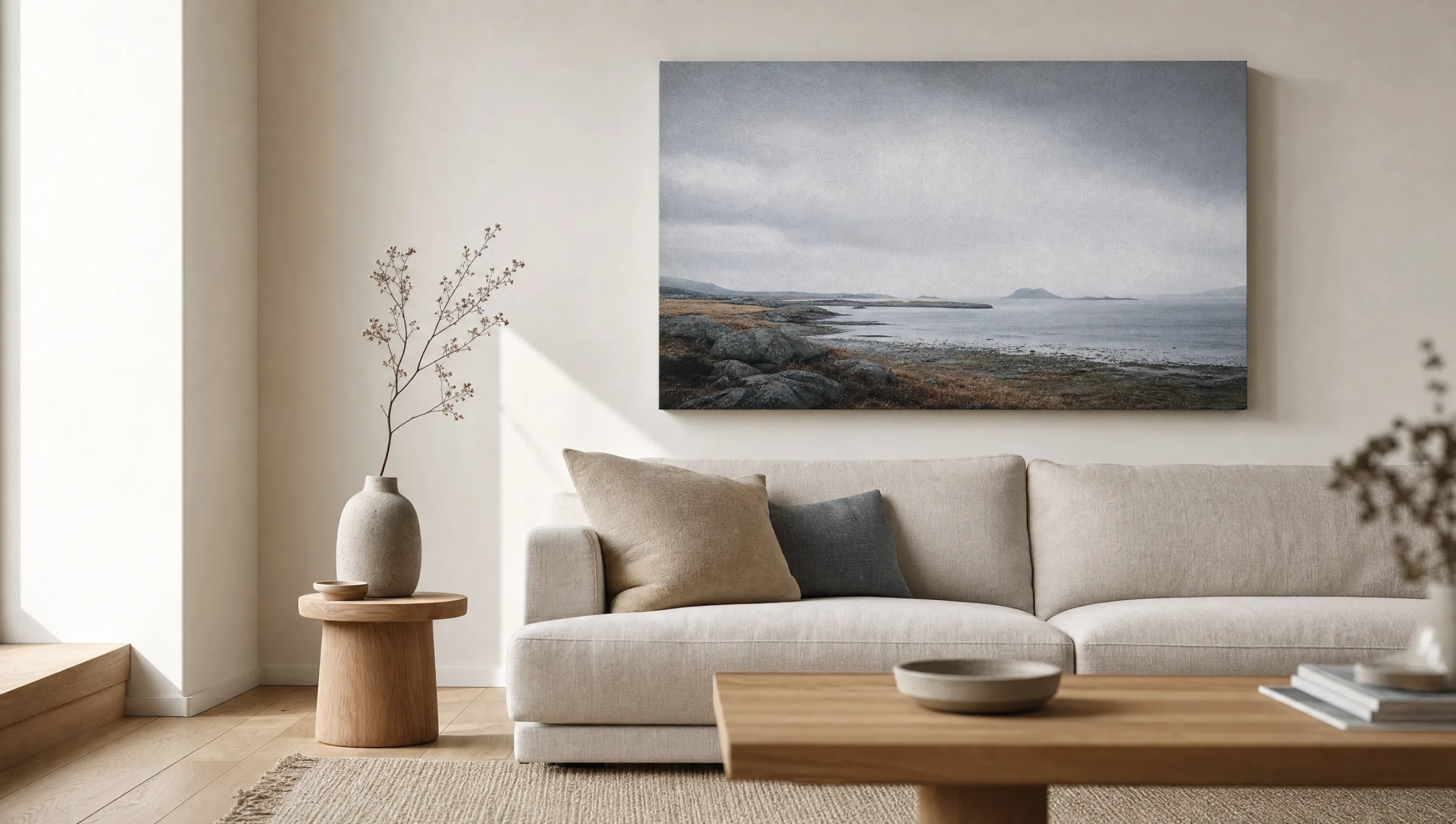
Landscape Canvas Prints: Motifs, Materials and Hanging
Landscape canvas prints combine a calm visual presence with a textile surface that scatters light softly. This overview organises motif groups, explains format and stretcher-frame options, and covers what to look for when choosing, hanging and caring for a canvas in a living space.
Why Landscape Canvas Prints Feel So Present on the Wall
Canvas lends landscape motifs a particular sense of calm. Its slightly rough surface breaks incoming light, making sky gradients, banks of mist or stretches of water appear less glossy — yet more three-dimensional — than they would on smooth photographic paper. Large-format nature photography benefits especially, because harsh reflections are avoided and the image remains readable from every angle in the room.
There is also the three-dimensional effect that a stretcher frame creates. Instead of a flat picture plane, a gentle relief sits against the wall — an effect that further reinforces the sense of depth so characteristic of landscape motifs. Anyone wanting to bring a photograph of a coastline, forest or mountain panorama into a living space will find that a landscape canvas print is a medium that feels complete even without an additional frame.
Popular Motif Groups for Landscape Canvas Prints
Landscape photography covers a wide range of subjects. Four motif groups define Reetro's editorial selection in particular — each with its own visual language and effect in a room.
Mountain Panoramas and Alpine Scenes
High-altitude shots layered with mist and rock suit long walls in landscape format. They bring order to a room and read clearly even in restrained colour palettes.
Coastlines, Sea and Open Water
Beaches, tranquil lakes or open North Sea landscapes bring a sense of expanse to a living room. The textile canvas surface softens hard horizons and supports a more relaxed visual mood.
Forests and Misty Landscapes
Dense trees and diffuse light are classic subjects for interiors with muted colour schemes. A matte canvas surface pays dividends here, showing depth of detail without any glare.
Fields, Dunes and Minimal Landscapes
Reduced horizon shots with large areas of flat colour work especially well above a sofa or sideboard. They provide visual quiet without thematically overloading the room.
Formats and Stretcher Frames for Landscape Canvas Prints
Format should follow the motif. Wide panoramas call for broad landscape formats from around 100 × 70 cm; classic forest or pathway shots also work well in a more compact 70 × 50 cm. Portrait formats suit narrow wall segments — beside doors or in hallways — and emphasise vertical arrangements such as waterfalls or tree trunks.
Stretcher frames come in shallow versions of around 2 cm depth and gallery-grade frames from 4 cm upwards. Deeper stretcher frames read as more confident in a room and cast a fine shadow onto the wall. The canvas itself should be sufficiently firm to prevent warping — a point that matters most with XXL formats.
Print method is equally important for image quality. Pigment-based inks on a matte, acid-free canvas ensure colour stability over many years. An additional protective coating guards against dust and light contact without making the surface shiny — a quality standard that distinguishes a well-made landscape canvas print from a budget alternative.
A good landscape canvas does not need to shout. Its job is to open up the room, not to overwhelm it.
Reetro Editorial
Hanging and Room Effect of Landscape Canvas Prints
A useful rule of thumb: the centre of the image sits at roughly 145 to 150 cm from the floor — close to average standing eye level. Above sofas or sideboards, the picture moves slightly lower to align with the furniture; around 20 to 30 cm of space between the top of the furniture and the bottom edge of the canvas keeps the visual line calm without the motif appearing to float.
Large formats read best alone and with clear wall space around them. Several smaller canvases can be grouped into a horizontal row, provided they are thematically related — three coastal motifs in a similar quality of light, for example. Mixing landscape and portrait subjects rarely works well; the visual language stays cleaner when one subject dominates.
Light also plays a role. Direct sunlight over sustained periods shortens the colour stability of any canvas. Indirect daylight or warm-white light sources at 2700 to 3000 Kelvin bring nature motifs out without distorting their colours — a consideration worth keeping in mind when choosing where to hang a landscape canvas print.
Care and Longevity
Canvas is easy to care for but sensitive to moisture. Dust can be removed with a dry, soft microfibre cloth, wiping in the direction of the weave. Cleaning products should be avoided, as they can damage the protective coating. For more stubborn marks, a lightly dampened cloth is sufficient, followed by a dry wipe.
Rooms with strongly fluctuating humidity — bathrooms or directly alongside a kitchen worktop — are not ideal for canvas prints. In dry, well-ventilated living spaces, well-produced landscape canvas prints will hold their colour and structure for many years without any visible change.
Häufige Fragen
-
01
What size should a landscape canvas print be?
It depends on the motif and the wall. Wide panoramas — mountains, coastlines, fields — work well from around 100 × 70 cm in landscape format. Above a standard sofa of 2 to 2.4 metres, formats between 120 × 80 cm and 140 × 100 cm are common, allowing the image to echo the line of the furniture without overpowering it. For hallways, dining niches or walls beside doors, a more compact 70 × 50 cm is sufficient. As a general guide, the canvas should occupy roughly two thirds of the furniture width below it — any smaller and it tends to look lost.
-
02
How does a landscape canvas print differ from a poster behind glass?
Canvas has a textile, slightly rough surface that scatters light and avoids reflections. It is stretched over a frame and needs no additional picture frame, which gives it a more spatial presence. A poster behind glass shows finer detail and sharper contrast but is more vulnerable to glare and tends to look visually flatter. For classic landscape photography with soft tonal transitions, a landscape canvas print is often the quieter choice; for graphic or typographic subjects, the framed poster remains the more precise option.
-
03
Which motifs work best as landscape canvas prints?
Motifs with clear depth layering and a restrained colour palette work well: mist-covered forests, wide coastal panoramas, mountain ranges arranged in multiple planes, or minimal dune and field landscapes. Heavily saturated, very detailed images — such as intense sunsets with intricate cloud structures — can lose sharpness on canvas because the weave texture remains visible. Anyone wanting to reproduce the finest detail should use high-resolution source files and, when in doubt, choose a slightly larger format so the image reads clearly through the texture.
-
04
How do you care for a canvas print properly?
In everyday use, regular dry dusting with a soft microfibre cloth along the direction of the weave is all that is needed. Chemical cleaners, glass cleaners and furniture polish should be avoided, as they attack the canvas's protective coating. For heavier soiling, a lightly dampened cloth works well — follow with a dry wipe. Sustained direct sunlight shortens colour stability and should be avoided. Rooms with strongly fluctuating humidity, such as bathrooms, are unsuitable for canvas prints.
-
05
At what height should a landscape canvas print be hung?
The classic rule places the centre of the image at around 145 to 150 cm from the floor, which corresponds to average standing eye level. Above furniture, the furniture edge takes priority: leave 20 to 30 cm between the top of a sofa or sideboard and the bottom edge of the canvas. For wide landscape formats, align the canvas to the central axis of the furniture rather than the centre of the wall. When combining several canvases, a consistent gap of around 5 to 8 cm between them creates a coherent, orderly overall line.
-
06
What print quality does Reetro use for landscape canvas prints?
Reetro produces landscape canvas prints to order through its production partner in the EU using pigment-based inks on matte, acid-free cotton-polyester fabric. Each print is then hand-stretched onto solid stretcher frames made from FSC-certified wood. A protective coating reduces dust and light contact without adding any sheen to the surface. The editorial selection focuses on nature photography with a clear visual language; motifs are colour-calibrated before printing so that skies, water and earth tones retain their natural depth.