
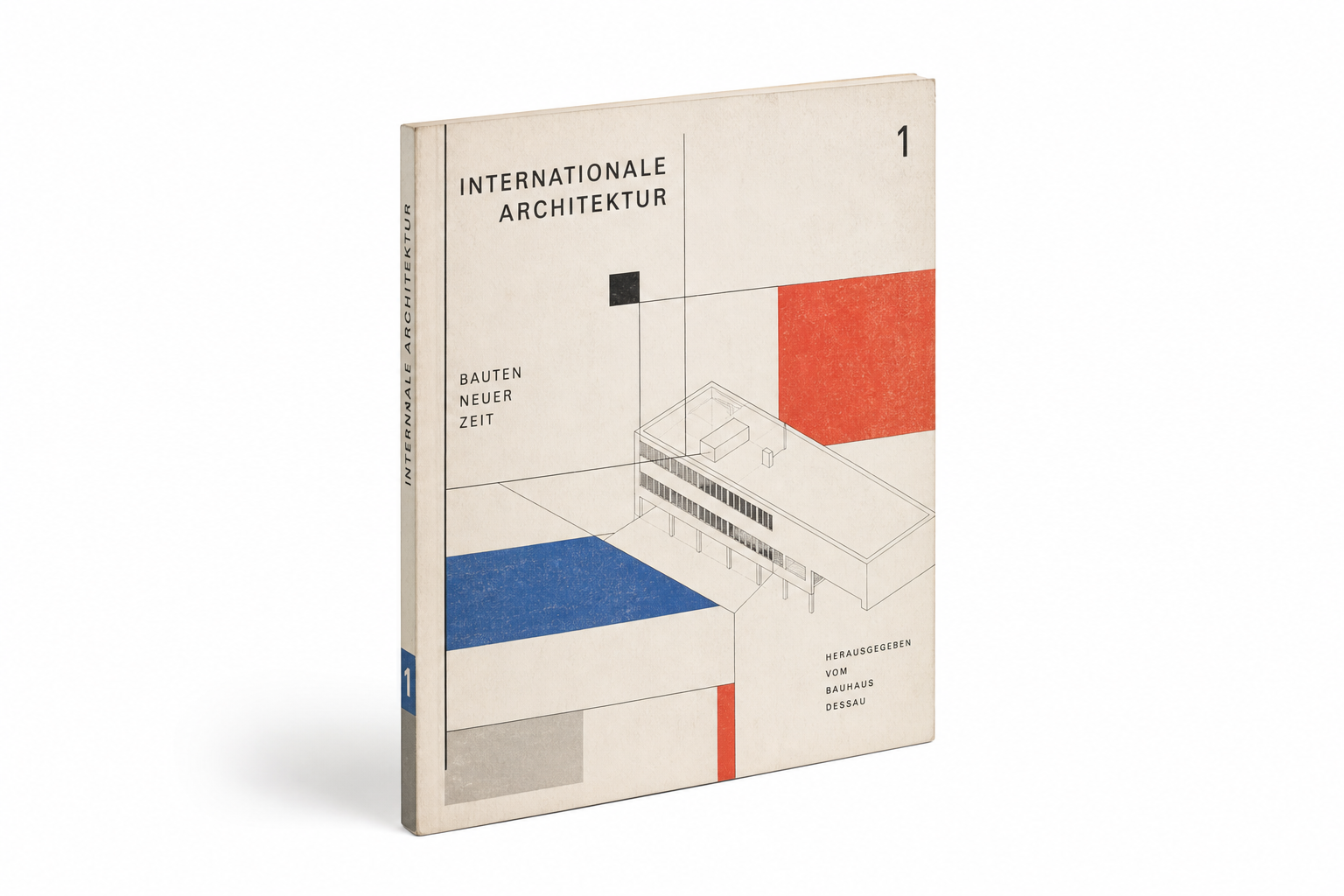
Internationale Architektur feels compelling for Reetro because the book does not merely discuss modernism; it stages it as a compact printed object. The Heidelberg University Library IIIF manifest lists the volume as Internationale Architektur, edited by Walter Gropius and published in Munich in 1925. Even that concise bibliographic frame matters: the object belongs to early Bauhaus communication itself, not to a later retrospective retelling of it.
Volume one of a larger Bauhaus publishing line
The Bauhaus-Archiv describes the Bauhausbücher as a series of 14 books published by the Bauhaus between 1925 and 1930, authored by teachers and friends of the school. Within that framework, Internationale Architektur reads less like an isolated title than like the opening move in a deliberate publishing programme that translated ideas from art, design, and architecture into reproducible book form. For Reetro, that editorial format is nearly as important as the content itself.
Not a heavy monument, but a precise working book
The Berkeley record for the second revised edition from 1927 makes the object unusually concrete. There, Internationale Architektur appears as Bauhausbücher 1, published in Munich by Albert Langen Verlag, with 111 pages, “chiefly illustrations,” and a height of 24 cm. The same record notes a foreword to the second edition dated July 1927 and the phrase “copyright 1925” on the title-page verso. That makes the volume feel less like a monumental statement than like a slim, image-driven working book of modern architecture.
Why the printed form matters so much
What stands out for Reetro is the way architecture is communicated here through sequence, reproduction, and page order. A 111-page book made up chiefly of illustrations turns modernism into something browsable rather than distant and theoretical. The Heidelberg digitization of the 1925 volume and the Berkeley details for the revised edition together suggest a printed object that relies less on decorative abundance than on editorial compression. That is precisely why it can still feel calm and contemporary now.
Why it fits Reetro
For Reetro, Internationale Architektur fits because it makes modernity legible through restraint, structure, and white space. The book is not loud; it is exact. If you respond to that kind of disciplined image sequence and reduced architectural order, it often leads to crisp posters or restrained framed art where surface, grid, and materiality matter more than effects. As an early Bauhaus print object, the volume is a reminder that design often becomes stronger when it stays light enough to think with.
Sources
- Heidelberg University Library, Internationale Architektur (Munich, 1925)
- Heidelberg University Library, IIIF manifest for Internationale Architektur
- UC Berkeley Library Digital Collections, Internationale Architektur (2nd revised edition, 1927)
- Bauhaus-Archiv / Museum für Gestaltung, Bauhausbücher 1–14