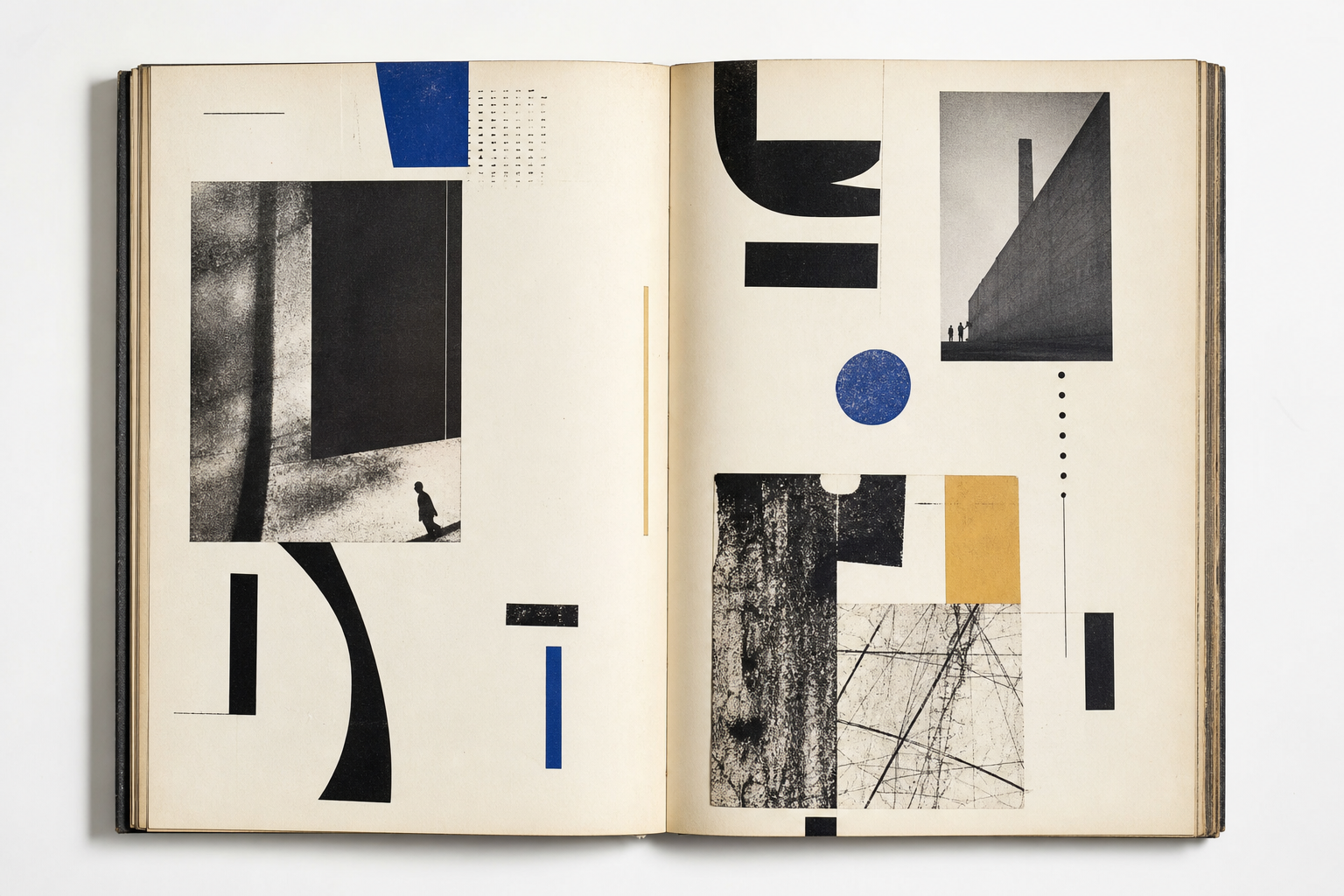
The Medium Is the Massage: An Inventory of Effects is one of those books where form and argument do not sit side by side as separate layers. According to Wikipedia, the book was co-created by Marshall McLuhan and Quentin Fiore, coordinated by Jerome Agel, and published in 1967. That is what makes it so compelling for Reetro: not only the media theory, but the printed object itself — a paperback that makes its claims tangible through sequence, imagery, typography, and pacing.
A book that performs its thesis as print
Wikipedia describes the volume as an experimental collage in which text is superimposed on images, some pages are printed backwards, and others are left nearly blank. That is why The Medium Is the Massage reads less like a conventional essay collection than a series of deliberately edited print shocks. Its ideas about media do not arrive only in sentences; they appear in the rhythm of the pages themselves.
McLuhan, Fiore, and Agel in a very concrete 1967 format
The Open Library record for edition OL5540159M lists a 1967 Bantam Books edition with 159 pages and names Marshall McLuhan and Quentin Fiore alongside Jerome Agel as coordinator. That matters because it frames the book not only as theory, but as a mass-circulating paperback. Its modernity was not locked away in deluxe form; it lived inside a printed format meant to travel widely.
Why the title matters beyond the famous typo
Wikipedia also preserves the best-known title anecdote: message became massage in typesetting, and McLuhan reportedly answered, “Leave it alone! It’s great, and right on target!” Even if the line has long since become design folklore, it fits the book unusually well. The project does not simply explain media in neutral prose; it demonstrates how media shape attention, perception, and bodily experience — how they “massage” the sensorium.
A durable entry in print history
The Internet Archive record for a later Gingko edition describes the book as “159 p. : 18 cm” and also notes “Originally published: New York : Random House, 1967.” Read together with the 1967 Open Library editions, that makes The Medium Is the Massage legible not only as a cult title, but as a durable printed artifact with a clear bibliographic trail. That is a strong fit for Reetro: if you respond to controlled collage surfaces, hard black-and-white contrast, and airy typography, it often leads to crisp posters or restrained framed art where a wall can behave almost like a page.