
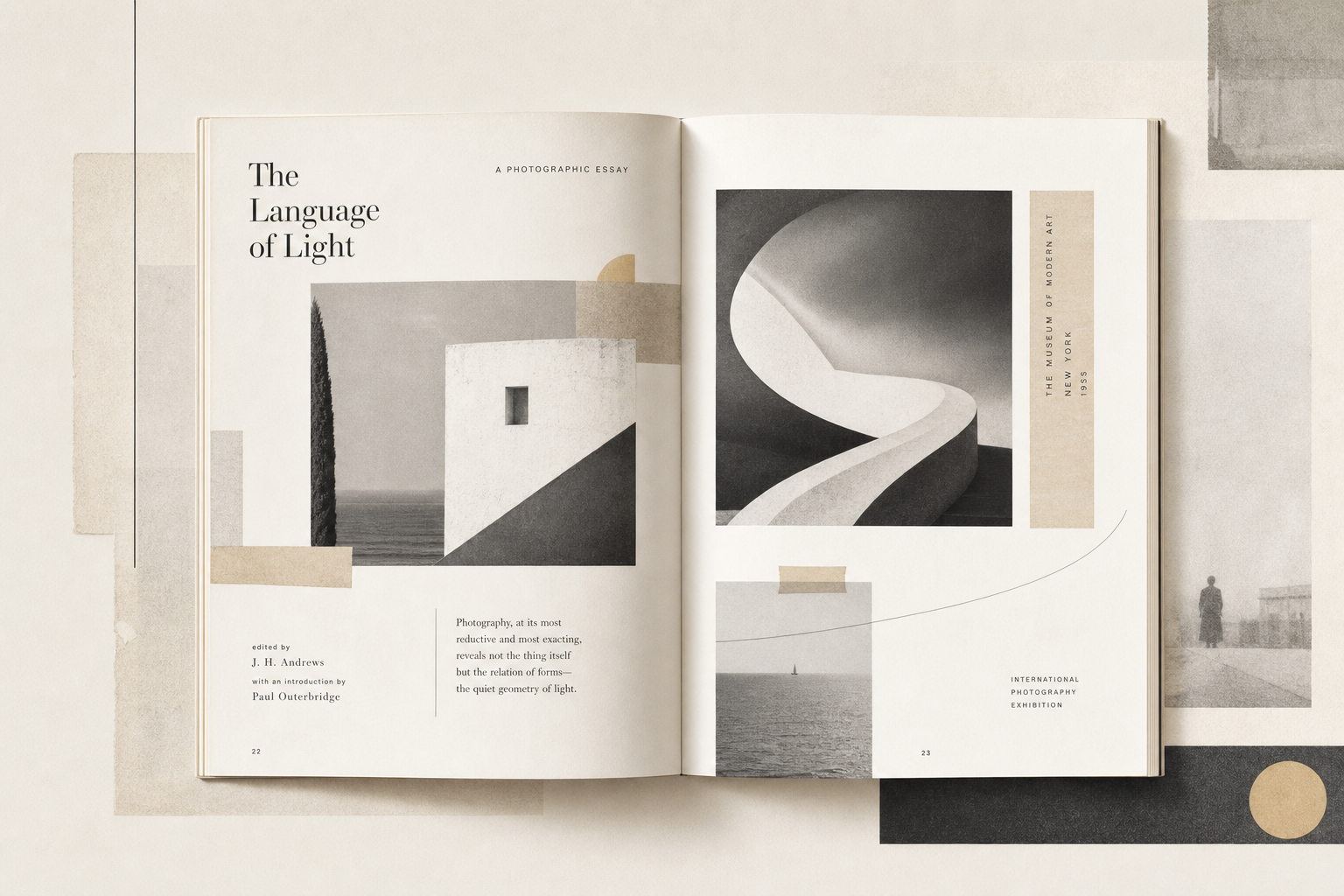
The 1955 catalog for The Family of Man feels compelling for Reetro because it does more than document an exhibition: it translates that exhibition into a portable print object. Wikipedia notes that the show assembled 503 photographs from 68 countries and was curated by Edward Steichen for the Museum of Modern Art. That already makes the book legible as a condensed image world shaped directly by exhibition thinking rather than by later retrospective packaging.
A catalog that turns an exhibition into a book
The basic framework is clear in Wikipedia’s summary: The Family of Man opened at MoMA in 1955, was curated by Steichen, and took its title from a line by Carl Sandburg. A 1955 Internet Archive record for The family of man; the greatest photographic exhibition of all time—503 pictures from 68 countries— lists the publisher as the Maco Magazine Corp., publishing for the Museum of Modern Art. That makes the catalog readable as a direct continuation of the exhibition itself, not merely as a later memorial object.
Multiple 1955 editions, but not generic mass paper
A second Internet Archive record is especially useful because it describes the 1955 Simon and Schuster edition as The family of man : the photographic exhibition, with 207 pages and a height of 29 cm. The same description notes that the project also appeared in a standard 192-page edition and a 256-page Pocket Book edition. Open Library confirms 1955 as the work’s first publication date and also lists 207 pages for the 1955 Simon and Schuster edition. That matters because the catalog emerges not as a single deluxe artifact, but as a deliberately tiered publishing system.
Leo Lionni, Jerry Mason, and a constructed image sequence
The print-production details make the object especially vivid. The Simon and Schuster metadata at the Internet Archive names Jerry Mason as editor, Leo Lionni as art director, Dorothy Norman for captions, and Allied Graphic Arts, Inc. for production. The same record also notes that pages 195 to 207 contain a special portfolio of Ezra Stoller’s photographs of the exhibition at the Museum of Modern Art, with installation design by Paul Rudolph and photographic footnotes by Wayne Miller, included only in that edition. In other words, this is not a neutral container of photographs but a carefully staged sequence of images, captions, and exhibition residue on paper.
Why it fits Reetro
For Reetro, the catalog matters because it compresses photography, typography, and white space into a calm surface that feels almost wall-like. It is neither just an image archive nor just a museum souvenir, but a mid-century printed object with a clear editorial attitude. If you respond to that kind of quiet black-and-white sequencing and measured image rhythm, it often leads to large-format posters or restrained framed art where surface and composition matter more than sheer visual noise.