
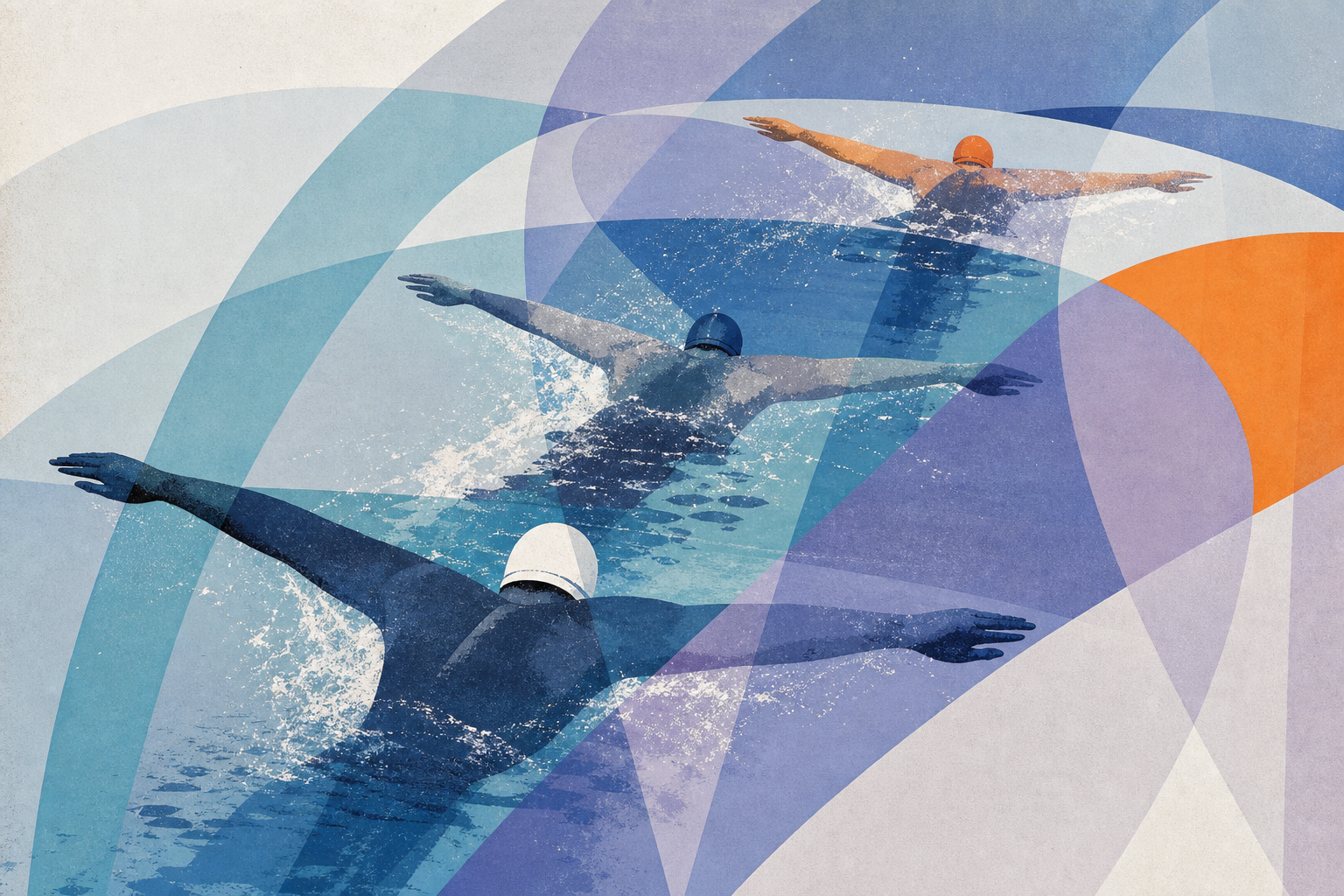
Otl Aicher’s poster München (Munich) 1972 shows very clearly why the printed materials of the 1972 Olympic Games still function as a benchmark. Cooper Hewitt lists the sheet as a 1972 poster designed by Otl Aicher, printed by Franzis-Druck in Munich, and made for the Munich Organizing Committee of the 1972 Olympic Games. The museum also gives the medium and size precisely: offset lithograph on paper, 118.4 × 83.8 cm.
What is actually on the sheet
Cooper Hewitt’s object description is especially useful here. It describes the motif as an image of three swimmers in the middle of a butterfly race. The photograph is overlaid with intensely saturated colour: the athletes in bright orange, the pool and water in purples and blues. At bottom left, orange sans-serif text reads “München” and “1972,” accompanied by the Olympic rings and the Munich Olympic emblem in white. So the poster is neither pure photography nor pure typography, but a tightly controlled print built from image, colour, and wayfinding logic.
Why this is more than a single sports poster
Poster House describes the graphic program of the 1972 Munich Games as a design achievement that many still regard as one of the best-designed Olympics. Crucially, it also notes that the program was not simply the work of a lone genius: Aicher was the central figure, but a team worked on the visual system for nearly six years. That is why the poster feels so strong. It reads as a self-contained sheet while clearly remaining part of a much larger order.
Colour as a signal of modernity
The official Otl Aicher site from the IDZ summarizes the effect in a concise way: with the colourful visual identity of the 1972 Games in Munich, Aicher sent a signal, and the young Federal Republic had arrived in modernity. A second article on the same platform explicitly attributes the visual identity to Dept. XI, an international team of graphic designers, illustrators, and technical staff. That context is what makes München (Munich) 1972 so interesting as a printed object: the poster is attractive, but it is above all one module in a broader public communication system.
Why it fits Reetro
For Reetro, the appeal lies in the balance. Photography remains visible, yet colour, contrast, and clean typography translate it into something almost abstract. If you like that kind of strict but not cold visual language, it often leads to large-format posters or more quietly staged canvas prints where a single motif holds a room through rhythm rather than detail. Aicher’s sheet shows how powerful printed sports graphics can be when they trust system more than pathos.