
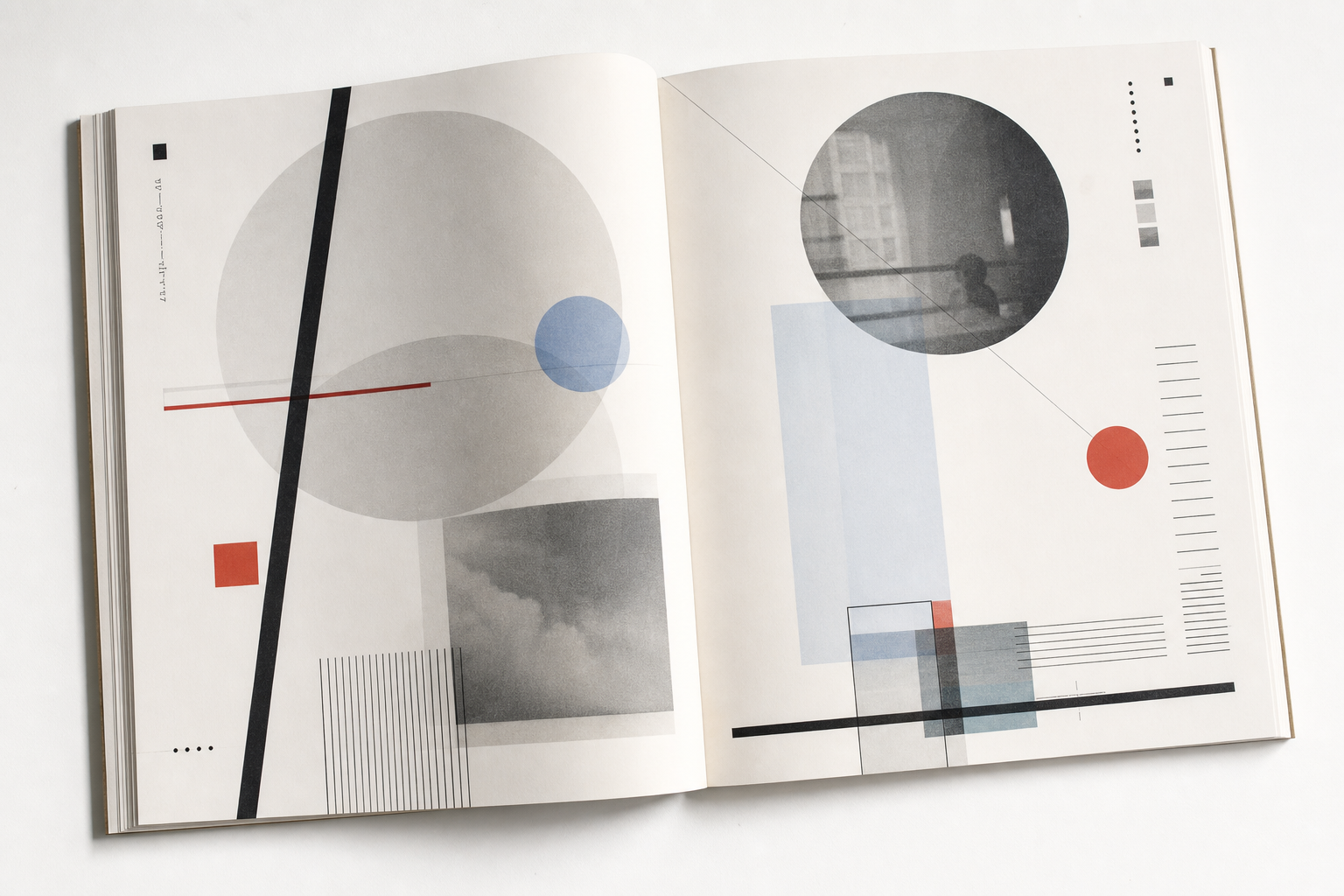
Malerei, Photographie, Film feels relevant for Reetro because the book reads like a compact laboratory of early modernism. The 1925 Open Library edition names Albert Langen as publisher and records 133 pages. The Metropolitan Museum of Art’s catalog entry for its copy also fixes the object in 1925 and describes it as a volume with 133 pages, one folded plate, and a height of 24 centimeters. That already makes the book tangible as a precisely made printed object rather than only as a theory title cited after the fact.
A slim Bauhaus book with clear material presence
The material facts are especially strong here. The Met’s entry for Malerei, Photographie, Film places the copy in the museum’s libraries and specifies 133 pages plus a folded plate. Open Library lists the same 1925 edition with 133 pages and Albert Langen as publisher. For Reetro, that matters because modernism appears here not only as style but as a portable, well-proportioned print format.
By 1927, a second version appears with a new spelling
The trail does not stop in 1925. The Met also holds an object titled Malerei, Fotografie, Film, dated 1927 and already using the now more familiar spelling without the ph in Fotografie. Open Library lists that 1927 edition at 140 pages and names A. Langen as publisher. The records therefore support a careful conclusion: the book did not remain a one-off print event, but circulated in at least one later version whose title spelling and extent shift slightly.
From the photogram to typophoto and onward to film
The book is also notably broad in scope. The Internet Archive description of the English translation, Painting, photography, film, explicitly mentions Rayographs, camera-less image making, collages, montages, and Moholy-Nagy’s thoughts on the relationship between type, sound, and visual perception. The contents reproduced there also include chapters such as Photography without camera. The photogram, Typophoto, Simultaneous or poly-cinema, and Dynamic of the Metropolis: Sketch for a film, also typophoto. For Reetro, that is the real draw: the book treats print, photography, and moving image not as separate media but as one connected modern surface.
Why it fits Reetro
Malerei, Photographie, Film fits Reetro because it shows a strikingly light and systematic version of modernism. If you respond to that mix of paper-white space, geometry, photographic abstraction, and strict typography, it often leads to crisp posters or restrained framed art where surface, rhythm, and visual order matter more than decoration. As a book from 1925, it remains a strong reminder that printed form can carry thought on its own.