
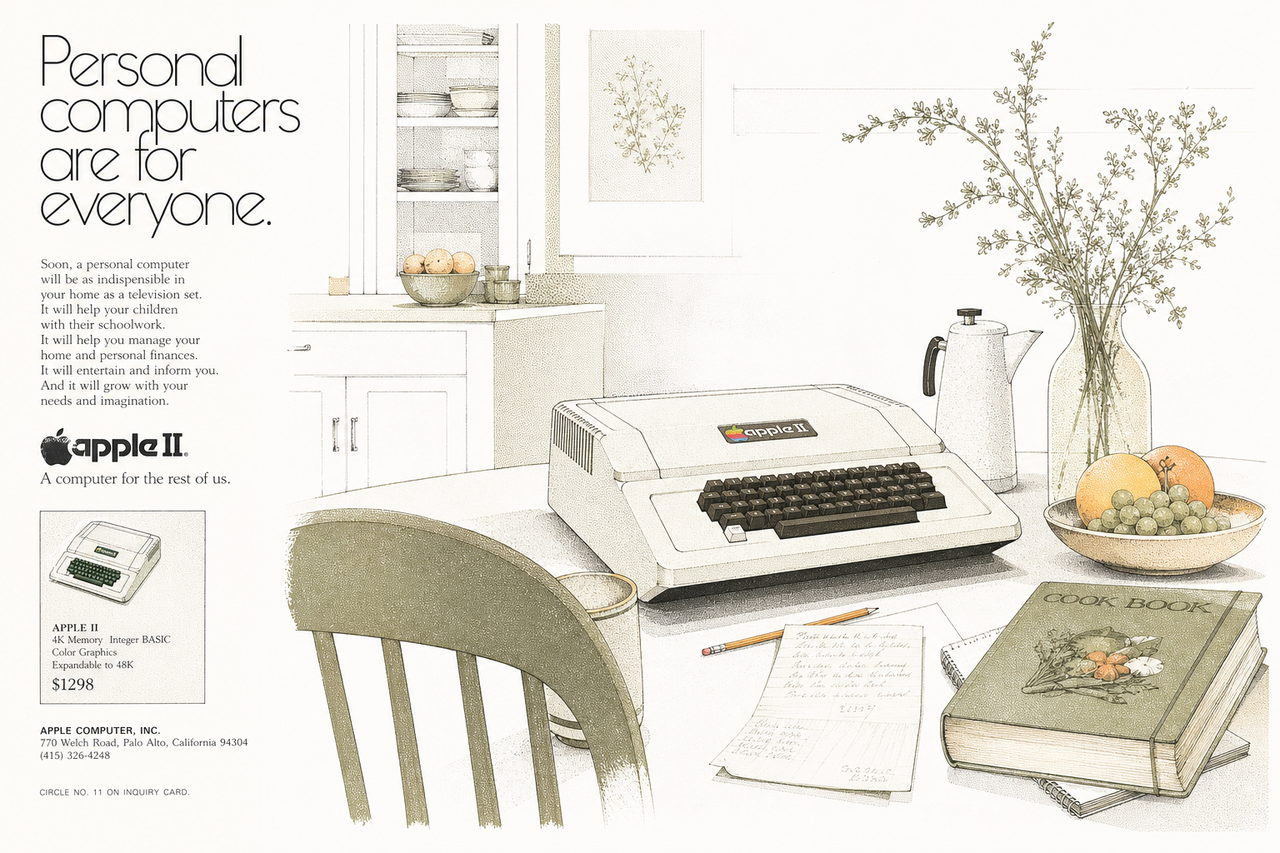
The first Apple II print advert from 1977 feels relevant for Reetro because it sells technology not as a laboratory image but as a printed everyday scene. The V&A describes the sheet specifically as the first Apple II print advert, printed only in magazines and issued in copies of Scientific American in September 1977. That framing already makes it more than simple product publicity: it becomes an early piece of home-computing image culture.
A computer at the kitchen table instead of in a machine room
The visual premise is clearly documented. According to the V&A, the advert shows a man sitting at the kitchen table working on an Apple II while a woman stands in the background in the kitchen. The caption reads, “The home computer that’s ready to work, play and grow with you.” That is exactly what makes the print object distinctive: the computer is introduced not through technical diagrams but through domestic roles, furniture, surface, and a promise of use. Print makes the machine socially legible.
Why that felt plausible and persuasive in 1977
The Computer History Museum and Britannica help with context. Both describe the Apple II as an early, commercially successful mass-market computer of 1977; CHM notes that it was fully assembled and ready to use with any display monitor, while Britannica stresses the plastic casing, colour graphics, sound, and the ability to connect to a television. CHM gives the same entry price for the 4K version as Britannica: $1,298. For an advert, that meant explaining not just computing power, but the idea that a computer could belong inside ordinary private space.
A print object that domesticates technology
That is why the advert still feels surprisingly exact. The V&A reads the Apple II as an example of the convergence of work and home computing, and the advert translates that shift directly on the page. Instead of industrial hardness, we get table edge, interior, and a beige casing as calming signals. The V&A also notes that Steve Jobs pushed for a more aesthetically pleasing foam-moulded plastic case in Pantone 453. That fits the printed staging perfectly: the object was meant not only to function, but to look acceptable in a living space.
Why it fits Reetro
For Reetro, the advert is compelling because it shows how strongly print can shape the perception of something new. It works with interior space, typography, ordinary life, and controlled colour rather than futuristic overstatement. If you respond to that quieter kind of historical image-making, it often leads to large-format posters or restrained framed art that rely less on noise and more on atmosphere. The Apple II advert is a reminder that print advertising can also function as a draft for a new way of living.