
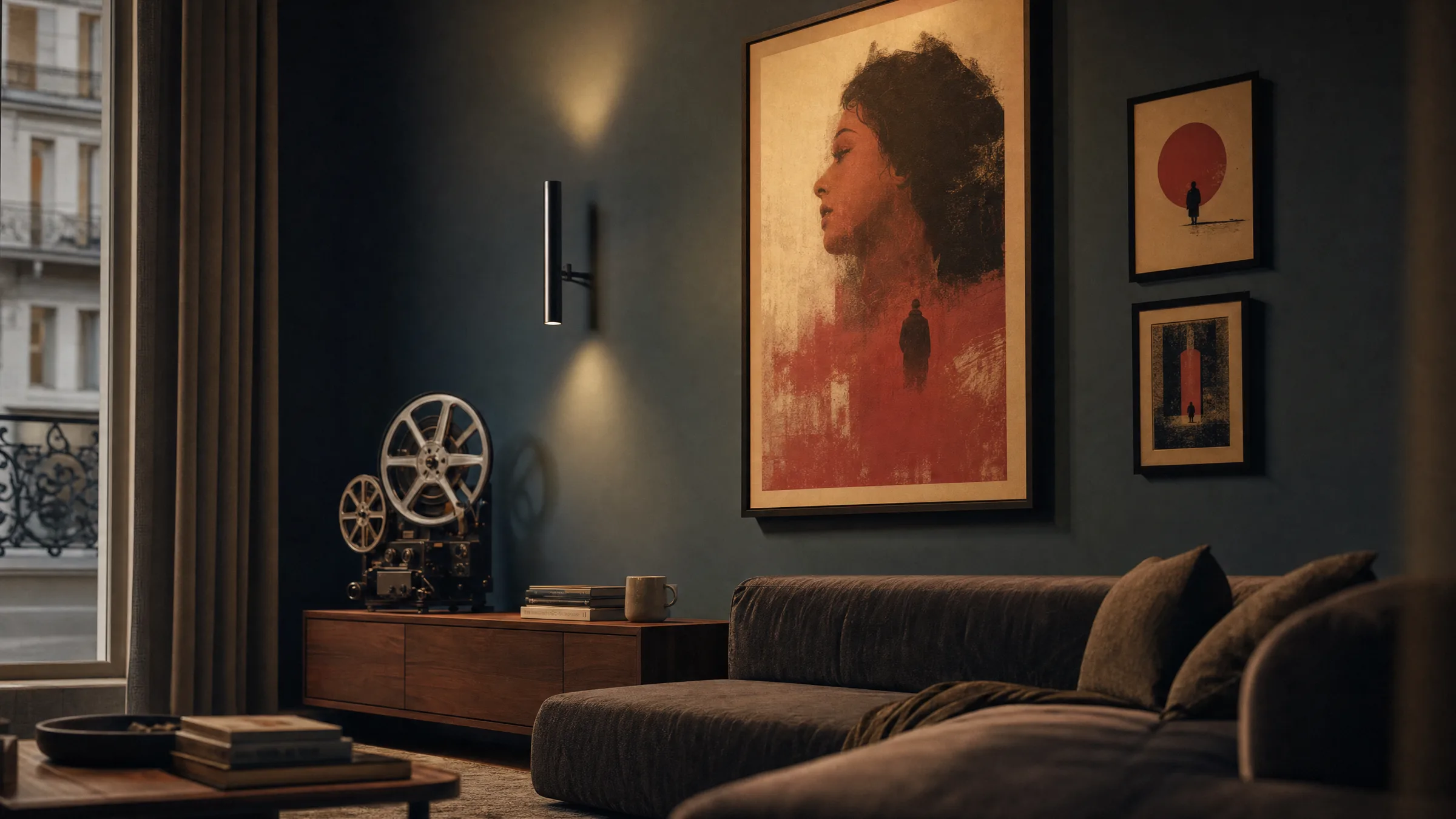
Home Cinema Decor: Wall Art and Posters for Your Film Room
Considered home cinema decor brings cinematic motifs together with a calm visual language, creating an atmosphere in the living room, media room or hobby den that recalls the picture houses of past decades — without feeling loud or overloaded.
What Makes Good Home Cinema Decor
Home cinema decor depends on the interplay of a few clearly placed visual elements. Rather than hanging many film posters side by side, a wall often works better when one large-format hero image sets the tone and smaller prints support it. This creates a visual rhythm that guides the eye while keeping the room calm.
The colour palette also plays a decisive role. Warm reds, deep navy and muted anthracite produce the slightly darkened mood typical of cinema auditoriums. Anyone wanting to reference classic film aesthetics can combine these colours with black-and-white motifs from the Golden Age of Hollywood or with typographic posters in the style of vintage title sequences.
A consistent framework for the choice of motifs matters just as much. One genre — film noir, science fiction or European art-house cinema, for example — makes for more convincing decor than a random mix. Within that bracket, different formats and techniques can be combined without the wall feeling arbitrary.
Motif Directions for Home Cinema Decor
Four editorial motif clusters that work particularly well in practice for the wall design of a home cinema or media room, and which can be combined with one another.
Vintage Film Posters
Reproductions of classic poster graphics from the 1950s to 1970s with a reduced colour palette, hand-drawn typography and the characteristic texture of period offset printing.
Typography & Quotes
Wordmarks, film titles or memorable quotes as graphic posters in clean serif or sans-serif type. Works especially well as a series in a uniform format.
On-Set Photography
Black-and-white images from film productions, camera motifs or behind-the-scenes directing moments. Has a documentary quality and suits rooms with dark wall colours.
Abstract Light Studies
Images that work with projected light, film grain or colour gradients. Restrained enough to hold their own beside strong posters as a quieter visual plane.
Formats and Materials for Home Cinema Decor
When realising a home cinema decor scheme, it pays to match the format to the wall area and the viewing distance. An XXL poster at 70 × 100 cm or larger reads like a reduced cinema screen on a free wall behind the sofa and anchors the room without additional elements. Smaller formats between 30 × 40 cm and 50 × 70 cm suit groupings, for instance along a corridor leading to the media room.
With materials, the direction of light is the primary consideration. Matte FSC-certified papers from 200 g/m² upwards reflect very little and remain easy to read even under side-lit wall lamps or LED strips. Premium canvas brings a tactile quality and picks up cinematic aesthetics through its subtle surface texture. Hexagonal aluminium prints, by contrast, add a graphic, almost architectural accent and work well as a series above a bench or sideboard.
For dark wall colours, a mount or a slim black frame that cleanly separates the image from the background is recommended. Frameless aluminium prints also read clearly in such rooms, because the edges close precisely and create no additional shadow line.
Convincing home cinema decor works like good film editing: it shows only what the scene truly needs — and leaves everything else out.
Reetro Editorial
Hanging and Lighting
The effect of a home cinema decor scheme depends greatly on how the images are hung and lit. A useful rule of thumb is to centre each piece at roughly 145 to 150 cm from the floor. If you mostly sit on a low, deep sofa, that centre line can drop five to ten centimetres so the motifs sit at a comfortable viewing angle.
For lighting, indirect warm-white sources at around 2,700 K are the most natural choice. They support the cinematic character without washing out the motifs. Directional picture lights or wall-mounted track spots with dimmable heads put individual posters in the spotlight, while ceiling wash lights provide even ambient brightness.
When grouping several pieces, the calmest results come from matching frame colours and consistent gaps of around five to eight centimetres between images. An imaginary central axis or a shared top or bottom edge holds even mixed formats together visually.
Home Cinema Decor in Smaller Rooms
Not every home cinema has a generous feature wall. In compact living rooms or basement spaces, a reduced home cinema decor with one or two well-chosen motifs works better than a densely hung gallery. A single XXL poster facing the seating position, or a narrow panoramic format above a sideboard, often carries more authority than many small prints.
In rented flats, posters can be hung using aluminium clamping rails or magnetic picture holders that require no drilling. These systems work reliably with papers from 200 g/m² upwards and make it easy to swap motifs seasonally — to coincide with a film festival, a new series season or a change of atmosphere.
Häufige Fragen
-
01
Which motifs work best for home cinema decor?
For a cohesive home cinema decor scheme, motifs that follow a clear genre or era work best. Vintage film posters from the 1950s to 1970s, black-and-white on-set photographs, typographic posters featuring film titles or quotes, and abstract light studies all combine well. The key is a shared framework of colour palette and visual language. If you lean towards film noir, stay with muted grey tones and strong contrasts. Science fiction calls for cool blues and violets; European art-house cinema suits restrained earth tones and documentary-style photography.
-
02
What format suits home cinema decor above a sofa?
For the wall behind or facing the sofa, generous formats are the most effective choice. A single XXL poster at 70 × 100 cm or 100 × 140 cm reads like a small screen and can carry the entire home cinema decor on its own. Alternatively, a row of two or three equally sized prints at 50 × 70 cm aligned on a shared central axis works well. As a proportion guide, the combined width of the group should be roughly two-thirds of the sofa width so the arrangement feels balanced.
-
03
How should I light my home cinema decor?
Warm white light at around 2,700 K best supports the cinematic feel. Indirect sources such as wall washers, LED strips behind furniture or dimmable picture lights create a quiet ambient mood without overexposing the motifs. Directional track spots can put individual posters in focused relief. It is worth avoiding direct overhead light that reflects off glossy surfaces. Matte papers and canvas are far more forgiving in this regard than high-gloss prints.
-
04
Which materials are best for posters in a home cinema?
Matte papers from 200 g/m² upwards are usually the best option for home cinema decor because they reflect very little light and remain clearly readable even under side lighting. Premium canvas adds a tactile quality through its fine surface texture and suits classic film motifs well. Aluminium prints — particularly in hexagonal formats — have a graphic, architectural quality and work nicely as a series. High-gloss surfaces are generally problematic in a home cinema because they can pick up reflections from the screen.
-
05
How many pieces belong in a well-balanced home cinema decor scheme?
Less is usually more. A calm home cinema decor often needs just one strong lead image and two to four supporting prints. In larger rooms, galleries of six to eight pieces are possible but should follow a clear system — matching frames, consistent widths or a shared colour world. More important than the number is the relationship between the pieces. A single, well-chosen XXL print can hold an entire wall, while an overloaded collection quickly feels restless.
-
06
What print quality does Reetro recommend for home cinema decor?
Reetro prints home cinema decor motifs to order through its production partner in the EU on FSC-certified papers from 200 g/m² with a matte coating. This combination delivers deep blacks, clean gradients and a low-reflection surface that reads well in a darkened film room. Premium canvas is available for a more tactile result, and hexagonal aluminium prints provide a graphic accent. All formats are produced to order and editorially curated, so new pieces can be added to an existing wall arrangement at any time.