Typographic Poster: The Art of Type on Your Wall
Typographic posters reduce visual language to its essentials: letters, words, sentences. What makes them work is not only the message itself, but the form of the type. This overview maps out styles, formats and materials, and helps with choosing the right piece for different rooms and contexts.
What defines a typographic poster
Typographic posters use type as the central design element. Unlike illustrative prints, they work with the visual qualities of letterforms, line spacing and composition. The content — a quotation, a single word, a line of a song — is brought forward through typographic treatment and becomes an image in its own right.
The range spans from strict grotesque in the Bauhaus tradition to hand-drawn lettering work. What all these variations share is a deliberate relationship between legibility and visual impact. Some pieces can be read from several metres away; others reveal their details only on closer inspection.
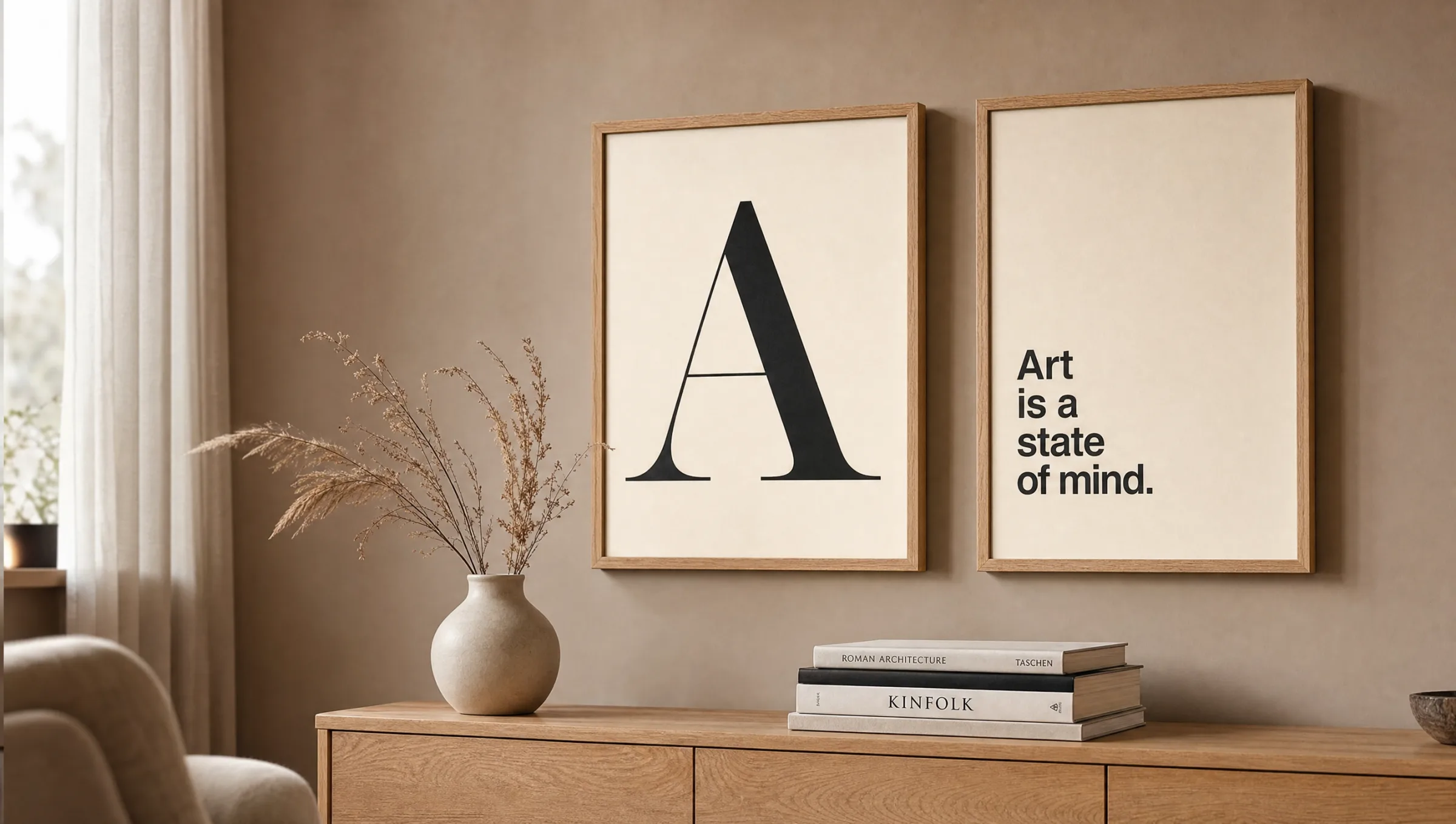
In a domestic setting, typographic posters work equally well as quiet solo pieces above a sofa and as part of a gallery wall, where they introduce pauses and rhythm between photographs or illustrations.
Styles of typographic poster
Four recurring design approaches define the field. They differ clearly in typeface choice, colour and overall character, and each suits different interior styles.
Bauhaus & Constructivism
Geometric typefaces, clear grids, often primary colours. These posters reference the modernism of the 1920s and sit especially well in minimal interiors.
Swiss Style
Helvetica, Univers and related grotesque typefaces, asymmetric layouts, generous white space. A restrained, matter-of-fact aesthetic that suits Scandinavian-influenced rooms.
Hand Lettering
Drawn letterforms with individual line quality, often combined with watercolour areas or a vintage character. Feels more personal and warmer than purely typeset work.
Editorial Minimal
Serif typefaces in the tradition of classic magazine setting, frequently black on cream. A calm approach that pairs well with photography.
Formats and placement of typographic posters
The impact of a typographic poster depends heavily on its format. Portrait orientations in a 2:3 or 3:4 ratio emphasise vertical compositions and suit narrow wall areas between doors or windows. Landscape formats are less common but work well above elongated sideboards.
For a solo placement, formats from 50 × 70 cm upward give the type enough presence. In gallery walls, smaller sizes such as 30 × 40 cm can be included, provided they are grouped with other pieces in the same format.
The gap between the top of a sofa or console and the lower edge of the frame should ideally be 20 to 30 centimetres. This creates a calm visual transition without the typographic poster appearing to slide off the furniture optically.
Good typography is invisible — on a typographic poster it becomes both content and image at once.
Reetro Editorial
Materials and print quality for typographic posters
Type tolerates no compromises in print. Edge sharpness, consistent ink density and a neutral paper-white determine whether a typographic poster reads as clean or slightly off. FSC-certified papers from 200 g/m² with a matte surface reduce reflections and allow letterform edges to appear precise.
For larger formats, premium canvas is an option, though it softens delicate serifs slightly. For very fine weights, paper printing is therefore preferable. Aluminium wall prints suit graphically reduced pieces with large open areas, but are less appropriate for detailed lettering motifs.
Reetro has typographic posters printed to order by its production partner in the EU on matte-coated papers. Pigment inks are fade-resistant and maintain their black tone for years — a quality that is especially noticeable in monochrome typographic work.
Combining and framing typographic posters
When it comes to framing: the more reduced the motif, the more understated the frame should be. Slim profiles in natural oak, black-lacquered wood or matte-black aluminium support the graphic language without competing with it. Mounts are optional and reinforce the editorial character.
In combination with other pieces, typographic posters act as a pacemaker. A single type-based image between several photographs draws the eye and gives a wall a thematic anchor. It is important that the type size matches the viewing distance — small text becomes lost on a large wall.
Häufige Fragen
-
01
Which typefaces work particularly well on a typographic poster?
Classic grotesque typefaces such as Helvetica, Futura or Akzidenz Grotesk work well, as do quiet serifs in the tradition of Garamond or Caslon. The choice depends on the character you are looking for: grotesque reads as contemporary and matter-of-fact, while serifs feel editorial and literary. For more expressive pieces, display typefaces or hand lettering are worth considering. What matters most is that the typeface can be reproduced with clean, sharp edges at the chosen size — particularly important for very fine stroke weights.
-
02
How large should a typographic poster be when hung above a sofa?
As a rough guide, a single typographic poster should span approximately two thirds of the sofa's width. For a 220 cm sofa, a format from 70 × 100 cm works well. For smaller sofas, 50 × 70 cm is usually sufficient. When combining several posters, the total width of the arrangement is the relevant measurement. The lower edge of the frame should sit 20 to 30 centimetres above the sofa back, so that the transition between furniture and wall art feels settled rather than cramped.
-
03
Do typographic posters work alongside photographic wall art?
Yes, the combination works very well. Typographic posters function as pauses between pictorial pieces in a gallery wall and give the arrangement structure. It helps to coordinate the colours of type and photographic pieces — for instance, black type with black-and-white photography, or cream paper with warm-toned images. Framing materials should also be kept consistent throughout, to support the impression of a considered, curated wall.
-
04
What paper is best suited to a typographic poster?
Matte-coated fine-art papers from 200 g/m² are generally the best choice for a typographic poster. They reproduce letterform edges precisely, produce minimal reflections and feel premium. Glossy surfaces can make type appear higher in contrast, but they also generate reflections that make reading uncomfortable. For very large formats or graphically reduced pieces, a lightly textured natural paper is also an option, lending a warmer, less sleek character to the piece.
-
05
Are typographic posters suitable for bedrooms?
Typographic posters suit bedrooms well, provided the motif and tone are kept calm. Short words or reduced letterform compositions are less visually demanding than text-heavy prints. Muted palettes — black, charcoal, cream, sand — support the restfulness of the room. Above a headboard, a single larger format is preferable to a small, busy arrangement, as the eye tends to seek clarity rather than variety in a bedroom.
-
06
How does Reetro's printing differ from standard poster printing?
Reetro has its prints printed to order by its production partner in the EU on FSC-certified papers from 200 g/m² with matte coatings. For typographic motifs this matters: type edges are reproduced sharply, and pigment-based inks keep the black tone stable over time. Alongside paper prints, the range includes premium canvas, hexagonal aluminium wall prints and designer cushions. Reetro's editorial selection also sets it apart from anonymous marketplaces — every typographic poster motif is curated and checked for print quality before it enters the range.