
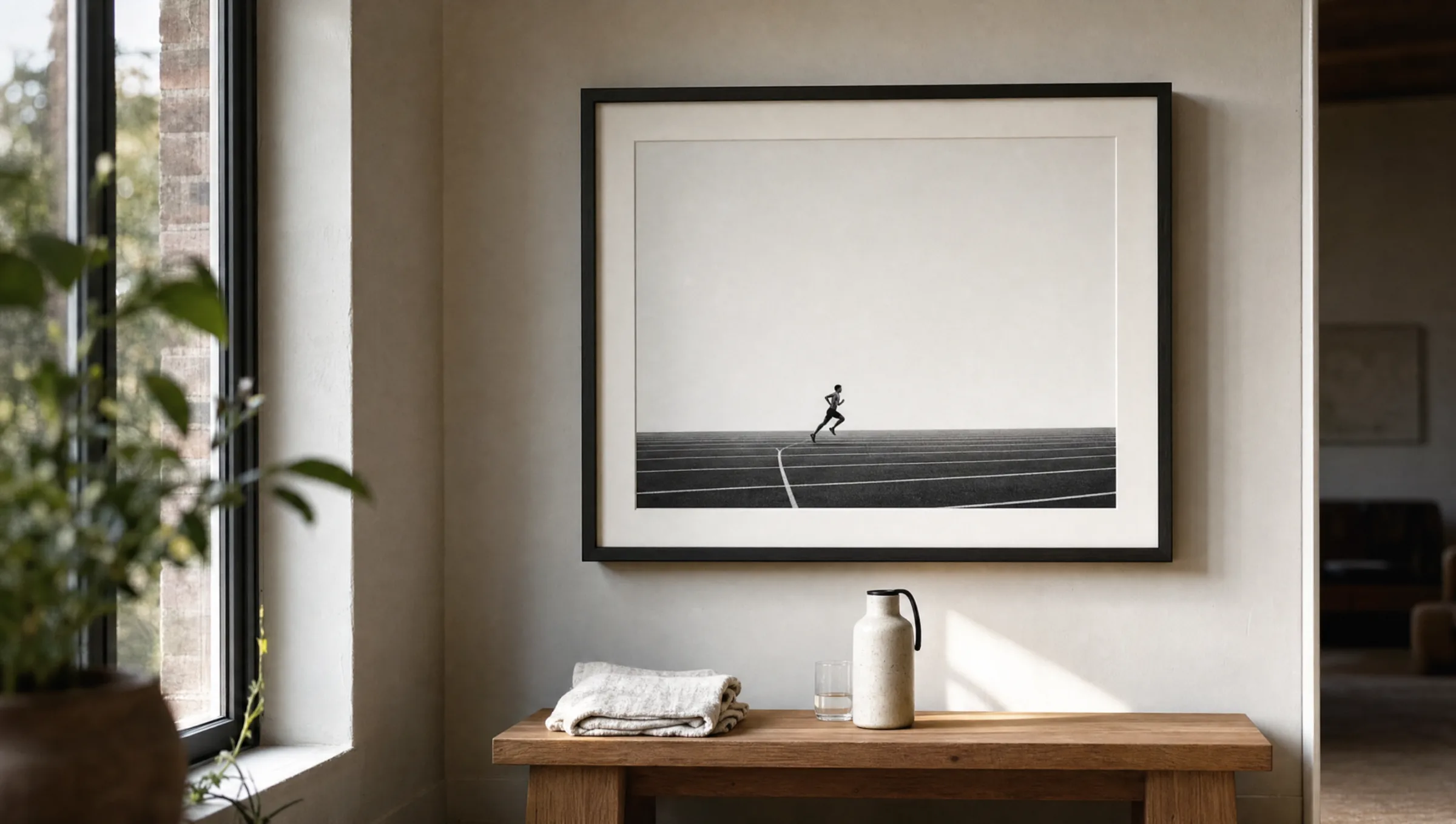
Sport Poster: Motifs and Formats at a Glance
A sport poster brings movement, discipline and atmosphere to your walls – whether in a home gym, a teenager's bedroom or a hallway. The range spans from reduced line illustrations and typographic training quotes to documentary stadium and street-sport photography. This editorial overview organises motif groups, formats and hanging ideas in a clear, practical way.
What defines a sport poster today
Sport posters have evolved well beyond the classic club or player placard into a distinct motif category of their own. They are less concerned with the fan culture of a single team and more with values such as endurance, focus and repetition – themes that work equally well in a private training room and in a home office. The visual language has expanded accordingly: calm black-and-white shots from a boxing studio sit alongside colour-reduced vector graphics of a running track.
A defining quality of a contemporary sport poster is formal restraint. Rather than overloaded collages, the dominant features are clear image axes, generous negative space and a limited colour palette. Typography is used deliberately – often as a short quote, a race distance or a time marker that comments on the image without overpowering it.
Motif groups for a sport poster
The following four categories cover the most common use cases and help narrow down your choice before format and material are decided.
Documentary Photography
Black-and-white or muted colour shots from boxing gyms, swimming pools or marathon routes. They feel narrative and suit living spaces with a calm, understated wall arrangement.
Minimalist Illustration
Reduced vector or line drawings of individual disciplines such as road cycling, tennis or yoga. Well suited to Scandinavian-influenced or modern interiors.
Typography and Training Quotes
Short text motifs featuring personal bests, route maps or training principles. Particularly effective in home gyms and work areas where the motif remains present throughout the day.
Vintage and Retro Prints
Olympic and tour posters in the style of the 1920s to 1970s. They add colour and historical depth and pair well with wooden furniture.
Format and hanging: where a sport poster makes its mark
Format choice depends heavily on the room context. In a home gym, where the image is viewed from a moderate distance while standing, large-format single motifs from 70 × 100 cm upwards work particularly well. They act as a focal point and do not have to compete with furniture.
In living areas, smaller formats between 30 × 40 cm and 50 × 70 cm are more common, often combined as a set of three or four. Here a sport poster can be mixed with calm landscape or architectural motifs to soften the thematic emphasis. In a hallway or stairwell, narrow portrait formats work well – think stylised running routes or elevation profiles.
For hanging, the standard guideline applies: centre the image at roughly 145 to 150 cm from the floor. Above seating furniture the poster may hang slightly lower, but should occupy about two-thirds of the furniture's width so that the proportions remain balanced.
A good sport poster does not tell the story of victory – it tells the story of the repetition behind it: the training days nobody ever photographs.
Reetro Editorial
Material and print quality in a sport poster
Because sport motifs are frequently high-contrast – deep blacks in the background, bright skin tones or stadium lighting in the foreground – paper choice matters more than it does with purely decorative subjects. Matte fine-art papers from 200 g/m² upwards absorb reflections and let shadows fall away softly. Lightly textured natural papers complement vintage poster motifs, while smooth museum papers render photographic work with greater precision. All Reetro prints are printed to order by a production partner in the EU on FSC-certified papers.
For heavily used spaces such as home gyms or utility areas, aluminium and canvas variants are worth considering. They are less sensitive to humidity and temperature fluctuations, require no glass frame, and reduce the glare that ceiling spotlights can produce on glossy surfaces.
Selecting a sport poster with a curated eye
Rather than anchoring your choice to a single discipline, it is worth selecting a motif on the basis of its graphic quality: how is the image axis constructed, which colours dominate, how much negative space remains? A sport poster that meets these criteria integrates naturally into a room even where no other sporting references are present.
Anyone wishing to combine several motifs should establish a unifying thread – either a shared colour palette, a consistent image technique (for example, exclusively black-and-white photography) or a recurring visual element such as lanes, lines or numbers. This produces a wall that reads as a coherent series rather than a loose collection of individual prints.
Häufige Fragen
-
01
Where is the best place to hang a sport poster?
Classic locations include the home gym, a work area, the hallway and a teenager's bedroom. In a home gym the motif can be large format and serve as a focal point – centre of image at roughly eye level when standing, around 150 cm from the floor. In a living room, a sport poster works better within a mixed arrangement alongside calmer motifs so the thematic reference does not dominate. Above seating furniture, the print should span roughly two-thirds of the furniture's width and start about 20 to 30 cm above the backrest.
-
02
Which motifs suit a sport poster in a living room?
Restrained motifs are the most enduring choice in a living room: documentary black-and-white photography, minimalist illustrations of individual disciplines, or typographic prints with a modest amount of text. Club logos or highly saturated kit designs tend to read as fan merchandise in that setting. If you still want to reference a favourite discipline, look for a motif with a clear image axis and a reduced colour palette – for example a stylised running track, an elevation map or an abstracted playing field.
-
03
What format works best for home gyms?
In a home gym the image is usually viewed from two to four metres away, often while standing or under physical exertion. Large-format single motifs from 70 × 100 cm upwards therefore carry better than small gallery arrangements. XXL formats up to 100 × 140 cm are feasible where the wall is free of equipment and mirrors. A matte surface is important, as directional ceiling spotlights create strong reflections on glossy prints.
-
04
How should high-quality art prints be cared for?
Direct sunlight should be avoided, as even lightfast pigments can shift over the years. Dust is best removed with a dry, soft microfibre cloth – never with damp or chemical cleaners. In rooms with higher humidity, such as near a shower or sauna area, aluminium or canvas variants are preferable to paper. Frames with anti-reflective glass further reduce glare.
-
05
Can several sport poster motifs be combined on one wall?
Yes, though a wall like that needs a formal or conceptual thread to hold together. Three approaches work well: a consistent image technique (photography only or illustration only), a shared palette of two or three tones, or a recurring visual element such as lanes, numbers or contour lines. Within that framework the disciplines themselves can vary. A calm, unified frame choice – ideally oak, black or aluminium throughout – helps the motifs read as a related series rather than separate objects.
-
06
What does Reetro look for when selecting a sport poster?
The Reetro editorial team selects motifs on the basis of graphic quality and suitability for living spaces, not club or event association. All prints are printed to order by a production partner in the EU on FSC-certified fine-art papers from 200 g/m² with a matte coating that lets contrasts fall away softly and minimises reflections. For demanding spaces, premium canvas and hexagonal aluminium wall prints are also available, so the same motif can be matched to the right material depending on the room.