
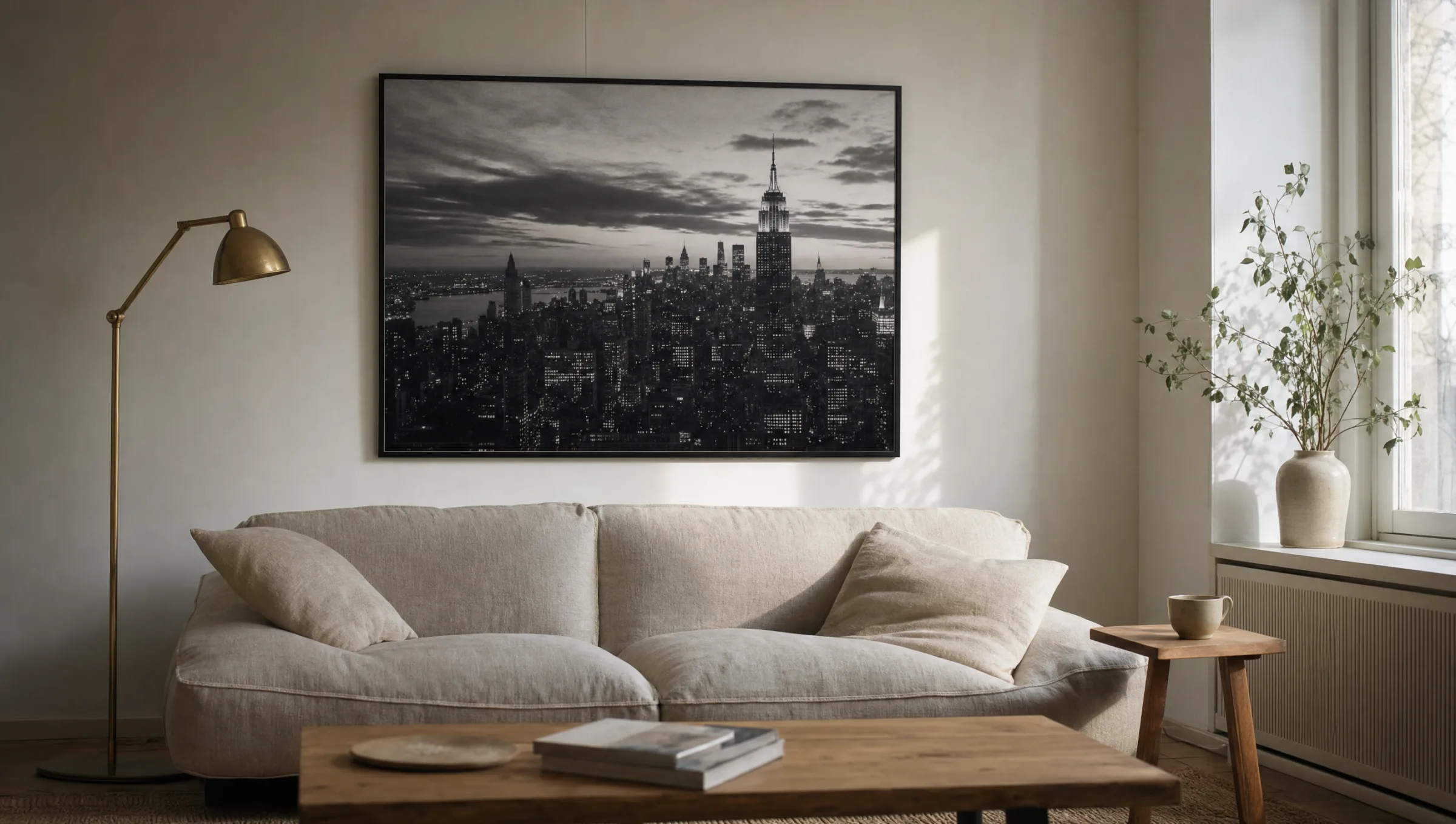
New York Poster: Motifs, Formats and Materials
New York is one of the most photographed cities in the world – which is exactly why it pays to look closely at which motifs still hold up today. This overview covers styles, formats and papers, and shows how a New York poster can sit quietly in a room without dominating it.
Why New York Posters Look So Different from One Another
A New York poster is not a uniform category. A black-and-white shot of the Brooklyn Bridge from the 1950s creates a completely different mood from a colour-rich street photography motif from SoHo or a graphically restrained skyline print. Choosing a motif is therefore less a decision about a city and more a choice of narrative – documentary, nostalgic, architectural or typographic.
Before selecting, it helps to clarify what role the image should play in the room. A large-format black-and-white motif above the sofa sets a calm anchor. A smaller, colourful street scene in a hallway works better as an incidental reminder. The motif should suit the viewing habits of the location where it will hang, not the other way around.
The period referenced also matters. Historical photographs often feel more measured because they have long since developed their own visual language. More recent photographs from Manhattan or Brooklyn carry the aesthetic of the smartphone era – not worse, but noticeably different.
Four Motif Groups for a New York Poster
The following categories help sharpen your sense of what you are looking for before committing to a specific image.
Skyline and Panorama
Classic wide-angle shots of Manhattan, often photographed from Brooklyn or New Jersey. They work in wide formats and carry large wall areas without feeling overloaded.
Architecture in Detail
Facades, fire escapes, water towers, lobby fragments. These motifs are more graphic, organise lines clearly, and suit paired-back interiors with clean furniture edges.
Street and Reportage
People, taxis, diners, subway entrances. Here the moment is everything. Such images suit rooms where you linger – dining areas, workspaces, reading corners.
Typography and Maps
Subway diagrams, street signs, borough names as lettering. A matter-of-fact choice that references memory without repeating a specific photograph.
Formats and Hanging for a New York Poster
Skyline motifs need width. A format such as 100 × 50 cm or 140 × 70 cm gives a horizontal composition room to breathe. Architectural details and portrait-oriented formats, on the other hand, work well at 50 × 70 cm or 70 × 100 cm – these correspond to classic poster proportions and combine easily with other prints.
When hanging, the centre of the image should sit at roughly eye level – in living spaces that is around 145 to 150 cm from the floor. Above seating furniture, the lower edge of the print may come closer to the back of the piece, so that the image and furniture read as a unit. Multiple New York posters can be arranged as a relaxed wall group, but should share a unifying element – such as matching frames or a consistent colour temperature.
Anyone working with a salon-style arrangement should set one dominant motif as an anchor and group the remaining images around it in smaller formats. Asymmetry is fine, as long as the outer edges of the group form a legible rectangle.
New York works best on paper when the motif does not try to show the whole city, but instead captures a single, quiet detail.
From the Reetro editorial team
Paper, Print and Longevity
For black-and-white photography, a matte FSC-certified paper from 200 g/m² upwards is recommended. It captures deep tones cleanly without glare, and gives gradients of grey the calm they need. Gloss surfaces can intensify highlights in skyline motifs, but in daylight they frequently produce distracting reflections.
Colour street photography benefits from a lightly satin finish that holds the colours without pushing them too far. At Reetro, New York posters are printed to order by our production partner in the EU using pigment-based inks with lightfastness as a priority. Framed behind glass or on canvas, the visual stability increases further.
Anyone hanging a poster without a frame should avoid direct sunlight and should not place the print in damp rooms such as bathrooms. A slight curl can usually be resolved by laying the poster flat under a heavy book for a couple of days.
New York Poster in a Room Context
A poster lives in relation to the room around it. Against a white wall, high-contrast black-and-white motifs read with clarity, while colourful street scenes in front of warm wall tones – sand, clay, off-white – settle more quietly into the space. Wooden furniture and textiles in muted shades support this effect further.
In smaller homes, a single well-chosen motif is often enough to establish a connection with the city. Larger rooms can carry series – for example three architectural details of the same format side by side. What matters is that the images do not compete with one another: a clear difference in size or brightness between them helps establish a hierarchy.
Häufige Fragen
-
01
What formats work best for a New York poster with a skyline motif?
Skyline shots are typically composed horizontally and need correspondingly wide formats. Tried and tested sizes include 100 × 50 cm, 120 × 60 cm and 140 × 70 cm. In smaller rooms 70 × 50 cm works well, provided the print is not hanging directly above wide furniture. A useful rule of thumb: the format should span roughly two-thirds of the width of the furniture beneath it, which creates a visual balance between the wall and the room.
-
02
Is a New York poster better in black-and-white or colour?
Both have their place. Black-and-white motifs feel more timeless, integrate more easily across interior styles and draw attention to architecture and light. Colour photographs carry a more specific atmosphere – yellow taxis, neon light, autumn in Central Park. A practical rule: the calmer the room, the more likely it is to accommodate a colour motif. The stronger the furniture and textiles already are, the more a restrained black-and-white version makes sense.
-
03
How do I hang several New York posters as a group?
A unifying element helps: matching frames, consistent colour temperature or the same category of motif – for example, architectural details only. With two or three prints, a row at equal height with five to eight centimetres between them works well. With four or more, an implied rectangle as an outer boundary is more effective than a completely free arrangement. Before drilling, it is worth laying the prints on the floor and photographing the arrangement to check the spacing.
-
04
What paper does Reetro use for New York posters?
Reetro prints New York posters to order through its production partner in the EU on FSC-certified paper from 200 g/m² with a matte coating. The matte finish reduces reflections and gives black-and-white motifs a quiet depth. For colour-intensive street photography, a lightly satin paper is optionally available, which retains colour saturation a little more firmly. The pigment-based inks are formulated for lightfastness, meaning the prints remain stable over the years as long as direct sunlight is avoided.
-
05
Which wall colour suits a New York poster?
Neutral, slightly off-toned shades work most reliably: warm white, sand, light greige or a muted sage green. Against pure white, high-contrast black-and-white motifs appear particularly crisp, though in larger formats they can feel somewhat hard. Dark walls – charcoal, deep blue – intensify night shots and neon motifs, but can absorb fine detail in lighter skyline prints. When in doubt, a test print in A4 placed on the intended wall for a few days is a reliable guide.
-
06
How do I care for an unframed poster over time?
Unframed posters should be protected from direct sunlight, moisture and dry heating air. For mounting, magnetic rails or acid-free adhesive strips that will not damage the paper surface work well. Dust can be removed carefully with a dry, soft microfibre cloth, always moving towards the outer edge of the print. If the paper develops a slight curl, laying the poster flat between two clean sheets under an evenly distributed weight for one to two days usually resolves it.