Cinema Posters: Film Motifs for Living Spaces and Collections
Buying cinema posters involves more decisions than simply choosing a motif. Format, paper weight, framing and the stylistic context of a film poster all determine how the piece reads in a room. This page provides an editorial overview of materials, visual worlds and practical considerations for collectors and interior spaces alike.
Why Buying Cinema Posters Is More Than a Decorating Decision
Film posters are an independent graphic genre in their own right. They carry the visual language of an era, working with typography, illustration or photography to compress an entire narrative into a single image. Anyone who spends time with the subject quickly finds that a well-composed film poster holds its own outside a cinema foyer and reads in a living space much like a curated graphic work.
The appeal of cinema posters lies in the way personal film preferences can be combined with a considered graphic statement. A minimalist poster from the eighties tells a different story than a richly illustrated Italian design from the sixties. The choice says as much about the viewer as an art print or photograph hanging on the same wall.
It is worth distinguishing between original theatrical release posters, licensed reprints and editorially reinterpreted designs. All three have their place, but they serve different interests: archival value, cinematic reference, or graphic wall design within a contemporary living context.
Visual Worlds in Cinema Posters
Film posters can be grouped by era and genre. This kind of categorisation helps to find a motif that fits both in content and stylistically with an existing interior.
Classics of the 1950s and 1960s
Hand-drawn illustration, warm colour palettes and expressive lettering define this era. They suit interiors with vintage furniture, wooden surfaces and muted wall tones.
New Hollywood of the 1970s
Reduced compositions, photographic portraits and strong colour contrasts. These posters work well in modern, relatively understated rooms.
Neo-Noir and Sci-Fi of the 1980s
Neon accents, airbrush aesthetics and dramatic lighting. A striking focal point in home offices, home cinema areas or hallways with darker wall tones.
Contemporary Alternative Posters
Illustrators and graphic designers reinterpret films, often in a screen-print style. These motifs combine well with other art prints in a salon-style gallery wall arrangement.
Formats, Paper and Print
Historical theatrical posters were produced in standardised formats — among them the German A1 (594 × 841 mm) and the American One Sheet (27 × 41 inches). Those looking to buy cinema posters today generally follow similar proportions to retain the characteristic portrait orientation. For generous wall expanses, XXL variants underscore the graphic impact that a film poster can carry.
For paper, matte, uncoated or lightly satin-finished stock is the most editorially interesting choice. It reduces reflections, avoids the look of commercial print and renders the tonal gradations of historical source material more precisely. FSC-certified papers from 200 g/m² upwards also have a tangible quality when a poster is hung unframed directly on the wall.
The print process itself determines longevity. Pigment inks on fine-art paper remain colour-stable over many years, while inexpensive offset reprints can yellow over time. Anyone planning to leave a poster in the same spot for the long term should seek out lightfast printing methods and indirect lighting.
A good film poster works like a short film on paper: it conveys in seconds what the film negotiates over two hours.
Reetro Editorial
Framing, Hanging and Care
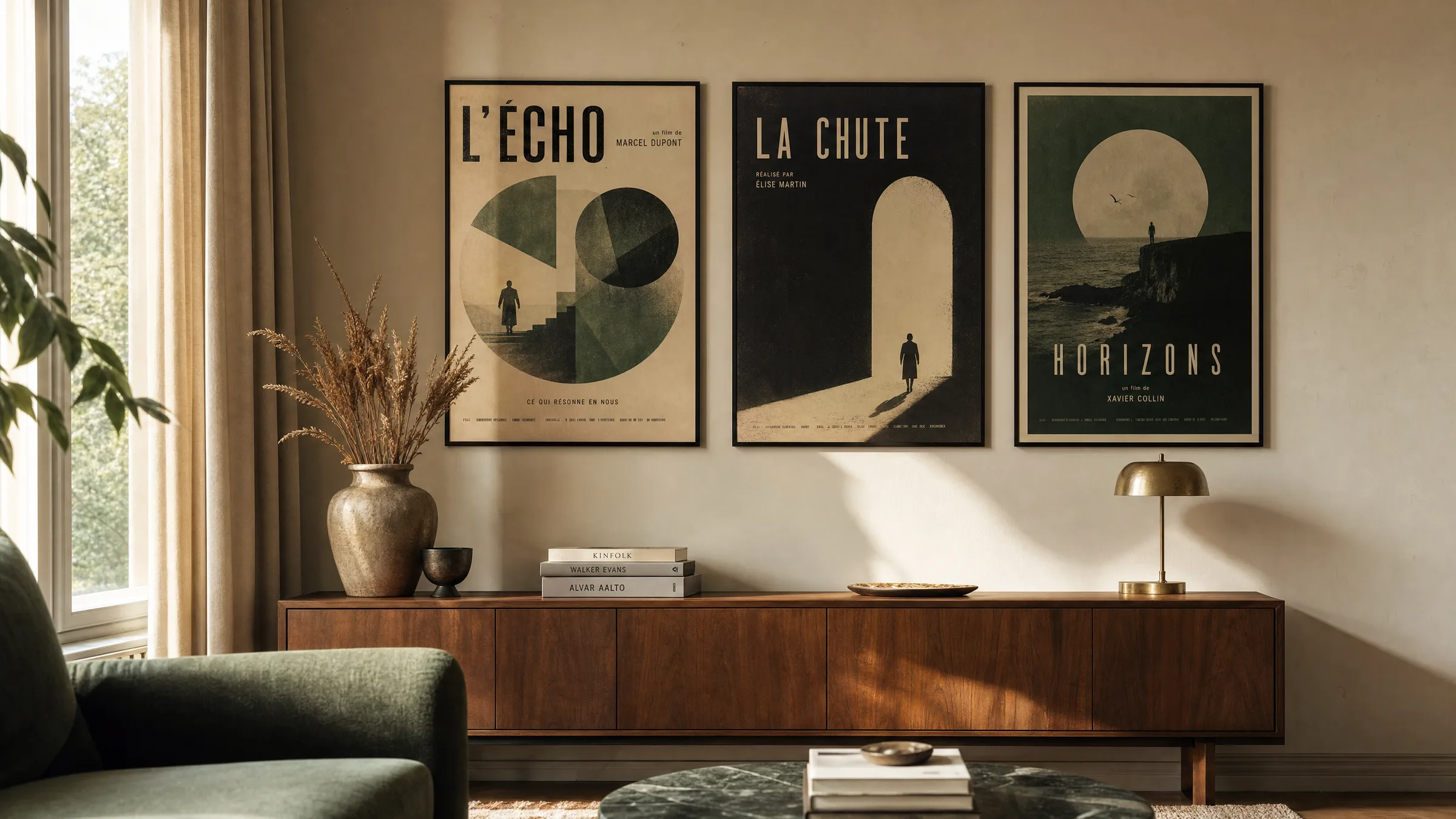
Whether a poster reads better framed or unframed depends on both the motif and the room. Graphically reduced cinema posters benefit from narrow black or oak frames, while illustrative designs from the sixties also hold their character with poster clips or magnetic rails. A mount gives smaller formats more presence and creates a visual pause between image edge and frame.
As a general hanging guideline, the centre of the image should sit roughly at eye level — in living rooms this is typically around 145 to 150 centimetres from the floor. When combining several posters, a consistent layout with even spacing keeps the arrangement coherent. In collector practice, sensitive papers are additionally protected with UV-filtering glass.
Care is straightforward: dry dusting with a soft cloth is usually sufficient. Direct sunlight, radiator heat and damp exterior walls should be avoided, as they encourage colour shifts and cockling.
Cinema Posters at Reetro
Reetro acts as an editorial curator, bringing together film motifs that hold up graphically and translate into contemporary living contexts. Printing is done to order by our production partner in the EU on FSC-certified papers from 200 g/m² with a matte coating, available as a classic poster, a premium canvas or a hexagon aluminium wall piece for a more object-like appearance.
Häufige Fragen
-
01
Where can I buy high-quality cinema posters?
High-quality cinema posters are available from specialist art-print retailers, museum shops and selected online curators. Key things to look for are stated paper weight, print process and licensing details. Anonymous marketplaces often offer lower prices but rarely provide transparent information about origin or material quality. Curated suppliers typically work with pigment-based printing, FSC-certified papers and documented source material, which translates into better colour accuracy and long-term stability.
-
02
What do cinema posters typically cost?
The price range is wide. Licensed reprints in A2 often start at around £20 to £40, while high-quality fine-art prints in A1 or XXL generally fall between £60 and £150. Original posters with archival value or limited artist editions can go considerably higher. Beyond the motif itself, paper quality, print process and format have the strongest influence on price.
-
03
Which format should I choose when buying cinema posters?
For the classic cinema feel, portrait orientation is the natural starting point. A1 (594 × 841 mm) closely matches the historical German theatrical format and works well above sideboards, sofas or in hallways. For large walls, XXL variants make sense; for gallery arrangements with multiple motifs, A2 or A3 are easier to compose. Before buying cinema posters, it is worth measuring the wall space and thinking about the intended viewing distance.
-
04
Framed or unframed?
Both work. A frame protects the paper from dust, UV light and physical damage and gives a more formal appearance. Unframed, with a magnetic rail or poster clips, the result is a looser, more editorial look that suits graphically reduced motifs particularly well. A practical middle ground is a narrow aluminium or oak frame with anti-reflective glass, which provides protection without adding visual weight.
-
05
How do I care for a film poster over the long term?
Direct sunlight, high humidity and significant temperature fluctuations are the most common causes of age-related damage. It helps to position the poster away from south-facing windows and radiators, and to dust the frame regularly with a dry cloth. For unframed cinema posters, leaving a slight gap between the paper and the wall reduces the risk of moisture build-up behind the print.
-
06
What makes Reetro's cinema posters distinctive?
Reetro curates film motifs with an editorial eye and has them printed to order by our production partner in the EU on FSC-certified papers from 200 g/m² with a matte coating. Alongside the classic poster format, premium canvas and hexagon aluminium wall pieces are available for a more object-like effect. The focus is on graphically strong motifs that work as independent wall pieces even outside a cinema context.