
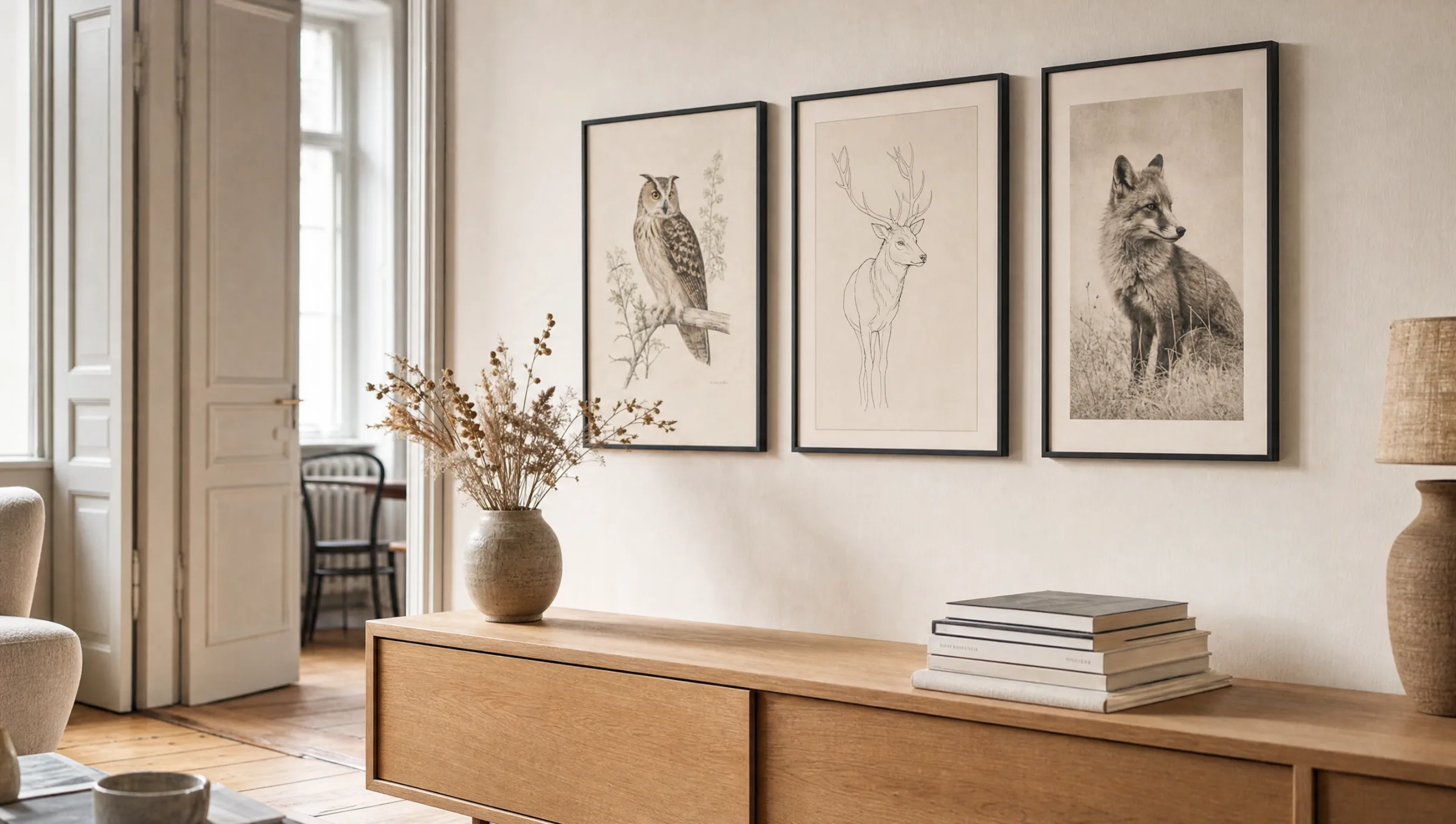
Animal Poster: Motifs, Styles and Materials – an Editorial Overview
Animal imagery is among the oldest pictorial subjects in existence. This overview maps the key motif groups, stylistic directions and print formats, and offers guidance on how animal posters can be placed calmly and cohesively in living rooms, children's rooms or workspaces.
Why Animal Posters Continue to Work
Animal imagery is immediately legible. A wolf silhouette, a resting stag or a precise insect illustration is registered by the eye in fractions of a second and emotionally processed just as quickly. That directness is precisely what makes this subject field so rewarding for wall decoration: no explanatory caption is needed for the image to have an effect.
At the same time, the visual language has diversified considerably. Alongside classical natural-history illustrations from the nineteenth century, there are now reduced line-art studies, photographic portraits and graphic interpretations. Animal posters therefore cover a broad spectrum — from child-friendly farmyard motifs to strict black-and-white studies of birds of prey.
Choosing a wall motif from the animal kingdom is less a question of genre than of style. The sections below map out this spectrum and name the criteria that help when making a selection.
Four Motif Groups for Animal Posters
Most motifs can be assigned to one of four thematic fields. The groups differ not only in subject matter but also in their typical visual language and the settings they suit best.
European Wildlife
Stag, fox, wolf, owl or wild boar. Often rendered in muted tones, frequently as photography or watercolour. Works well in rooms featuring wood, linen and natural colours.
Birds and Insects
Botanically inspired plates depicting butterflies, beetles or songbirds. Particularly effective as a set; well suited to gallery walls in hallways or studies.
Pets and Farmyard Animals
Dog, cat, horse, chicken. Ranges from realistic portraits to illustrative character studies. Popular in living rooms and children's rooms alike.
Exotic Fauna
Lions, elephants, toucans or marine life. Often more richly coloured; works well as a solo statement above a sofa or sideboard.
Styles: From Natural-History Plates to Line Art
Within each motif group, the stylistic direction determines the overall effect. Historical-scientific illustrations — drawing on references such as Brehm's Life of Animals or Audubon's bird plates — bring quiet, warm tones and fine linework. They feel scholarly and sit well alongside dark wooden frames.
At the other end of the spectrum are reduced line-art studies that suggest an animal in just a few strokes. These suit minimally furnished rooms and leave much of the wall surface calm. Photographic animal posters, by contrast, work through detail and texture — the coat of a bison or the eye of an eagle owl carries the image on its own.
A fourth group comprises graphic-illustrative interpretations with flat colour fields, clear palettes and reduced perspective. These are particularly popular in children's rooms because they feel welcoming without sliding into cartoon territory.
A good animal image says nothing more than the animal itself shows — the restraint of the motif is its true quality.
Reetro Editorial
Formats, Paper and Framing for Animal Posters
For a single motif above a sofa, formats from 50 × 70 cm upwards are appropriate, with 70 × 100 cm common in the XXL range. When hanging several animal posters side by side — for instance three bird plates in a hallway — smaller formats such as 30 × 40 cm work better, as they arrange more neatly in a grid.
For paper, matte FSC-certified fine art paper from 200 g/m² upwards has established itself as a composed substrate. It reflects almost no light, keeps fine lines crisp and ages with dignity. For particularly detailed photographic motifs, premium canvas or a hexagonal aluminium print is worth considering, as these allow for deeper blacks. All prints are printed to order by our production partner in the EU.
Framing should support the motif rather than overwhelm it. Light oak mouldings suit natural-history plates, narrow black frames suit photographs, and aluminium frames suit graphic interpretations. A mat border of two to five centimetres further settles the image and gives the motif visual breathing room.
Placing Animal Posters in a Room Context
Animal imagery needs room to breathe. A single large-format motif works best when at least 30 centimetres of wall remain free on either side. Above furniture, the lower edge of the frame should sit approximately 20 to 30 centimetres above the top of the piece.
In gallery arrangements, it is advisable to keep all motifs within the same stylistic family — three botanical bird plates rather than a mix of photograph, watercolour and line art, for example. This creates a cohesive visual unit that holds together rather than fragmenting into unrelated parts.
Häufige Fragen
-
01
Which animal posters work best in a living room?
In a living room, calm single motifs tend to work best. European wildlife in muted tones — a stag in morning mist, an owl as a study, a wolf in black and white — fit into almost any interior. For classically minimal rooms, line-art studies are a strong choice; for rooms with wood and linen, historically styled natural-history plates feel right at home. Formats from 50 × 70 cm create a clear visual axis above a sofa or sideboard without dominating the room.
-
02
Are animal posters suitable for a children's room?
Yes, though with a different visual language than in living spaces. In a children's room, illustrative animal posters with clear colour fields, friendly proportions and recognisable subjects — farmyard animals, woodland creatures or marine life — tend to work well. Realistic predator photography or sombre engraving-style prints are generally less suitable. Sets of three motifs arrange neatly above a bed or play rug and can be added to or swapped out as the child grows.
-
03
What paper is recommended for animal prints?
For most motifs, matte fine art paper from 200 g/m² upwards is the most composed option. It does not reflect light, keeps fine lines sharp and renders watercolour and engraving motifs without unwanted sheen. For photographic animal motifs with deep blacks, a semi-matte paper or an aluminium substrate can be worthwhile, as these bring out contrast and fine detail more forcefully. In both cases, it is important that the surface does not sit in direct light.
-
04
How do I combine several motifs into a gallery wall?
The simplest rule is to stay within one stylistic family. Three botanical bird plates, four insect engravings or two line-art animal posters read as a group when the colour palette, line weight and frames correspond. Mixing photography, illustration and watercolour too freely tends to fragment the arrangement. A continuous reference line — for instance the centre of all frames at the same height — and a consistent gap of four to six centimetres between frames also help to hold the composition together.
-
05
What frame colour suits an animal poster?
It depends on the motif. Natural-history plates and watercolours pair well with light oak or ash frames, as the warm wood picks up their muted tones. Photographic motifs read most clearly in narrow black wooden frames. Graphic, flat-colour illustrations can also come into their own in simple aluminium frames. A mat border of two to five centimetres further settles the image and gives the motif visual space.
-
06
How does Reetro approach production?
All animal posters are printed to order by our production partner in the EU on FSC-certified fine art papers from 200 g/m² with a matte coating. Motifs are editorially curated and colour-corrected for print, so that historical plates do not appear washed out and photographic motifs do not come across as overly contrasty. Alongside paper prints, premium canvas and hexagonal aluminium wall prints are available, making it possible to find the right substrate for each motif.