
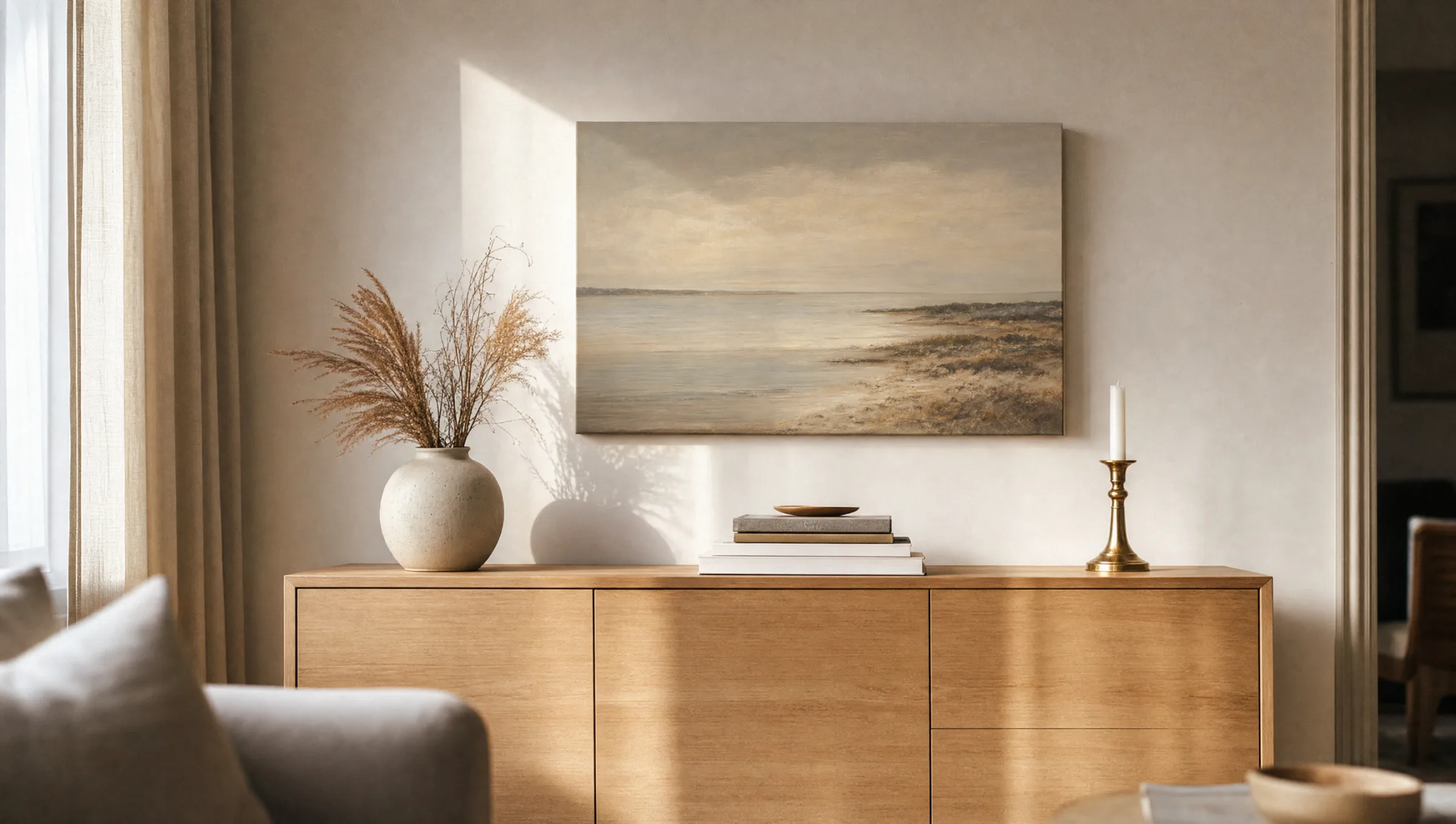
60x40 Canvas: The Compact Landscape Format in Editorial Overview
A 60x40 canvas is one of the most versatile wall formats available: large enough to hold its own as a standalone piece, compact enough for shelving walls, hallways, and smaller living spaces. We place the format in context, compare suitable subject matters, and offer guidance on materials, hanging, and combining prints into a gallery wall.
Why the 60x40 Canvas Format Is So Popular
At 60 centimetres wide and 40 centimetres tall, the 60x40 canvas strikes a practical middle ground between a single statement piece and a full gallery wall. The landscape orientation follows an approximate 3:2 aspect ratio, echoing classic photography — shots of architecture, landscape, or still life feel balanced and calm in this proportion.
At the same time, the format is large enough to work independently above a sideboard, desk, or two-seater sofa. In smaller rooms such as bedrooms, work corners, or hallways, it replaces an oversized XXL print while remaining visually present. Those who want to check the scale in advance can mark the area on the wall with masking tape before committing.
From an editorial standpoint, the format is particularly well suited to motifs with a horizontal line: coastal horizons, skylines, desert panoramas, or graphic compositions built around a clear central axis.
Suitable Subject Matters for a 60x40 Canvas
Not every motif works in every format. These four directions have proven especially effective for the 60x40 landscape format in editorial practice.
Landscape & Horizon
Coastlines, mountains, dunes, and fields benefit from the wide landscape orientation. The horizontal line gets room to breathe without the image feeling monumental — ideal above narrow dressers or bed headboards.
Architecture & City
Facade details, bridges, and street perspectives in black-and-white or muted tones read as quiet and documentary in the 3:2 crop. A considered choice for home offices and entrance areas.
Abstract Fields
Colour-field painting and reduced compositions with horizontal structure make good use of the format's width. They work as a solitary piece or as part of a salon-style hanging arrangement.
Botanicals & Still Life
Pressed grasses, branches, or ceramic arrangements in natural tones have the feel of a quiet editorial spread from an interior magazine when printed at 60x40.
Material and Craftsmanship: What Matters in a 60x40 Canvas
The visual quality of a canvas depends not only on the motif but significantly on the fabric, print, and stretcher bar. High-quality canvases are printed on a cotton or cotton-polyester weave of around 350 to 400 g/m². A matte surface reduces reflections, which is especially important at 60x40 cm since the print often hangs at eye level.
The stretcher bar should be at least two centimetres deep — ideally three to four. This allows the canvas to sit slightly away from the wall, casting a fine shadow and giving the piece a three-dimensional quality rather than a flat, poster-like appearance. Hidden staples on the back and neat corner folding are quality markers that become apparent on closer inspection.
Colour-stable output is achieved through pigment inks combined with an ICC colour profile. Even so, we recommend keeping the canvas out of direct, prolonged sunlight to preserve both colour depth and fabric tension over time. Reetro canvases are printed to order by our production partner in the EU, on FSC-certified stretcher frames.
The 60x40 format is the most honest size for a single print: large enough to register — small enough not to dominate.
Reetro Editorial
Hanging, Combining, and Caring for Your 60x40 Canvas
A single 60x40 canvas looks most settled when its centre sits at approximately 145 to 152 centimetres from the floor — the standard gallery hang height. Above a piece of furniture, the gap between the top of the piece and the bottom of the canvas should be between 15 and 25 centimetres, so that the image and furniture read as a cohesive unit.
In a gallery wall, the 60x40 canvas combines well with portrait-oriented 40x60 prints, square 40x40 formats, or smaller 30x20 pieces. A consistent framing approach is key — either all frameless stretched canvases or all framed prints throughout the arrangement.
For day-to-day care, a dry microfibre cloth is all that is needed to remove dust from the surface every few weeks. Wet cleaning, spray cleaners, and long-term direct sun exposure should be avoided to keep colours and fabric tension intact over the years.
Häufige Fragen
-
01
How large does a 60x40 canvas look on the wall?
A 60x40 canvas reads as a clearly visible individual piece without dominating the room. Above a piece of furniture between 140 and 180 centimetres wide, it occupies roughly one-third to one-half of the furniture's width and forms a strong visual anchor point. In a room of 12 to 20 square metres the format is sufficient to define a wall while leaving enough breathing room for a second, smaller piece alongside it.
-
02
Which motifs work best on a 60x40 canvas?
The 3:2 landscape format works especially well with motifs that have a strong horizontal line: landscapes with a horizon, city skylines, abstract colour fields with lateral structure, and photographic still lifes. Vertically composed motifs — standing portraits or narrow botanical studies — can feel cropped in this format; a 40x60 portrait canvas is a better fit for those subjects.
-
03
How do I hang a 60x40 canvas correctly?
A reliable rule is to position the centre of the canvas at around 145 to 152 centimetres from the floor. Above a piece of furniture, keep a gap of 15 to 25 centimetres between the top of the furniture and the bottom edge of the canvas so that both elements feel visually connected. A single picture hook or X-hanger is usually sufficient for a 60x40 canvas; for deeper stretcher bars, two nails at the appropriate spacing provide additional stability.
-
04
What stretcher bar depth should I choose?
A stretcher bar between two and four centimetres deep is recommended. Two centimetres has a restrained look that suits gallery-style walls with multiple pieces. Three to four centimetres adds dimensionality, casts a finer shadow, and makes the canvas appear to float slightly from the wall when viewed from the side. Stretcher bars shallower than two centimetres can make the piece read more like a flat print than a proper canvas.
-
05
How do I care for a canvas over the long term?
In everyday use, gently dusting the surface every few weeks with a dry, soft microfibre cloth is all that is required. Spray cleaners, damp cloths, and abrasive products should be avoided, as they can lift pigment from the surface. Long-term direct sunlight is also best avoided, as it will gradually fade colours over the years. Stable room temperature and normal humidity help to keep the fabric properly tensioned.
-
06
What sets a Reetro 60x40 canvas apart from standard prints?
Reetro has its canvases printed to order by its production partner in the EU on a matte-coated cotton fabric using pigment inks, mounted on FSC-certified stretcher bars. Motifs are curated editorially rather than assembled algorithmically — Reetro operates as a publisher of wall art, not as an anonymous marketplace. This means a 60x40 canvas from Reetro differs from typical mass-market prints primarily in fabric weight, colour depth, and the considered depth of the selection available.