Starry Night Print: Vincent van Gogh's Night Sky on Your Wall
Few works in art history are as widely recognised as Vincent van Gogh's night sky above Saint-Rémy. Anyone looking for a Starry Night print for their walls encounters a motif of dense symbolism, clear composition, and remarkable colour depth — qualities that need to be considered carefully when choosing a format and print method.
Origins and Art-Historical Background
Vincent van Gogh painted The Starry Night in June 1889 at the Saint-Paul-de-Mausole asylum near Saint-Rémy-de-Provence. The painting depicts a swirling night sky above a quiet village with a tall church steeple and a dark cypress rising in the foreground. The original has been held at the Museum of Modern Art in New York since 1941 and is considered one of the most reproduced paintings in Western art history.
Contrary to popular belief, the work was not painted outdoors but from memory. Van Gogh combined the view from his barred studio window with impressions of the Provençal landscape. This act of compression accounts for the painting's intense emotional charge — a quality that remains relevant when choosing a Starry Night print for a living space, since the work generates atmosphere even in printed form.
The painting belongs to a series of nocturnal studies by van Gogh, which also includes Starry Night Over the Rhône (1888) and Café Terrace at Night. This wider body of work is important for contextualising the image: the famous picture does not stand in isolation but marks the culmination of a sustained engagement with light sources, stars, and the colours of night.
Formats and Materials for a Starry Night Print
Which print method suits the motif depends on room size, lighting conditions, and the intended effect. Three options at a glance.
XXL Poster on Matte Fine Paper
Large-format posters from 70 × 100 cm bring the swirling brushstrokes into the room. A matte coating reduces reflections and lets the deep blue tones rest calmly without being skewed by gloss.
Canvas with a Fine Texture
Canvas emphasises the painterly character and recalls the surface structure of the original. For a Starry Night print, gallery stretcher frames with a depth of at least 4 cm work well, as they give the composition physical presence on the wall.
Hexagonal Aluminium Panels
For a more curated presentation, individual details — the moon, the cypress, the village — can be combined as hexagonal aluminium panels. The result is a contemporary reading of a classic work.
Understanding the Composition and Colour Palette
The composition follows a clear diagonal movement from lower left to upper right. The cypress on the left breaks the horizontal line of the village and leads the eye into the spiralling clouds. Eleven glowing yellow stars, an oversized moon, and a calm foreground create a balance between movement and stillness.
The palette is dominated by ultramarine, cobalt blue, and Prussian blue, accented with chrome yellow and off-white. For reproduction, this means a Starry Night print requires a printing process with high tonal depth in the blue range — otherwise the sky appears flat. Pigment inks and a paper weight of at least 200 g/m² are advisable here.
The scale of the original is also worth noting: the painting measures just 73.7 × 92.1 cm — smaller than most reproductions lead people to expect. This reference point can help in planning a realistic wall format for your own space.
I have a terrible need of — shall I say the word — religion. Then I go out at night to paint the stars.
Vincent van Gogh, letter to Theo van Gogh, September 1888
Hanging: Where a Starry Night Print Works in a Room
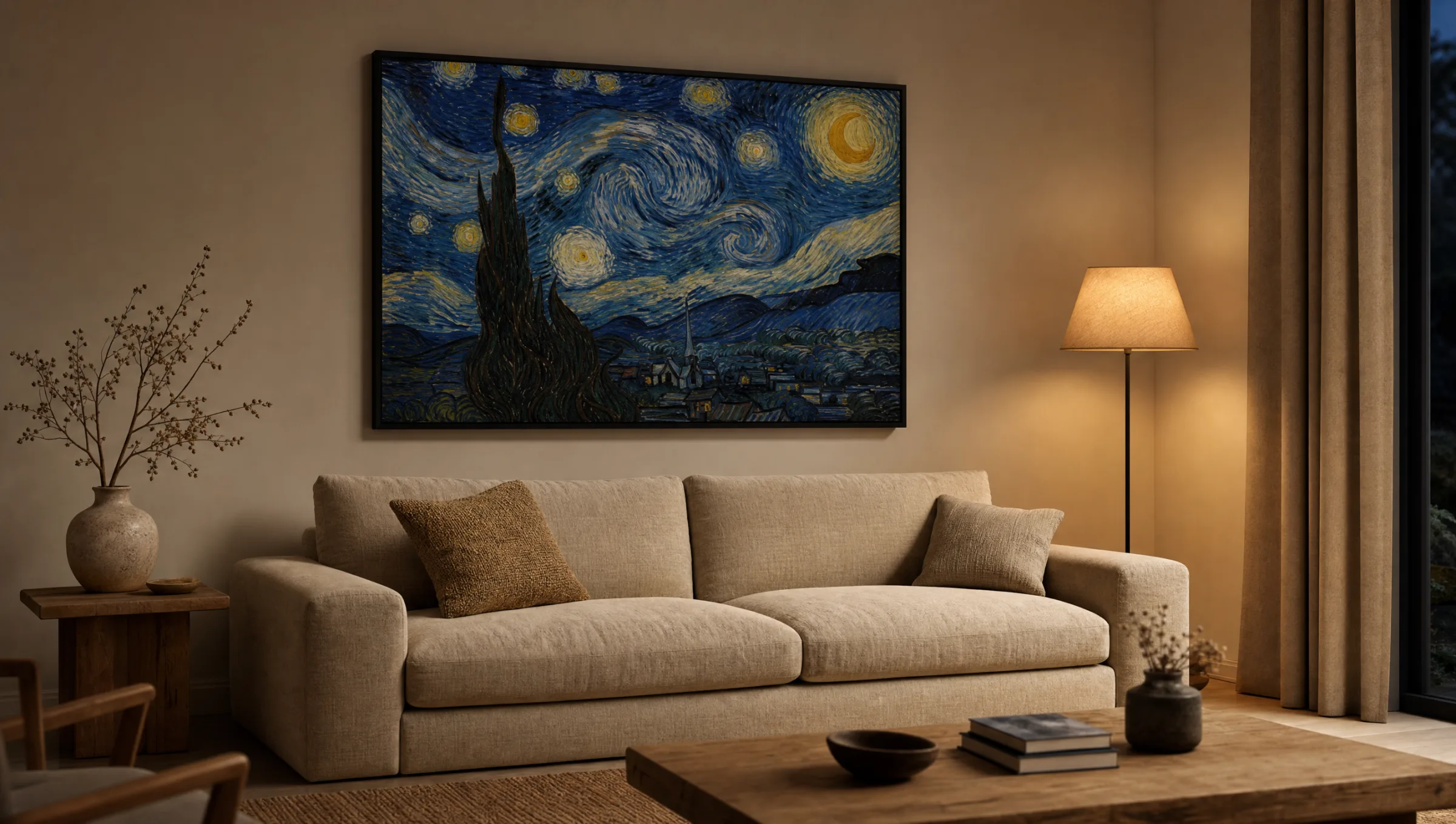
The motif has a strong presence of its own and therefore suits calm surroundings on the wall. Above a sofa, on a feature wall in the bedroom, or as a standalone piece in a hallway, it comes into its own most effectively. In a salon-style arrangement with many competing works, the composition tends to get lost.
Rooms with cool wall colours — sage green, greige, off-white — provide a harmonious backdrop. Warm terracotta tones, by contrast, create a lively contrast with the nocturnal blue. A hanging height of 140 to 150 cm to the centre of the picture is considered a comfortable eye level for most living spaces.
For lighting, indirect warm-white light sources between 2,700 and 3,000 Kelvin work well. Direct spotlights can cause reflections on glossy surfaces; matte prints handle direct illumination considerably better.
Care and Longevity
Like all pigment prints, a Starry Night print should not hang in direct sunlight. UV radiation can cause colour shifts over the years even with fade-resistant inks, particularly in the yellow tones of the stars. A wall without direct midday sun is the simplest protective measure.
Dust can be removed from matte paper surfaces with a dry, soft microfibre cloth. Moisture and cleaning agents should be avoided. For framed prints, anti-reflective museum glass is recommended — it reduces reflections without distorting the appearance of the image.
Häufige Fragen
-
01
Who painted the Starry Night?
The Starry Night was painted in June 1889 by Vincent van Gogh during his voluntary stay at the Saint-Paul-de-Mausole asylum near Saint-Rémy-de-Provence. It depicts a swirling night sky above a quiet village with a church steeple and a tall cypress in the foreground. The original is held today at the Museum of Modern Art in New York and is one of the best-known works of Post-Impressionism.
-
02
How large is the original Starry Night painting?
The original painting measures 73.7 × 92.1 cm — smaller than most viewers expect. This is useful to keep in mind when assessing the impact of a reproduction print in your own space. For modern interiors, larger formats such as 70 × 100 cm or 80 × 120 cm are often more suitable, as they give the composition more room and allow the fine brushwork in the sky to read more clearly.
-
03
What format suits a Starry Night print above a sofa?
As a general rule, a picture above a sofa should occupy roughly two-thirds of the sofa's width. For a 220 cm wide sofa, a width of around 140 to 150 cm works well. As the Starry Night is a landscape-format composition, dimensions such as 100 × 140 cm or 90 × 120 cm are particularly appropriate. A gap of 20 to 30 cm between the top of the sofa and the lower edge of the print is also recommended.
-
04
Which material shows a Starry Night print to best effect?
Matte fine papers of at least 200 g/m² render the deep blues calmly and without distracting reflections. Canvas emphasises the painterly brushwork and echoes the surface quality of the original. Aluminium or acrylic mounts give a more contemporary, cooler feel. The best choice depends on the interior style: classic residential rooms benefit from paper or canvas, while minimal-modern spaces suit a flat aluminium surface.
-
05
Is the Starry Night in the public domain and may it be reproduced?
Yes. Vincent van Gogh died in 1890, so the work is in the public domain in the UK, the US, and most other countries. Reproductions, prints, and adaptations are legally permitted. The main differences between editions lie in print quality: the source file, colour profile, inks, and paper all determine how closely a reproduction captures the depth and colour accuracy of the original.
-
06
What should I look for when buying a high-quality Starry Night print?
Three things matter most: a high-resolution source image, fade-resistant pigment inks, and a paper or substrate with sufficient weight and a stable surface. Reetro uses FSC-certified fine papers from 200 g/m² with a matte coating for its Starry Night print, and all printing is done to order by our production partner in the EU. This ensures the blue tones remain stable over the years and the fine brushwork in the sky stays clearly legible.