
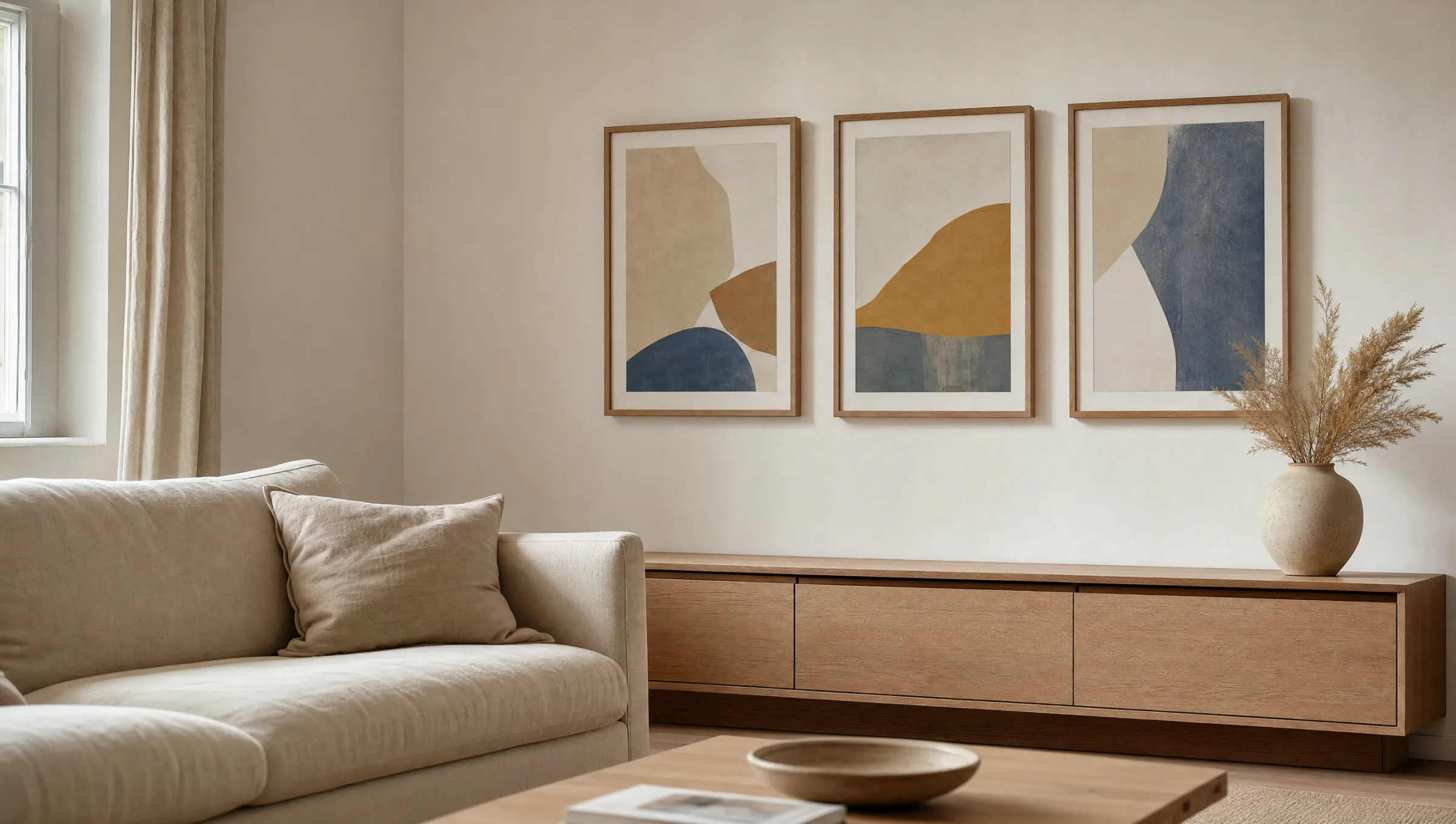
Framed Art Prints: Choosing Sizes, Frames and Wall Arrangements
Framed art prints are the quietest way to give a room character. This guide covers the sizes, frame types and paper qualities that have proven their worth — and explains how individual prints or full wall arrangements can sit naturally within an existing interior.
Why Framed Art Prints Make an Impact
A frame is more than protection — it defines the boundary between motif and wall and gives the image a sense of composure. Framed art prints read more quietly than loose posters because the clean edge guides the eye and allows the print to register as an object in its own right. This visual distance is precisely why framed works have been standard in galleries, hotels and editorially considered interiors for decades.
There is also a conservation dimension: glass or acrylic keeps dust, UV radiation and fingerprints at bay. Acid-free mounts prevent the paper from yellowing over time. Choosing to frame a print is therefore also a decision about longevity — a factor that carries particular weight with high-quality pigment prints on FSC-certified paper.
Frame Types at a Glance
The choice of frame often influences the character of a print more than the motif itself. Four options have established themselves in editorial interior contexts.
Slim Wood Frame
Profiles between 15 and 25 mm wide in oak, walnut or lacquered black. Understated and modern, it suits almost any motif and works especially well in gallery-style arrangements.
Aluminium Frame
Matte black or brushed silver with a very narrow visible edge. Feels precise and technical, supporting photographic subjects and contemporary graphic work. Lighter than wood and well suited to large formats.
Wide Wood Frame
Profiles from 35 mm upwards, often in solid oak or a dark smoked-oak finish. Brings a classic quality and suits smaller, deliberately curated single pieces above a console or sideboard.
Floating / Shadow-Gap Frame
The print appears to float within the frame, without glass. Suited to canvas or mounted prints rather than traditional paper. Conveys a calm, museum-like presence.
Sizes and Proportions for Framed Art Prints
The most common sizes for framed art prints follow international standards: 30×40, 50×70 and 70×100 cm. These dimensions make it straightforward to swap frames later and are available from almost every supplier. Square formats such as 50×50 cm have a graphic quality and work well as a pair or triptych.
A simple rule of thumb applies to wall impact: above a 220 cm wide sofa, a central single print should be at least 70×100 cm, otherwise it risks looking lost. Alternatively, two or three smaller prints can be grouped together, with the combined width taking up roughly two-thirds of the furniture's width. In hallways and on narrow wall sections, portrait formats from 50×70 cm upwards work better than wide landscape orientations.
Wall clearance also matters. Leaving at least 15 cm of space to the ceiling and 20 cm above the nearest piece of furniture allows the image to breathe. Prints placed too close to surrounding objects appear cramped, regardless of their quality.
A good frame steps back so the image can speak — it only becomes visible when you consciously look for it.
From the Reetro editorial team
Paper, Printing and Material Quality
Every quality print rests on a specific material decision. For framed art prints, Reetro uses FSC-certified fine art paper from 200 g/m² with a matte coating, printed to order in the EU. This weight ensures the paper stays flat behind glass without buckling. The matte surface reduces reflections and gives subtle gradients real depth.
Pigment-based inks are more durable than dye-based alternatives. They retain their colour fidelity over many years, provided direct sunlight is avoided. Combined with acid-free mounts and UV-filtering glass, framed prints achieve a conservation quality that was once reserved for original works.
Care and Longevity of Framed Art Prints
Framed works are largely maintenance-free. The glass can be cleaned with a soft, dry microfibre cloth; aggressive glass cleaners should not be sprayed directly onto the surface, as liquid can seep beneath the frame. For wood frames, occasional dusting with a dry cloth is sufficient.
When moving or re-hanging framed art prints, carry the frame flat and avoid pressing on the image side. For longer-term storage, a dry, dark location with moderate room temperature is ideal — basements and lofts are problematic due to humidity and heat respectively.
Häufige Fragen
-
01
What frame colour works best with framed art prints in a living room?
The right frame depends on the motif and the existing interior. Black wood frames read graphically and support high-contrast prints such as black-and-white photography or typographic works. Natural oak or light ash pick up warmth from the room and pair well with botanical illustrations or pastel-toned watercolours. White frames recede and suit colour-intensive contemporary subjects. Anyone planning several framed art prints as a wall arrangement should settle on a single frame material to keep the composition calm. On dark walls, wide off-white mounts work particularly well because they visually separate the image from its surroundings.
-
02
Do framed art prints always need a mount (mat board)?
No — a mount is a design choice rather than a requirement. It creates distance between the motif and the frame edge, draws the eye towards the image and protects the print from direct contact with the glass. For traditional watercolours, smaller formats or gallery-style arrangements, a mount between 4 and 8 cm wide is worth considering. With large-format posters or modern photographs, a borderless presentation often looks cleaner and more contemporary. A practical approach: enhance smaller formats up to 30×40 cm with a mount, and frame larger prints from 50×70 cm upwards without one.
-
03
How do you hang multiple framed art prints correctly?
For a balanced arrangement, the centre of the group of prints should sit at roughly eye level — around 145 to 150 cm from the floor. With identically sized frames, a grid with consistent gaps of 4 to 6 cm between images looks calm and considered. With mixed formats, it is worth laying out the arrangement on the floor first, or testing it on the wall with paper templates. A shared axis — top edge, bottom edge or horizontal centre line — holds the group together visually. Above sofas or sideboards, the arrangement should span approximately two-thirds of the furniture's width.
-
04
What paper is best for framed art prints?
High-quality framed art prints are produced on acid-free paper of at least 200 g/m². Matte fine art paper with a slight texture suits illustrations and watercolour reproductions, reducing reflections under glass and rendering colour nuances softly. Semi-matte or satin surfaces bring more depth to photographic subjects. FSC-certified materials and pigment inks that resist fading are important quality markers. Reetro has its art prints printed to order by a production partner in the EU on FSC papers from 200 g/m² with a matte coating — a standard that remains visually stable and colour-accurate behind glass even after many years.
-
05
Where should framed art prints not be hung?
Direct sunlight is the greatest threat to any print — UV light causes visible fading of pigments within a few years. Rooms with strong fluctuations in temperature and humidity, such as windowless bathrooms or positions directly above radiators, are also unsuitable, as paper can shift and buckle. Kitchens are possible provided a safe distance from the hob is maintained, since grease and steam gradually settle on glass and frame surfaces. The ideal locations are interior walls in living rooms and bedrooms with indirect natural light.