
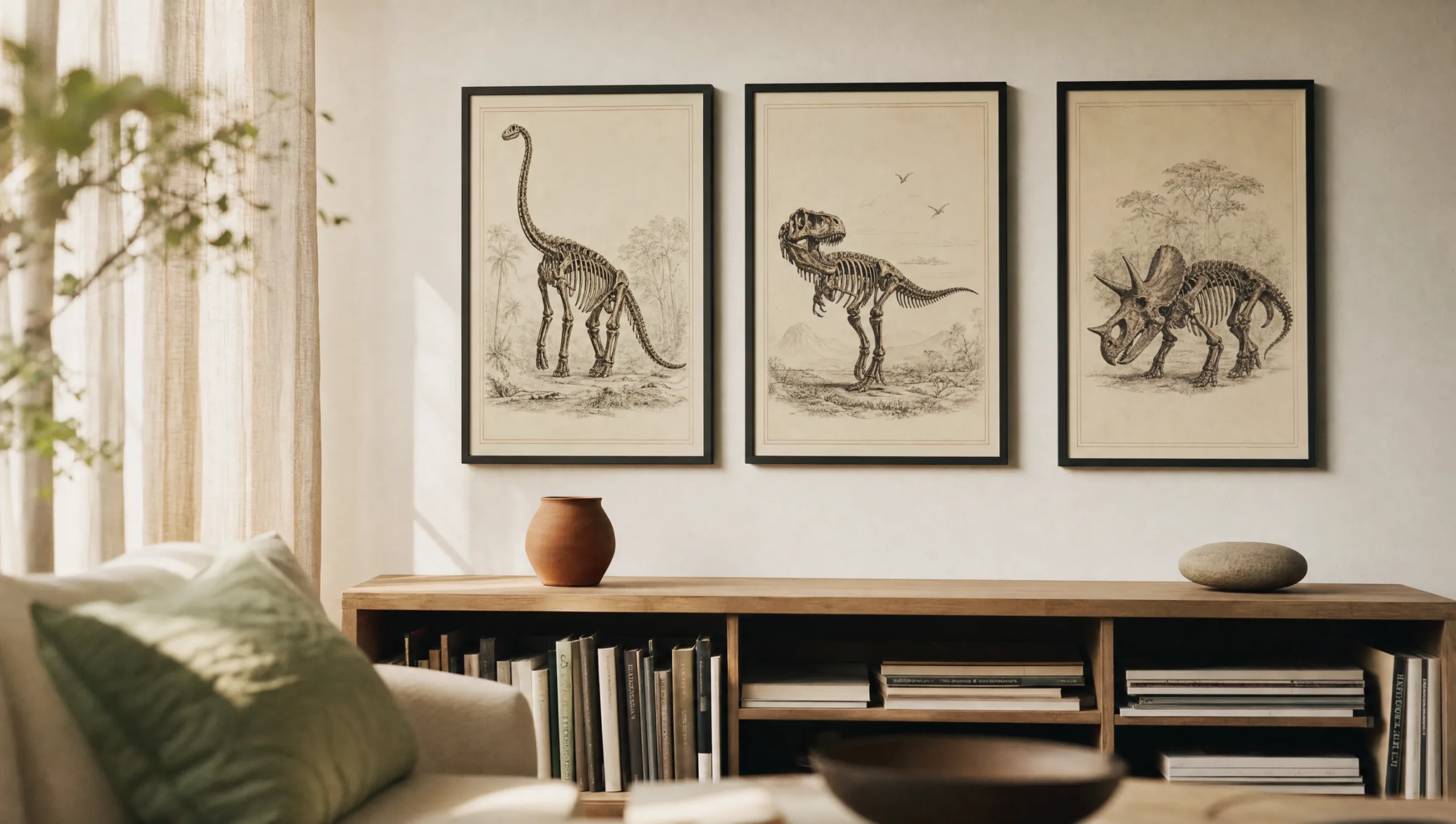
Dinosaur Poster – Prehistoric Motifs as Wall Art
Dinosaur posters bring together scientific interest and decorative appeal. Whether a detailed skeletal drawing, a palaeontological illustration, or a graphically reduced motif – dinosaur imagery works equally well in children's rooms and in living spaces with a natural-history sensibility.
Why a Dinosaur Poster Is More Than Children's Room Décor
Dinosaur motifs span an unusually broad range. At one end sit scientifically precise illustrations that capture anatomical detail, size comparisons, or geological timescales. These prints draw on the tradition of teaching charts from the 19th and early 20th centuries and have earned a firm place in interior design as vintage infographics.
At the other end sits a more contemporary visual language shaped by graphic design: minimalist silhouettes, linework illustrations, and flat-design motifs in muted tones. This approach integrates effortlessly into modern living spaces without abandoning the prehistoric theme.
Both directions lend themselves to a range of rooms when paired with the right formats and materials – from a single square print to multi-part sets, through to an XXL dinosaur poster that commands an entire wall.
Three Visual Styles of Dinosaur Poster at a Glance
Dinosaur motifs fall broadly into three design categories, each suited to different rooms and interior styles.
Scientific Illustration
Anatomical drawings and palaeontological charts in sepia or black and white. Feels refined in home offices, libraries, or hallways with an appreciation for historical printmaking aesthetics.
Graphic-Modern Motif
Reduced silhouettes, geometric shapes, or linework in neutral tones. Suits contemporary living spaces where the subject should remain thematically present but visually restrained.
Children's Room Illustration
Soft outlines, friendly colour palettes, and characterised figures. A natural choice for children's rooms, but equally well suited to playrooms, nurseries, or educational settings.
Format and Material: What Matters in a Dinosaur Poster
Paper weight is a decisive quality factor. Posters below 180 g/m² tend to buckle, particularly at large formats or in slightly damp rooms such as bathrooms. Reetro uses FSC-certified papers from 200 g/m² upward with a matte coating that keeps reflections to a minimum while producing a calm, lightly textured surface.
For dinosaur motifs with fine lines and small labels – as is often the case with anatomical illustrations – a format of at least 50×70 cm is recommended so that detail drawings remain legible. Strongly graphic or flat motifs can also work well at smaller sizes such as 30×40 cm.
Those looking for a more robust alternative can opt for aluminium wall prints. The hexagonal format is particularly interesting for collages of several dinosaur motifs, as it allows an unconventional arrangement without producing a conventional rectangular gallery.
A well-chosen dinosaur motif printed on quality paper communicates more about the scale of Earth's history than any label could – the visual language does the explaining.
Reetro Editorial
Grouping and Hanging: Dinosaur Posters in a Gallery Wall
Several dinosaur posters can be combined as a thematic gallery wall. A reliable approach is to organise by geological era – Triassic, Jurassic, and Cretaceous as separate motifs in a set. Consistent frames and a shared colour tone across the prints ensure the group reads as a whole without appearing cluttered.
A general rule for hanging is that the centre of the artwork should sit at eye level – typically around 145 to 155 cm from the floor. In children's rooms this value is adjusted downward so that children can take in the motifs from their own perspective. Frameless posters can be fixed with poster hangers or magnetic wooden rails, which allow a quick change of motif whenever needed.
Care and Longevity of Art Prints
Matte paper is less susceptible to visible fingerprints than glossy surfaces, but should still not be touched directly. Dust can be removed with a soft, dry brush or a microfibre cloth. Direct sunlight accelerates colour fading, so a location away from persistent UV exposure significantly extends the life of a print.
High-quality prints using pigment-based inks – as printed to order by Reetro's production partner in the EU – achieve colour fastness of several decades under normal living conditions. Lower-cost dye-based inks can fade noticeably within a few years, which is especially apparent with strong, saturated colours.
Häufige Fragen
-
01
What formats are best suited for a dinosaur poster in a children's room?
For children's rooms, formats between 30×40 cm and 50×70 cm work particularly well. Smaller formats are easier to position at a child's eye level and allow a straightforward change of motif when needed. Larger formats from 70×100 cm upward work well as a single focal point above a bed or on a clear stretch of wall. It is important that the motif is printed with sufficient detail so that figures and labels remain recognisable even from a distance.
-
02
What sets a high-quality dinosaur poster apart from cheaper alternatives?
The main differences lie in paper weight, printing technology, and the ink used. High-quality dinosaur posters are printed on papers of 200 g/m² or above, which remain dimensionally stable and do not buckle. Pigment-based inks deliver deeper black values and significantly higher colour fastness than inexpensive dye-based inks. Matte coatings also reduce reflections, which allows for a calmer reading of the motif in rooms with multiple light sources.
-
03
Can I combine several dinosaur posters as a gallery wall?
Yes, dinosaur motifs work well in thematic gallery wall arrangements. A coherent approach is to select prints with a similar visual language – for example, exclusively scientific illustrations or exclusively graphic-modern silhouettes. Consistent frame colours and even spacing between the prints help the group read as a single design unit. Sets of two to four same-sized posters are a straightforward starting point that requires minimal planning.
-
04
How do I protect a poster from fading?
The most important protective measure is avoiding prolonged direct sunlight. UV radiation accelerates colour degradation across all printing processes. A position with indirect daylight or controlled artificial lighting significantly extends the lifespan of a print. Framing a poster with UV-protective glass adds a further layer of defence. Pigment-based inks on quality materials achieve colour fastness of several decades under typical home conditions.
-
05
Are dinosaur posters only suitable for children?
No, dinosaur motifs have a wide design range. Scientific illustrations in a vintage style suit home offices, libraries, or hallways with an appreciation for historical printmaking. Graphically reduced silhouettes integrate naturally into modern living spaces. The themes of prehistory and natural history appeal to adults who value a scientific aesthetic, entirely independent of a childhood context.
-
06
Where are Reetro's posters printed, and what materials are used?
Reetro prints all posters to order through its production partner in the EU and uses exclusively FSC-certified papers from 200 g/m² with a matte coating. Pigment-based inks ensure precise colour reproduction and high lightfastness. The result is a print that differs clearly in feel and appearance from mass-produced standard posters – without sacrificing a broad choice of motifs.